Le Christ en tant qu'homme de douleurs
Sandro Botticelli · 1500
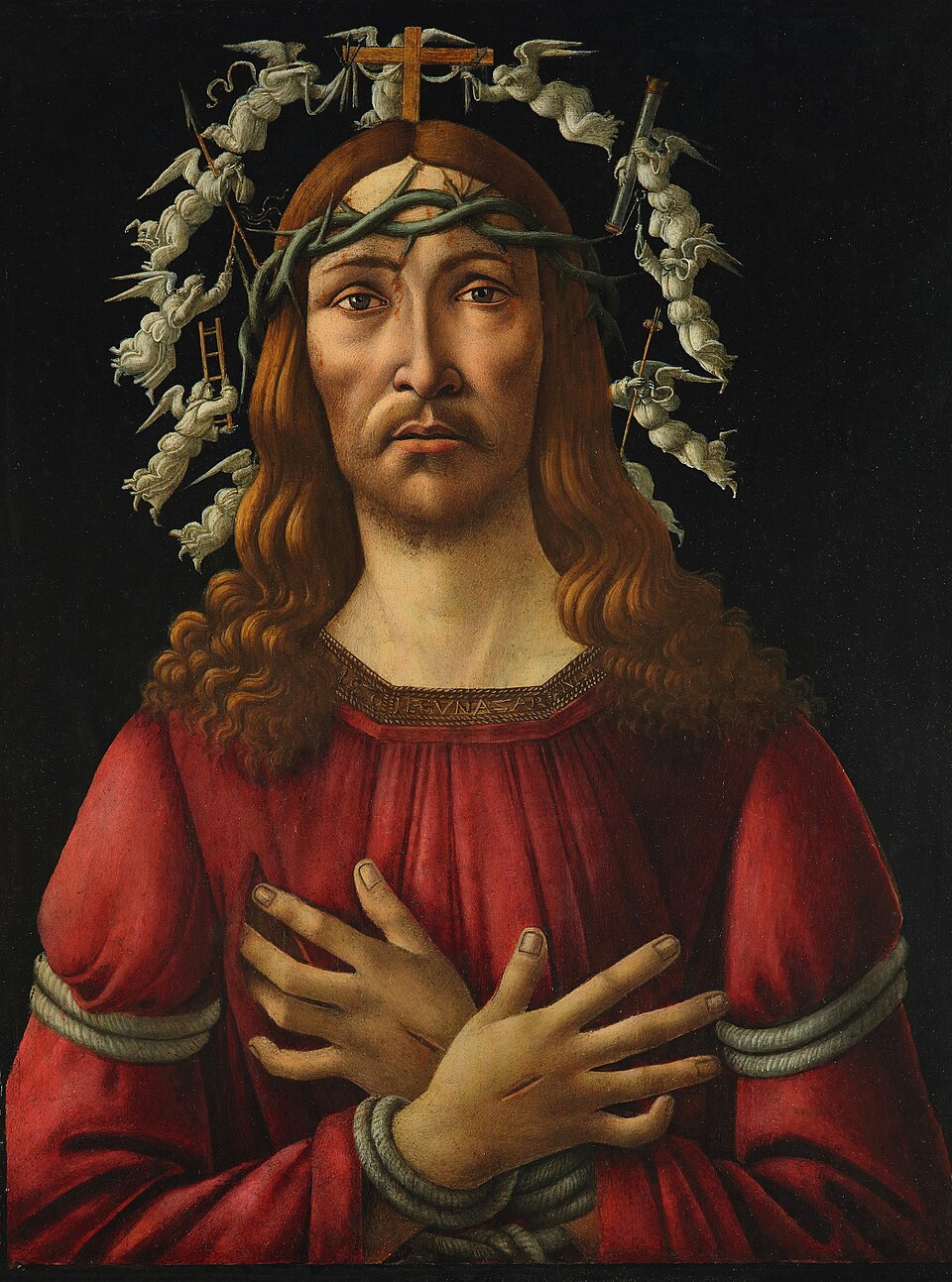
Christ looks out wearing a crown of thorns, his wrists bound with rope, while angels behind him carry the instruments of his Passion. For decades it was thought a workshop piece; in 2009 it was given back to Botticelli himself.
The story behind the painting
Botticelli painted The Man of Sorrows in tempera and oil on panel, probably sometime between 1500 and 1510; Wikidata gives 1500. It comes from the period after 1492, when he was strongly influenced by the Dominican friar Girolamo Savonarola, who ruled Florence as a theocratic leader. In the nineteenth century the picture belonged to the famous opera singer Adelaide Kemble, and it has remained in private collections ever since. Her descendant Pamela Margaret Stanley, later Lady Cunynghame of Milncraig, sold it at auction in 1963 as a work of Botticelli's workshop, not of the master.
What to look for
Jesus wears a crown of thorns and his hands and wrists are bound with rope. Behind him stands a cross, a sign of his crucifixion. As was typical of a Man of Sorrows, a group of angels holds other instruments of the Passion. Look for the ladder used to take him down from the cross, the spear of Longinus that pierced his side, the pillar where he was bound and whipped, the nails that fastened him, the pincers used to pull them out, and the sponge the Roman soldiers dipped in vinegar and offered him before he died. The panel measures about 69 by 51.4 cm.
Meaning and intent
A Man of Sorrows is not a scene from a single moment of the Gospel story but an image for contemplation: the suffering Christ shown face to face with the viewer, surrounded by everything he endured. The source describes these instruments, the Arma Christi, as the means by which Jesus defeated Satan, so they are signs of victory as well as of pain. Painted in the years when Savonarola's preaching had marked Botticelli deeply, the picture offers a direct, sober devotion: no setting, no narrative, only the wounded Christ and the signs of what he suffered.
Legacy
In 2009 the painting was reattributed to Botticelli himself, and in 2010 it was shown in the exhibition Botticelli: Likeness, Myth, Devotion at the Stadel Museum in Frankfurt. A later technical analysis by Sotheby's revealed something hidden: beneath the finished picture lies a drawing for a Madonna and Child. Botticelli had turned the panel around to paint the new work, so the abandoned design now sits upside down under the face of Christ. In January 2022 the painting was sold at auction at Sotheby's in New York, a little less than a year after another of his works set an auction record for the artist.
Le saviez-vous ?
- Painted around 1500 to 1510, after Botticelli came under Savonarola's influence.
- Once owned by the opera singer Adelaide Kemble.
- Sold in 1963 as a workshop piece, reattributed to Botticelli in 2009.
- A Madonna and Child drawing lies upside down beneath the paint.
À propos de l'artiste
Sandro Botticelli (1445-1510)
art religieux · homme · Jésus-Christ · robe · Sainte Couronne
Autres œuvres de Sandro Botticelli
 La Naissance de Vénus - Sandro Botticelli (c. 1485)
 Le Printemps - Sandro Botticelli (1480s)
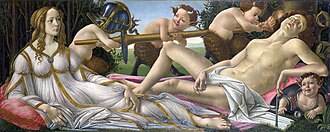 Vénus et Mars - Sandro Botticelli (1485)
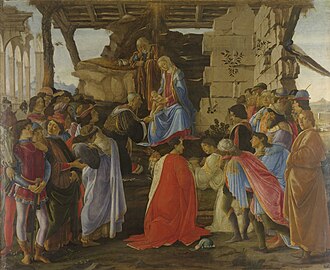 L'Adoration des mages - Sandro Botticelli (1470s)
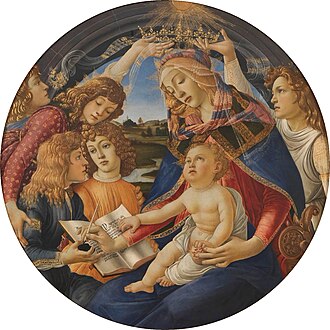 La Madone du Magnificat - Sandro Botticelli (1481)
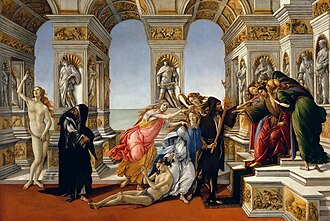 La Calomnie d'Apelle - Sandro Botticelli (1490s)
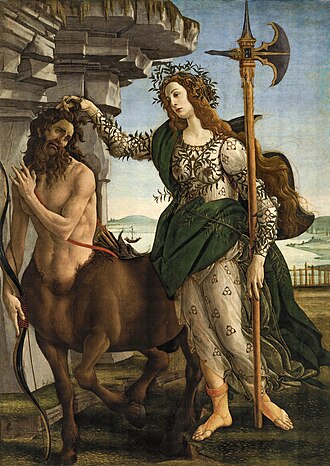 Pallas et le Centaure - Sandro Botticelli (1482)
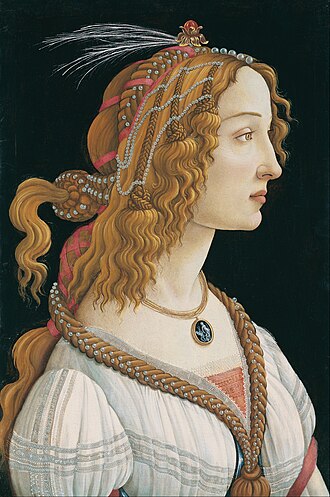 Portrait ideale d'une jeune femme - Sandro Botticelli (1480)
Œuvres d'artistes liés
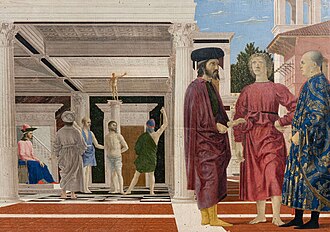 La Flagellation du Christ - Piero della Francesca (1450s)
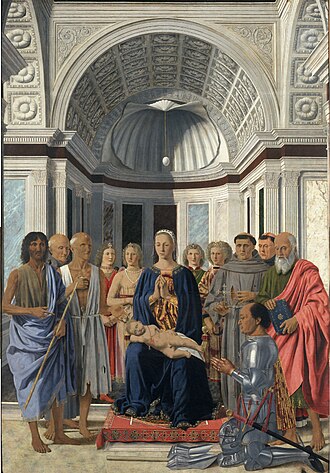 La Conversation sacrée - Piero della Francesca (1472)
 La Joconde - Leonardo da Vinci (1503-1519)
 La Dame à l'hermine - Leonardo da Vinci (1490)
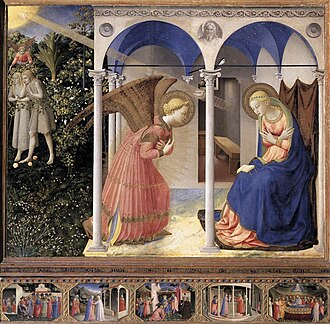 L'Annonciation - Fra Angelico (1425)
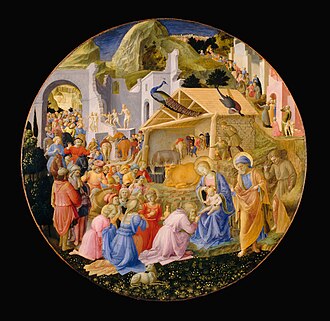 Tondo Cook - Fra Angelico (1430)
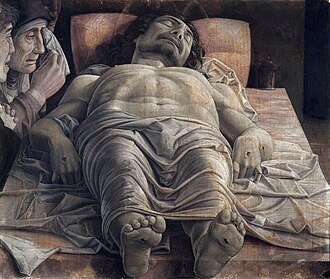 Lamentation sur le Christ mort - Andrea Mantegna (1483)
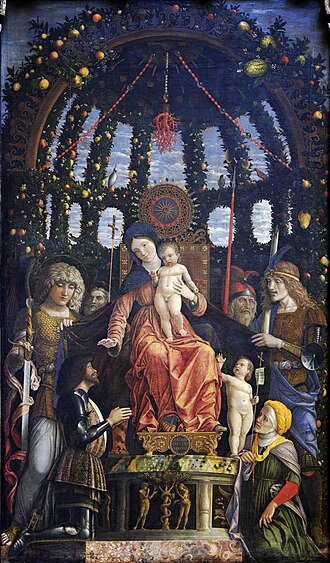 La Vierge de la Victoire - Andrea Mantegna