Château Bentheim
Jacob van Ruisdael · 1650s
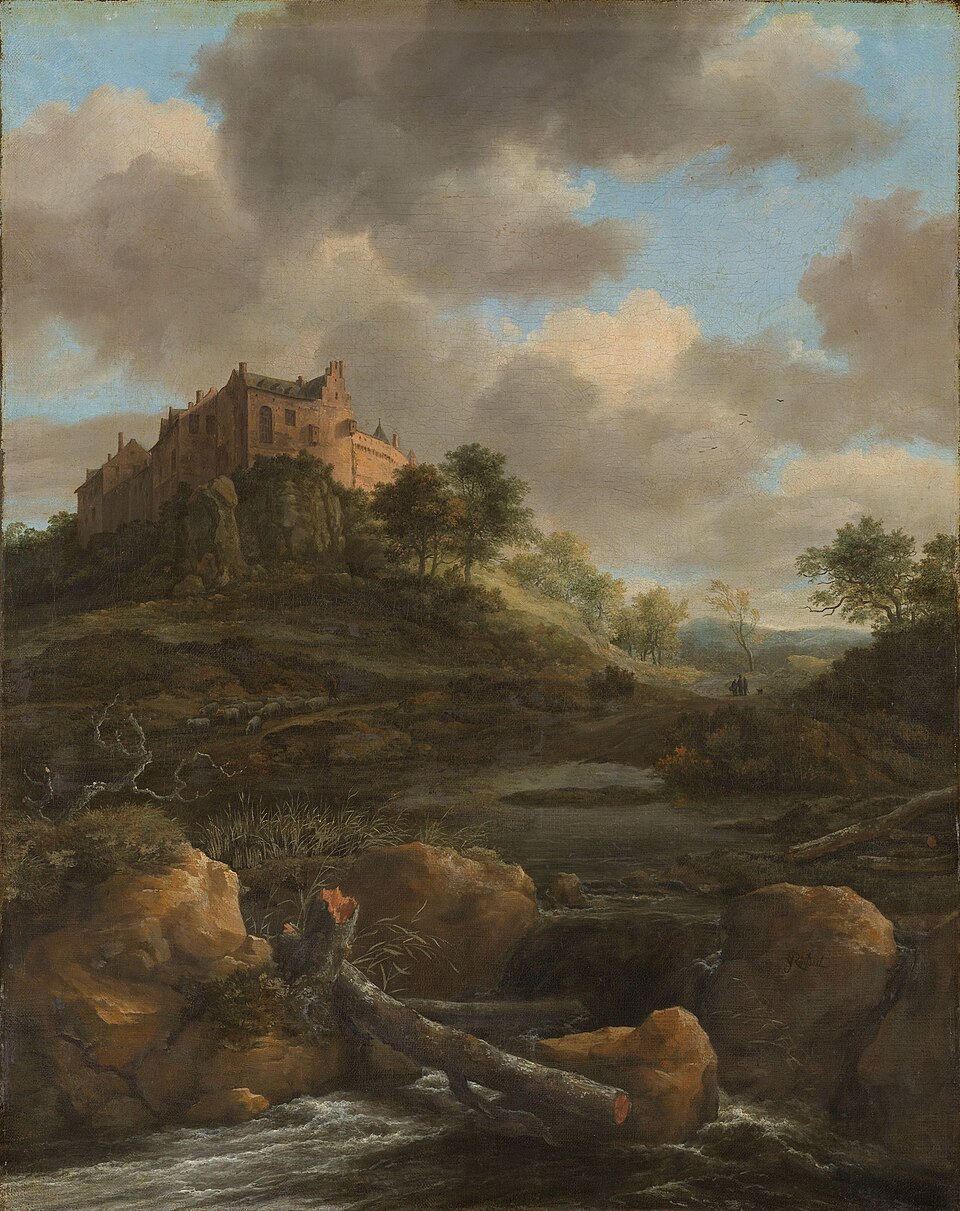
A castle crowns a rocky hill, a stream tumbles over stones, a shepherd drives his sheep. Ruisdael made Bentheim look like a mountain fortress, though in reality it barely rises above the plain.
The story behind the painting
Bentheim is a small German town near the Dutch border, about 26 kilometres beyond Ootmarsum, a town Ruisdael also painted. Little is known about his trip there. It has been suggested he made a kind of grand tour, but his contemporaries mostly went south to Italy, not east. One theory links him to an expedition to fetch Bentheimer sandstone for the new Amsterdam Town Hall, a project that employed many artists; the stone was popular for canal houses. It is just as plausible that he was invited to paint the castle. Sources remain unclear, and the painting itself is dated only to around the 1650s.
What to look for
In 1911 Hofstede de Groot described the scene: the castle stands in the left middle distance on the rocky summit of a hill; to the right a valley with a road; in front, masses of rock with a stream forming a little waterfall. On the left bank a shattered tree trunk lies diagonally across the water beside its stump. Farther back the stream widens and a shepherd drives his sheep forward. He called it a fine picture, full of light. The painting is signed in full on a rock at the right. Wikidata gives its size as 68 by 54 cm.
Meaning and intent
Ruisdael painted Bentheim Castle several times in this period, and he often set it on a high hill, though the real castle is only slightly raised above the surrounding plain. The exaggeration turns a modest landmark into something grand and wild, with rock, broken wood and falling water around it. The article also notes that people of Haarlem and Amsterdam then travelled mostly on foot or by canal boat, and that Ruisdael's pictures often show walkers on sandy tracks. If he went east by boat, that could explain his many sketches of water mills and sluices.
Legacy
Hofstede de Groot recorded that the painting was engraved by W. Unger and that it had a pendant. It passed through sales in Amsterdam in 1805 and 1810 and was already in the Rijksmuseum by 1835, where it remains. Ruisdael was even tempted to make a dramatic sweeping version of the castle, which his Haarlem contemporary Nicolaes Berchem, called his great friend by the biographer Arnold Houbraken, copied almost in mirror image. It is assumed the two artists travelled together, but no archival evidence beyond dated artworks supports this.
Le saviez-vous ?
- Painted around the 1650s by Jacob van Ruisdael.
- The real castle sits only slightly above the plain.
- Signed in full on a rock at the right.
- In the Rijksmuseum since at least 1835.
À propos de l'artiste
Jacob van Ruisdael (1628-1682)
paysage · arbre · Rijksmuseum · montagne · colline
Autres œuvres de Jacob van Ruisdael
 Le Moulin près de Wijk bij Duurstede - Jacob van Ruisdael (1670)
 Le Cimetière juif - Jacob van Ruisdael (1650s)
 Paysage avec une cascade - Jacob van Ruisdael (1668)
 Vue de Haarlem avec des champs de blanchiment - Jacob van Ruisdael (1670)
 Deux moulins à eau et d'une écluse près Ouvrir Singraven - Jacob van Ruisdael (1650)
 Dunes boisées - Jacob van Ruisdael (1646)
 Le cimetière juif - Jacob van Ruisdael (1653)
Vue d'Egmond aan Zee - Jacob van Ruisdael (1650)
Œuvres d'artistes liés
 La Ronde de nuit - Rembrandt van Rijn (1642)
 Autoportrait - Rembrandt van Rijn (1659)
 La Jeune Fille à la perle - Johannes Vermeer (1665)
 La Laitière - Johannes Vermeer (c. 1658)
 La Fête de la Saint-Nicolas - Jan Steen (1660s)
 La Mangeuse d'huîtres - Jan Steen (1658)
 Le Joyeux Buveur - Frans Hals (1620s)
 Le Cavalier riant - Frans Hals (1624)
 La Cour d'une maison à Delft - Pieter de Hooch (1658)
 La Peleuse de pommes - Pieter de Hooch (1663)