Exécution du doge Marino Faliero
Eugène Delacroix · 1826
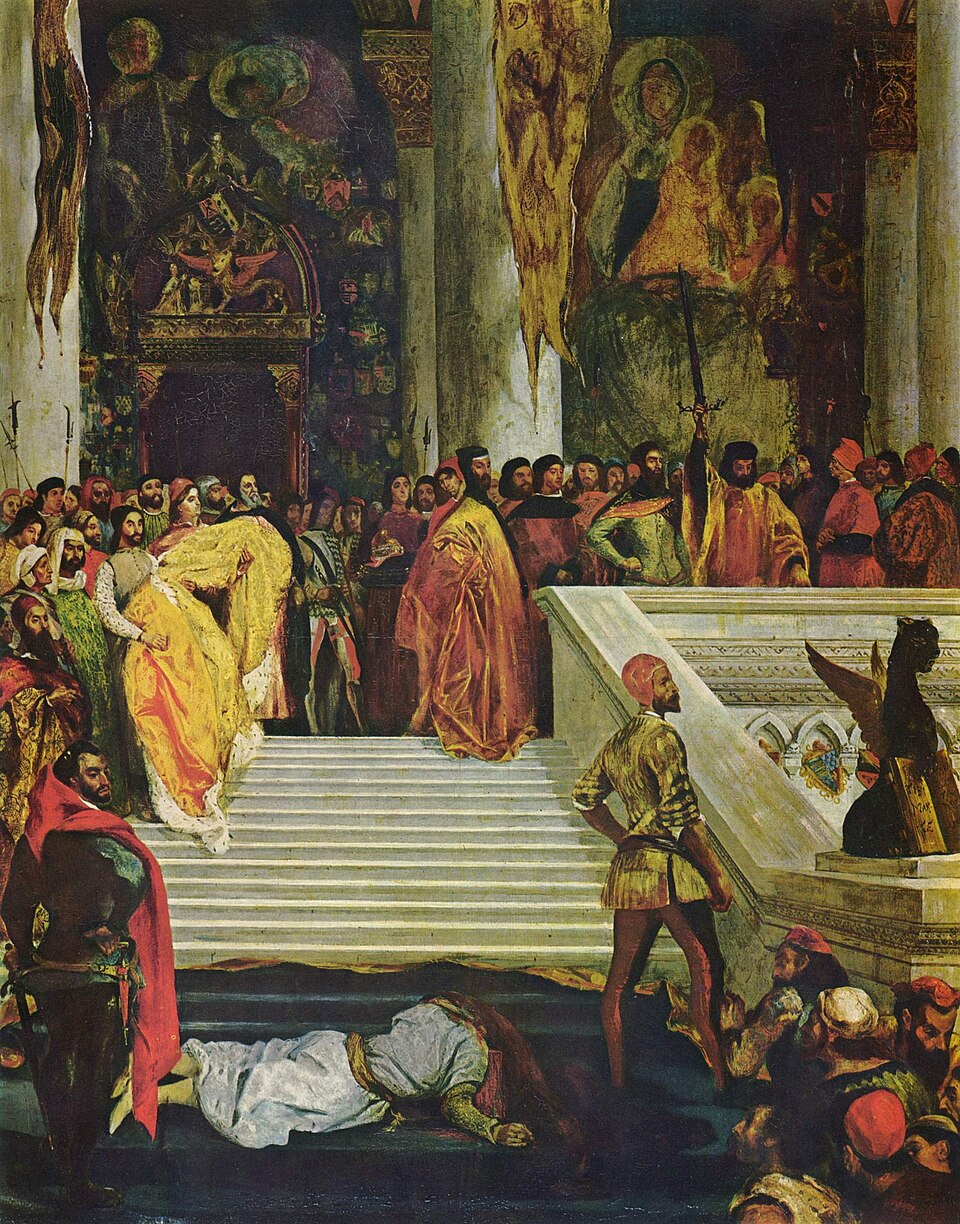
The deed is done. On a white staircase in Venice a headless body lies in white, while a nobleman lifts the bloody sword toward heaven. Delacroix painted the moment after the execution, and critics still argue over what his scattered, jewel-like scene means.
The story behind the painting
Delacroix completed the painting in 1826, inspired by Lord Byron's play Marino Faliero, Doge of Venice of 1821, which was based on the real doge Faliero, who lived from 1274 to 1355. Faliero, once a military hero, was convicted of conspiring with Venetian commoners to overthrow the noble oligarchy ruling the Republic and slaughter the nobility. The canvas, about 146 by 114 cm, was first shown in 1826 at an exhibition held for the benefit of the Greeks, then at the Salon of 1827. Today it belongs to the Wallace Collection in London.
What to look for
The scene is the Giants' Staircase inside the Doge's Palace, where Faliero had also been crowned. His headless body lies at the foot of the steps, dressed in white, stripped of his ducal robes. At the top stand members of the Council of Ten and other aristocrats in bright costly clothes; one holds up the sword of execution, pointing it toward a painting of Christ above. Flags and religious wall-paintings, of the Virgin and Saint Mark, dress the loggia. On the other side of the blank staircase a mixed crowd gathers, two figures holding the doge's yellow robe. The executioner stands in profile, and a guard blocks the onlookers. In Byron's play the head rolls down the steps, but here no head can be found.
Meaning and intent
Instead of the climax, Delacroix shows the aftermath. Alexander Potts compares the picture to a little collage of separate, flattened motifs, with the unifying event already past. Rather than one central action, the staircase divides the nobility from the people and stages a psychological confrontation between them. Scholars also read it against France under Charles X, when the public feared betrayal and conspiracy against the state and were troubled by the violence of public executions. Gothic horror, which fascinated Delacroix from his teens, and Orientalist touches such as the Turkish executioner add to the drama, while the painter departs from classical balance and symmetry in favour of an enigmatic, dynamic scene.
Legacy
Reception was mixed. Ludovic Vitet in Le Globe faulted the drawing and the colour in 1826. At the Salon of 1827 Auguste Jal praised the design of the white staircase, comparing it to medieval woodcuts, and predicted that Delacroix would soon leave behind this small-scale, mannered technique, then widely imitated; neither critic connected it with Byron. Later, Maxime Du Camp complained that the painting gave equal value to every object, from human fingers to tapestries and coats of arms. For Lee Johnson, Delacroix used a sketch-like touch as an expressive device to stir the viewer's imagination, an idea at the heart of Romantic painting.
Le saviez-vous ?
- Completed in 1826, after Byron's play of 1821.
- Shows the moment after Faliero's beheading on the Giants' Staircase.
- Shown in 1826 for the benefit of the Greeks and at the Salon of 1827.
- Now in the Wallace Collection, London.
À propos de l'artiste
Eugène Delacroix (1798-1863)
Autres œuvres de Eugène Delacroix
 La Liberté guidant le peuple - Eugène Delacroix (1830)
 La Mort de Sardanapale - Eugène Delacroix (1827)
 Scènes des massacres de Scio - Eugène Delacroix (1824)
 La Barque de Dante - Eugène Delacroix (1822)
 Femmes d'Alger dans leur appartement - Eugène Delacroix (1834)
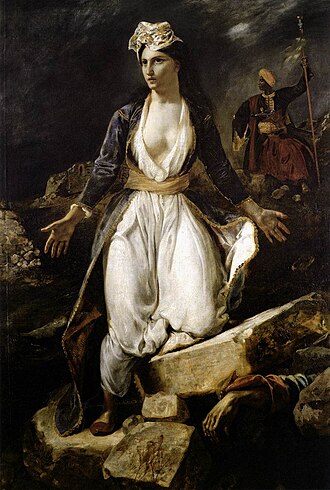 La Grèce sur les ruines de Missolonghi - Eugène Delacroix (1826)
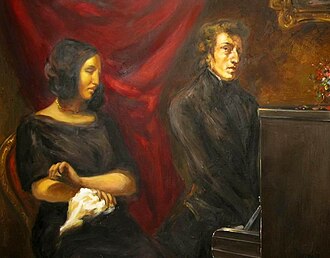 George Sand et Frédéric Chopin - Eugène Delacroix (1837)
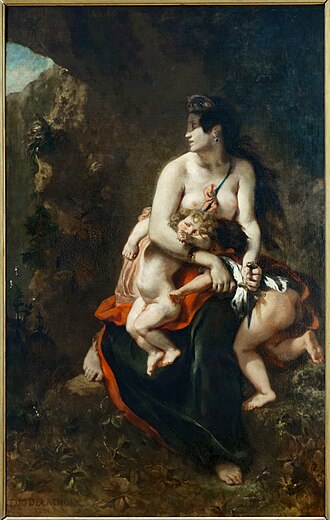 Médée furieuse - Eugène Delacroix (1836)
Œuvres d'artistes liés
 Tres de Mayo - Francisco Goya (1814)
 La Maja nue - Francisco Goya (1800)
 Le Voyageur contemplant une mer de nuages - Caspar David Friedrich (c. 1818)
 L'Abbaye dans une forêt de chênes - Caspar David Friedrich (1800s)
 Le Dernier Voyage du Téméraire - J. M. W. Turner (1839)
 Pluie, Vapeur et Vitesse - J. M. W. Turner (1844)
 L'Enfant bleu - Thomas Gainsborough (1770)
 Les Époux Andrews - Thomas Gainsborough (1748)