La Mort de Germanicus
Nicolas Poussin · 1627
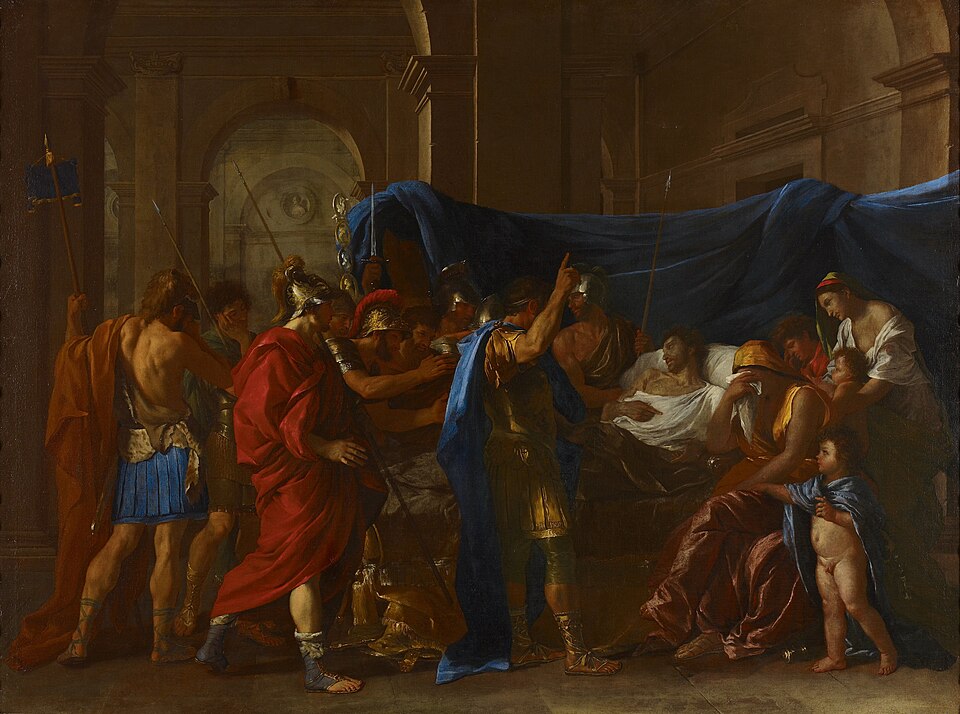
A dying Roman general asks his family and soldiers to avenge him. Poussin, a young painter only a few years in Rome, may have been the first ever to paint this scene, and it made his name.
The story behind the painting
Cardinal Francesco Barberini, nephew of Pope Urban VIII, probably ordered the painting in October 1626, on his return from a diplomatic visit to Spain. He turned to Nicolas Poussin, who had settled in Rome in 1624, perhaps known to him through the poet Giambattista Marino or the banker Marcello Sacchetti. Barberini had already commissioned a Capture of Jerusalem from him. Poussin delivered The Death of Germanicus on 21 January 1628, though both Wikipedia and Wikidata date it 1627.
What to look for
The scene comes from the Annals of Tacitus. Germanicus, elder brother of Claudius, won fame fighting the Germans for Emperor Tiberius, which earned him his name. Sent to Syria, he met opposition from the governor Gnaeus Calpurnius Piso. On his deathbed he made his wife Agrippina the Elder and his family swear to avenge him. The canvas is about 148 by 198.1 cm. The subject is a deathbed, a family and an oath: grief turned toward a promise.
Meaning and intent
Poussin is probably the first painter in history to take on this subject. He most likely knew Tacitus through an Italian translation, many of which circulated in Rome. The picture is a death made into a lesson about loyalty, grief and the bond between a leader and the people who loved him. Germanicus enjoyed great popularity among the Roman people, and the scene gathers that love and loyalty around his bed at the moment he asks for justice.
Legacy
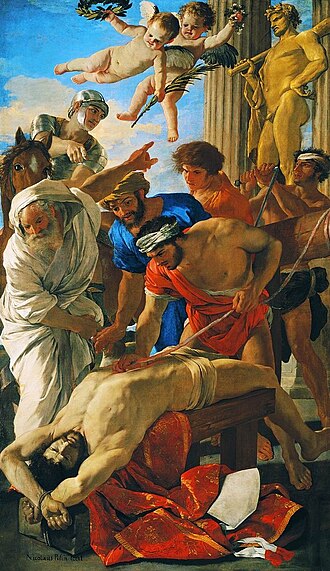
The painting quickly made an impression: the very next month, February 1628, Poussin was chosen to paint an altarpiece for Saint Peter's Basilica, The Martyrdom of Saint Erasmus. The cardinal gave the work to his nephew Maffeo Barberini, and it stayed with the Barberini family in Rome and Florence until 1958, when the Minneapolis Institute of Art acquired it. For a young painter recently arrived in Rome, it was a decisive step.
Le saviez-vous ?
- Commissioned by Cardinal Francesco Barberini.
- Delivered on 21 January 1628.
- Probably the first painting of this subject.
- In the Minneapolis Institute of Art since 1958.
À propos de l'artiste
Nicolas Poussin (1594-1665)
Autres œuvres de Nicolas Poussin
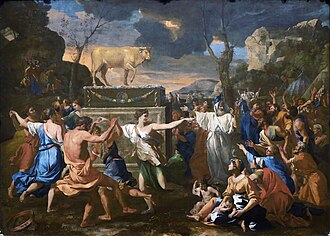 L'Adoration du Veau d'or - Nicolas Poussin (1634)
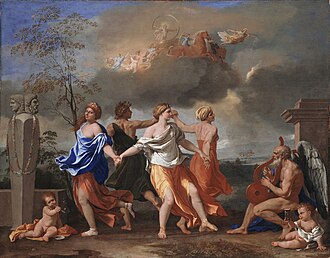 La Danse de la vie humaine - Nicolas Poussin (1630s)
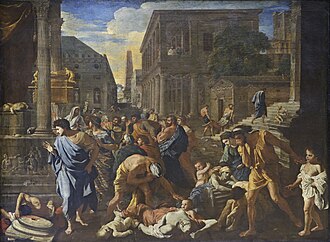 La Peste d'Asdod - Nicolas Poussin (1630)
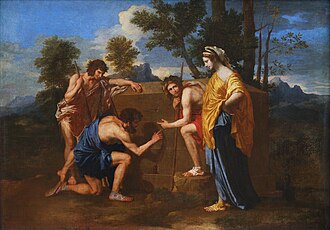 Les Bergers d'Arcadie - Nicolas Poussin (1638)
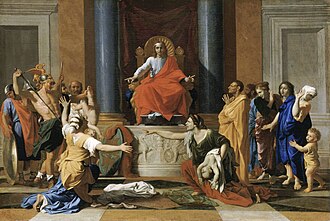 Le Jugement de Salomon - Nicolas Poussin (1649)
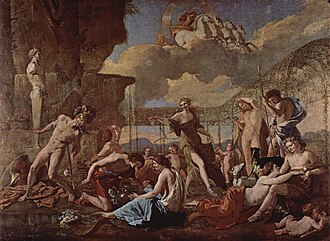 L'Empire de Flore - Nicolas Poussin (1631)
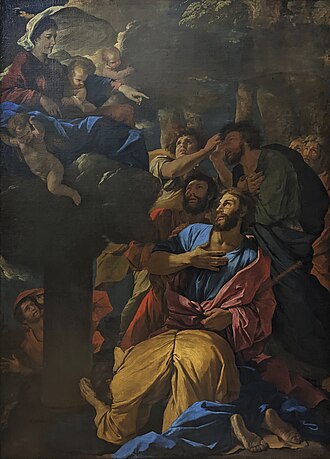 L'Apparition de la Vierge à saint Jacques le Majeur - Nicolas Poussin (1620s)
 Le Martyre de saint Érasme - Nicolas Poussin (1628)