L'Adoration du Veau d'or
Nicolas Poussin · 1634
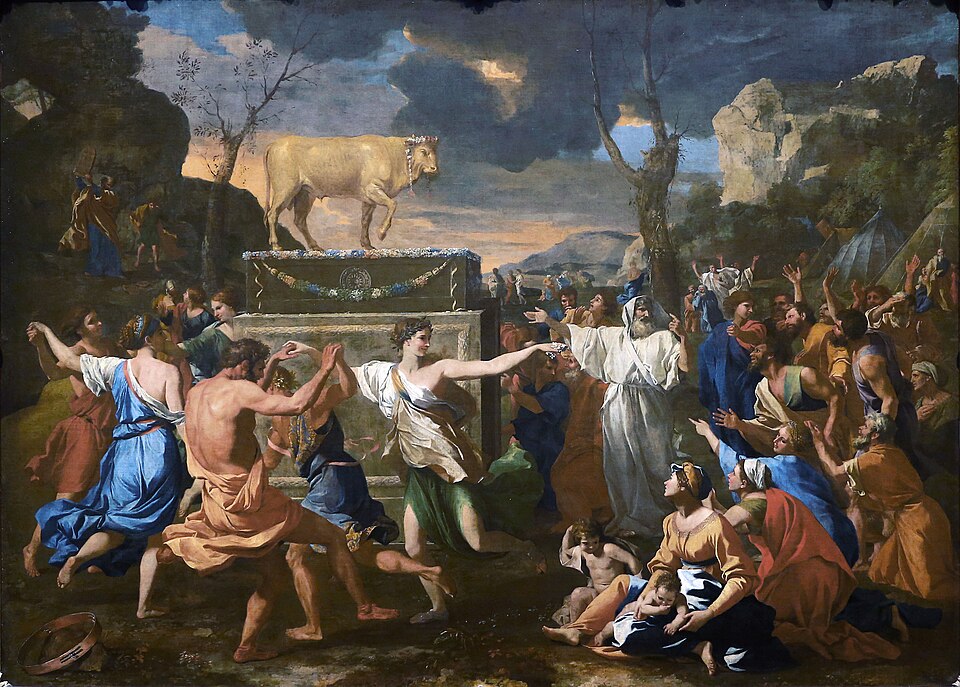
A crowd dances around a golden idol while, far off on the mountain path, Moses raises the tablets of the Law, about to smash them. Poussin catches the exact moment before joy turns to judgement.
The story behind the painting
Poussin produced the painting between 1633 and 1634, and Wikidata gives 1634. It was made as one of a pair, with The Crossing of the Red Sea, commissioned by Amadeo dal Pozzo, Marchese di Voghera of Turin, a cousin of Cassiano dal Pozzo, Poussin's main supporter in Rome. The two canvases stayed together for centuries: by 1685 they belonged to the Chevalier de Lorraine, in 1710 they were bought by Benigne de Ragois de Bretonvillers, and in 1741 they passed to Sir Jacob Bouverie, whose son became the first Earl of Radnor.
What to look for
The calf stands on an ornate pedestal, a little left of centre. Around it, on the left, men and women whirl in a farandole, a linked chain of dancers. On the right a kneeling crowd leans in to listen to Aaron, dressed in white. Two trees frame the scene: a dry one on the right and one in leaf on the left, pointing toward the two men coming down from the mountain, Moses and Joshua. Moses holds the tablets high above his head, ready to break them. The canvas measures about 153 by 212 cm.
Meaning and intent
The subject comes from chapter 32 of the Book of Exodus. While Moses was on Mount Sinai, Aaron gathered the people's gold and made a calf, an idol inspired by Egyptian gods, against the commandment forbidding such images. Poussin places the celebration in the foreground and the consequence in the distance. The bright, sensual dance and the small figure of the furious prophet tell the whole story at once: the pleasure of the crowd and the anger already on its way down the slope.
Legacy
The Earls of Radnor kept the pair until 1945, when they were separated for the first time. The Adoration of the Golden Calf went to the National Gallery in London, with half the cost contributed by the Art Fund, while The Crossing of the Red Sea went to the National Gallery of Victoria in Melbourne. The painting hangs in Room 19. On 17 July 2011 it was attacked with red spray paint, along with Poussin's Adoration of the Shepherds, by a French-speaking vandal who covered most of the nude figures.
Le saviez-vous ?
- Painted 1633-1634 as a pair with The Crossing of the Red Sea.
- Subject from Exodus, chapter 32.
- Bought by the National Gallery, London, in 1945.
- Vandalised with red spray paint in 2011.
À propos de l'artiste
Nicolas Poussin (1594-1665)
art religieux · femme · homme · National Gallery · arbre · ciel · enfant · montagne · danse
Autres œuvres de Nicolas Poussin
 La Danse de la vie humaine - Nicolas Poussin (1630s)
 La Peste d'Asdod - Nicolas Poussin (1630)
.jpg) Le Jugement de Salomon - Nicolas Poussin (1649)
Le Jugement de Salomon - Nicolas Poussin (1649) L'Empire de Flore - Nicolas Poussin (1631)
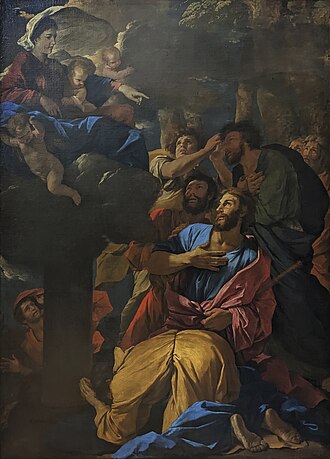 L'Apparition de la Vierge à saint Jacques le Majeur - Nicolas Poussin (1620s)
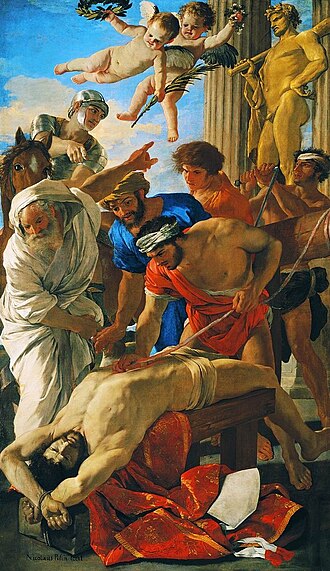 Le Martyre de saint Érasme - Nicolas Poussin (1628)
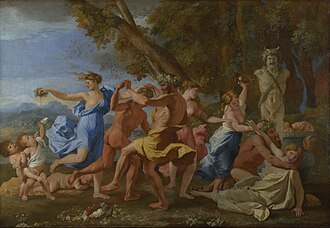 Bacchanale devant un terme - Nicolas Poussin (1630s)
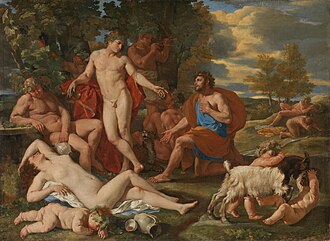 Midas devant Bacchus - Nicolas Poussin (1630)