Le Comte de Floridablanca et Goya
Francisco Goya · 1783
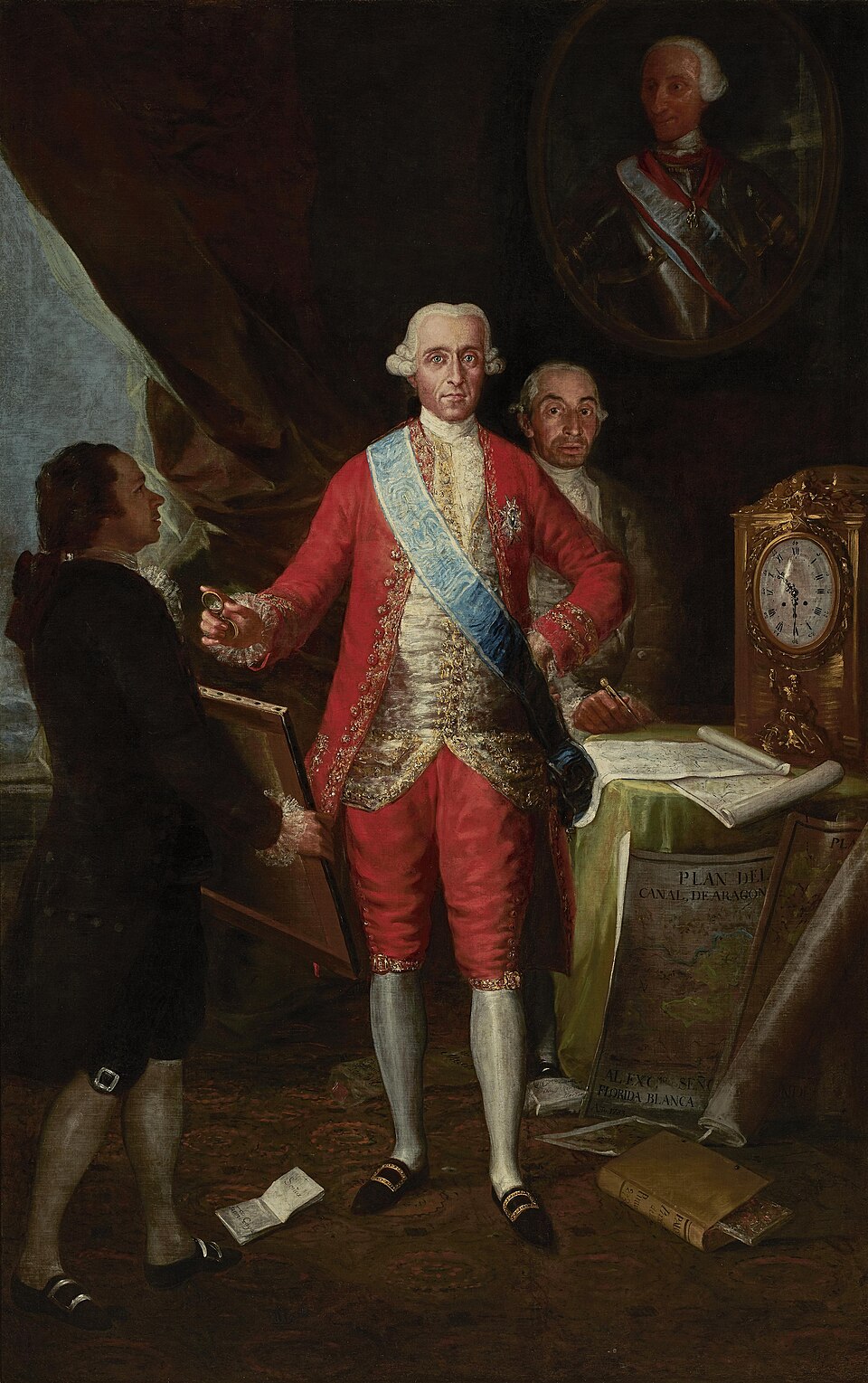
A minister in red velvet stands in the light, while a small painter in the shadows holds up a canvas for his approval. In 1783 Goya painted the Count of Floridablanca, and himself, at the height of the count's power.
The story behind the painting
Jose Monino y Redondo, Count of Floridablanca, had made his name as ambassador in Rome, and his success carried him to the post of First Secretary of State, which he held for fifteen years. When Goya painted him in 1783, the count was at the peak of his power. For Goya this was one of his first large portraits of a prestigious figure, and he worked hard to win the favour of the Madrid nobility, who soon began to commission portraits from him.
What to look for
The canvas is large, 262 by 166 cm. The count stands, distant, turned toward the painter, who presents him with a picture. He wears red velvet with a white waistcoat and stockings, shoes with gold buckles and the sash of the Order of Charles III. Behind him, perhaps the architect Ventura Rodriguez, plans of the Aragon Canal lie scattered on the floor. A green covered table holds an elegant gilded clock, and an oval portrait of Charles III hangs above. Notice the care given to embroidery and lace.
Meaning and intent
The plans on the floor, of one of Floridablanca's major projects, have been read as a symbol of bureaucratic work as a new value of the ruling class. The count's intelligent face looks at the viewer with the pride of his office. Goya stages a very particular relationship between painter and patron: the minister in the light, the painter in shadow and made smaller by perspective, so that the difference in social rank is plain. As in all his portraits, the sitter's personality is closely studied, with an influence of Velazquez, whom the young Goya admired.
Legacy
The portrait helped open the door to Goya's career as a portraitist of the Madrid elite. The man in it would not stay at the top. Floridablanca fell from favour in 1792 and retired to his home town of Murcia. In 1808, during the Spanish War of Independence, he was named President of the Supreme Junta, and he died that same year. Wikidata records the painting in the collection of the Bank of Spain, so the image of a powerful minister now belongs to a state institution.
Le saviez-vous ?
- Painted by Goya in 1783.
- Goya shows himself in shadow presenting a picture.
- One of Goya's first large portraits of a prestigious sitter.
- Held by the Bank of Spain.
À propos de l'artiste
Francisco Goya (1746-1828)
Autres œuvres de Francisco Goya
 Tres de Mayo - Francisco Goya (1814)
 La Maja nue - Francisco Goya (1800)
 Saturne dévorant un de ses enfants - Francisco Goya (1819)
 La Famille de Charles IV - Francisco Goya (1800)
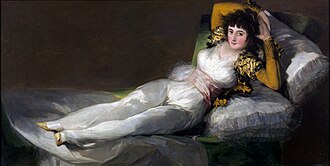 La Maja vêtue - Francisco Goya (1800)
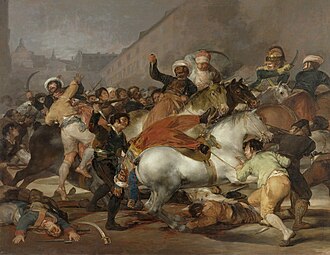 Dos de Mayo - Francisco Goya (1814)
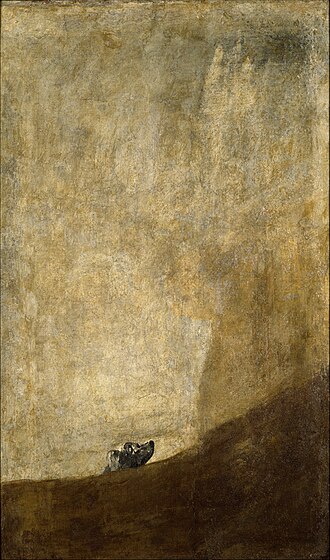 Le Chien - Francisco Goya (1819)
 Le Sabbat des sorcières - Francisco Goya (1820s)
Œuvres d'artistes liés
 Le Voyageur contemplant une mer de nuages - Caspar David Friedrich (c. 1818)
 L'Abbaye dans une forêt de chênes - Caspar David Friedrich (1800s)
 La Liberté guidant le peuple - Eugène Delacroix (1830)
 La Mort de Sardanapale - Eugène Delacroix (1827)
 Le Dernier Voyage du Téméraire - J. M. W. Turner (1839)
 Pluie, Vapeur et Vitesse - J. M. W. Turner (1844)
 L'Enfant bleu - Thomas Gainsborough (1770)
 Les Époux Andrews - Thomas Gainsborough (1748)