The Assassination of Saint Peter Martyr
Titien · 1520s
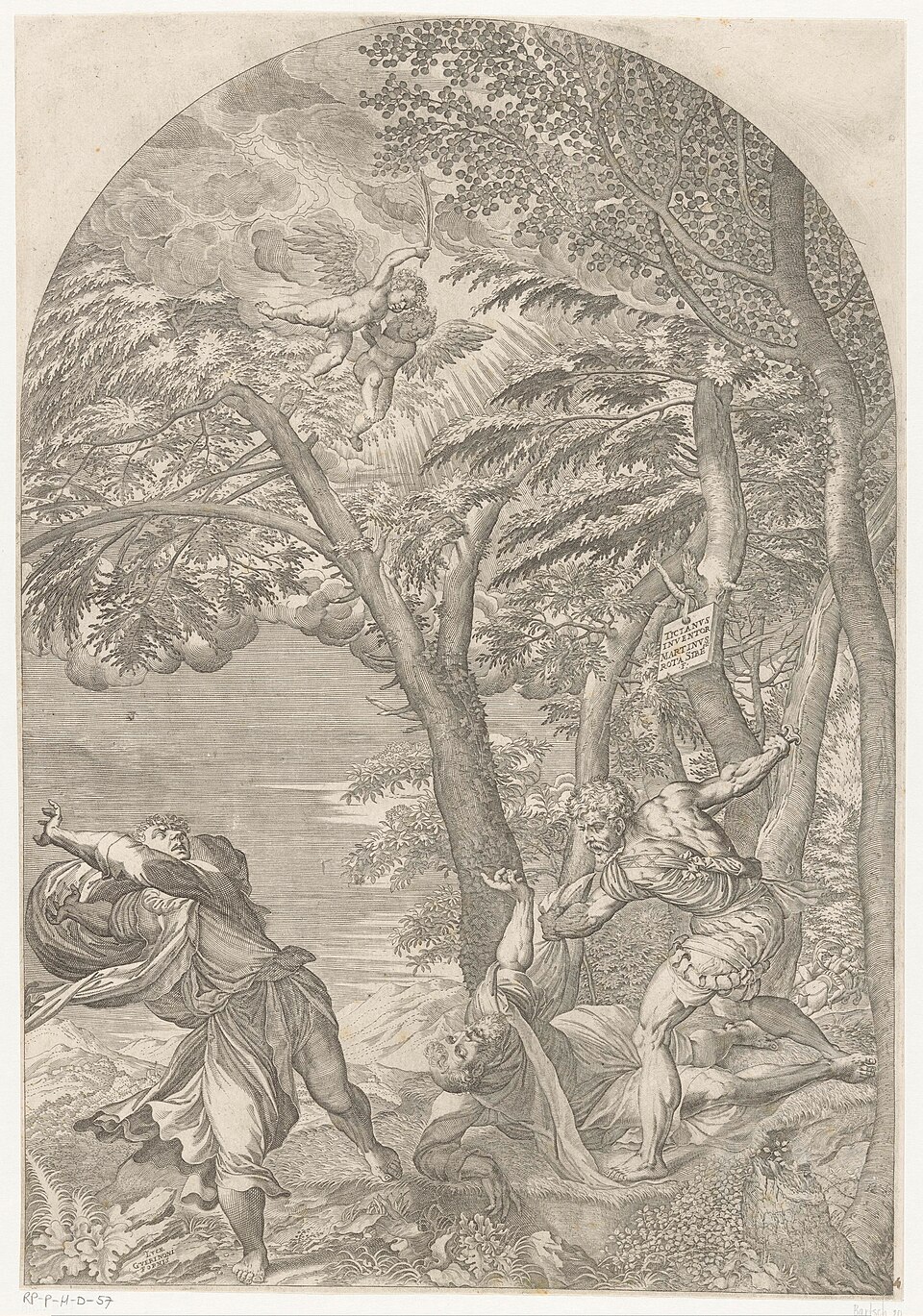
Vasari called it the greatest thing Titian ever made. A huge altarpiece of violence beneath a great tree, it shaped painters from Caravaggio to Carracci, and then burned in a Venetian chapel in 1867. Only copies remain.
The story behind the painting
In 1528 Titian competed with Il Pordenone and Palma il Vecchio to paint the martyrdom of Saint Peter Martyr for the altar of the saint's confraternity in San Zanipolo, the church of Santi Giovanni e Paolo, the main Dominican centre in Venice. Titian won, partly because the Dominicans did not want to be outdone by the Franciscans, who already had his Assumption and Pesaro Altarpiece in the Frari. The work was delivered on 27 April 1530. Wikipedia dates it 1528 to 1529, while Wikidata gives the 1520s. The seventeenth-century biographer Carlo Ridolfi wrote that Titian went back to Cadore to study dawn light on the mountain peaks.
What to look for
We can only look through copies and engravings: a 1691 copy by Johann Carl Loth now hangs in its place, and a print was made under Titian's own supervision. The original was painted on panel, one of Titian's pioneering large vertical altarpieces. Wikipedia gives about 500 by 306 cm, Wikidata 515 by 308 cm. According to the historian Charles Hope, it combined extreme violence with a landscape, mostly one great tree, that pressed into the scene and heightened the drama in a way that looks forward to the Baroque. Look for the falling saint, the fleeing brother and the tree above them.
Meaning and intent
Giorgio Vasari wrote in his Lives of the Artists that this was more complete, more celebrated and greater than any other work Titian produced in his whole life. Pietro Aretino recorded the reactions of the sculptors Niccolò Tribolo and Benvenuto Cellini when they saw it in Venice. Its influence ran deep: the figure of Saint Matthew in Caravaggio's Martyrdom of Saint Matthew is based on Titian's Peter, and the red-cloaked Roman soldier in Annibale Carracci's Resurrection on his fleeing brother. Early in the seventeenth century the Dutch merchant Daniel Nys tried in vain to buy it.
Legacy
In 1797, after the French suppressed the monastery, the painting was taken to France and transferred from panel to canvas. Antonio Canova's restitution project brought it back to Venice in 1816, but it was placed in the Madonna del Rosario chapel, not on its original altar. On 16 August 1867 a fire destroyed the chapel and the painting; the article quotes a source saying it was destroyed by an Austrian shell. Giovanni Battista Cavalcaselle called the loss irreparable for art. Besides copies, a pen study survives in the Wicar Museum in Lille, along with two blurry photographs of fragments saved from the fire, which are themselves lost.
Le saviez-vous ?
- Commissioned after a 1528 competition; delivered 27 April 1530.
- Called Titian's greatest work by Vasari.
- Destroyed by fire in Santi Giovanni e Paolo, Venice, on 16 August 1867.
- A 1691 copy by Johann Carl Loth hangs in its place.
À propos de l'artiste
Titien (1488-1576)
art religieux · École vénitienne
Autres œuvres de Titien
 Vénus d'Urbin - Titian (1538)
 L'Assomption de la Vierge - Titian (1510s)
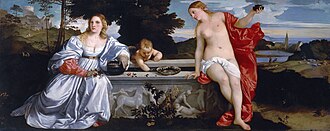 Amour sacré et Amour profane - Titian (1510s)
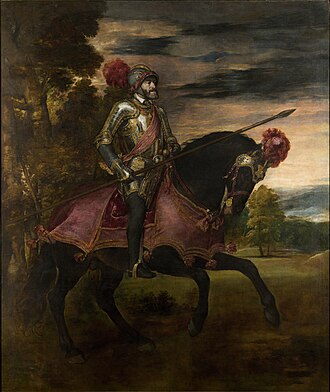 Charles Quint à cheval à Mühlberg - Titian (1548)
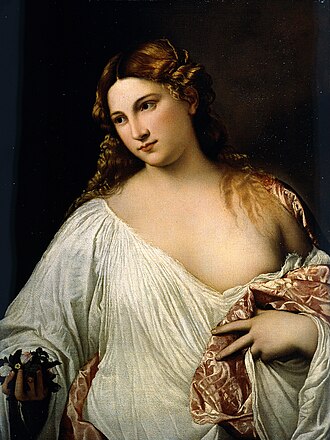 Flore - Titian (1517)
 Allégorie du Temps gouverné par la Prudence - Titian (1550)
 Diane et Actéon - Titian (1550s)
 Bacchus et Ariane - Titian (1520s)
Œuvres d'artistes liés
 La Cène - Jacopo Tintoretto (1563)
 Miracle de l'esclave - Jacopo Tintoretto (1540s)
 Les Noces de Cana - Paolo Veronese (1560s)
 Le Repas chez Levi - Paolo Veronese (1573)