Voûtain au-dessus de Salmon, Booz et Jobed
Michel-Ange Buronarroti · 1511
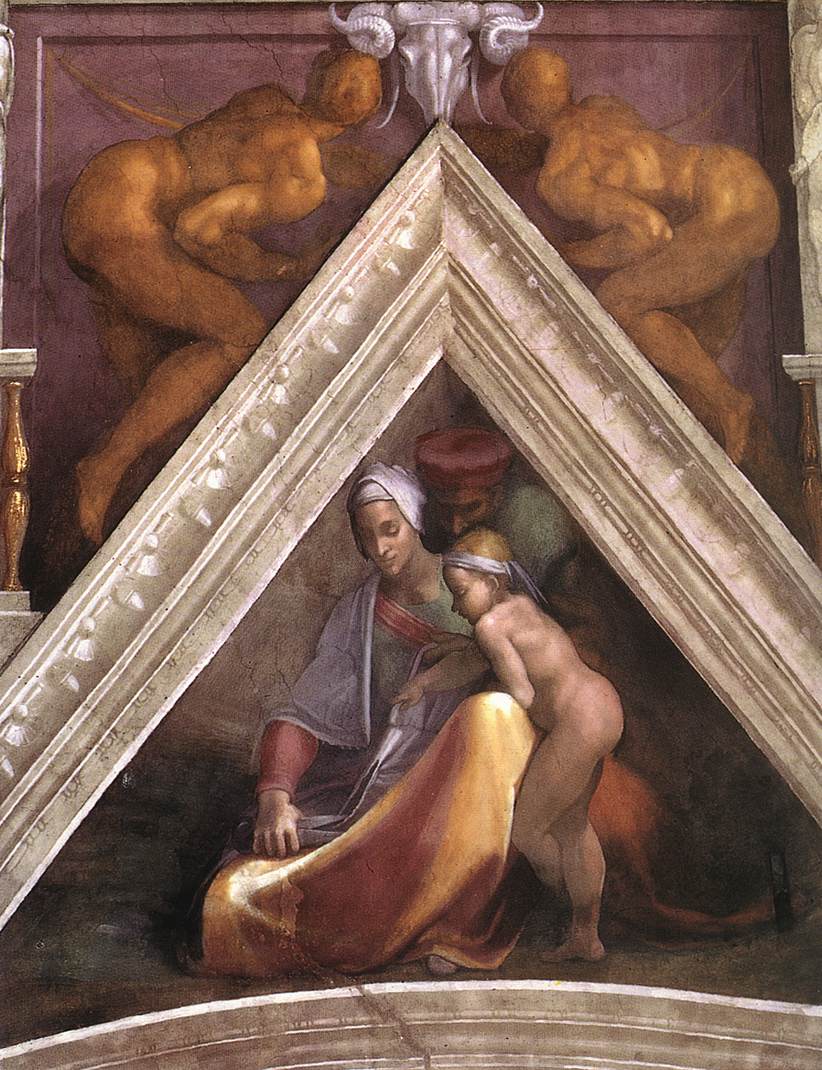
A mother cuts a piece of cloth while a child holds it, and everyone around her seems absorbed in that small task. High on the Sistine Chapel ceiling, Michelangelo turned a biblical genealogy into an ordinary family moment.
The story behind the painting
Above the lunettes of the Sistine Chapel, Michelangelo painted a row of curved triangular vaults, part of the ceiling commissioned by Pope Julius II. Together with the lunettes below, they hold the series of the Ancestors of Christ, drawn from the genealogy of Jesus in the Gospel of Matthew. The ceiling was frescoed in two phases, starting from the wall opposite the altar, so the latest episodes of the story were painted first. By summer 1511 the first half was done, the scaffolding was taken down and rebuilt, and the second phase, begun in October 1511, ended a year later, in time for the unveiling on the eve of All Saints' Day 1512. This vault, above Salmon, Boaz and Obed, was one of the last to be painted. The French Wikipedia article dates it to around 1511 to 1512, while Wikidata gives 1511.
What to look for
Since Boaz and Obed are identified in the lunette below, Salmon should appear in the vault, probably as a child with his father and mother. The group fits perfectly into the triangle, woven together by gestures and glances. All attention falls on the mother, who cuts a cloth held by the child and by a hand that may be hers or her husband's. They seem to sit in front of a building, more or less lit depending on how close they are to us. The woman's legs are covered by a bright yellow cloak that turns white at the knees, where the light is strongest. The husband, in a purple hat and a dark green cape, barely emerges from the dim light.
Meaning and intent
The vaults differ from the lunettes in style and form: dark backgrounds instead of light ones, and families seated on the ground rather than on steps, to fit the triangular space. The figures are identified only through the names written on the plaques in the lunettes below, and a lunette crowned by a vault usually carries three names instead of two. Scholars do not agree on who is who. Michelangelo gave the figures no iconographic attributes, and he may not have wanted a direct, certain identification at all, concentrating instead on showing different human types and attitudes. That uncertainty is part of what makes these quiet family groups so open to the viewer.
Legacy
In the triangular spaces above each vault sit the so-called bronze nudes, monochrome figures imitating bronze, placed symmetrically against dark violet backgrounds and separated by a ram's skull hung with golden ribbons. Here the two nudes seem to climb along the frame to peer at something near the central ram's head. Both were made from the same cartoon reversed, and both turn their backs to the viewer, showing the napes of their necks. Small differences break the mirror image, such as the slightly different position of the front leg of the right-hand figure. The fresco measures about 245 by 340 cm and remains in place in the Sistine Chapel, in the Vatican Museums.
Le saviez-vous ?
- Part of the Sistine Chapel ceiling commissioned by Pope Julius II.
- One of the last vaults painted, around 1511-1512.
- Salmon is probably shown as a child with his parents.
- Measures about 245 x 340 cm.
À propos de l'artiste
Michel-Ange Buronarroti (1475-1564)
Haute Renaissance · chapelle Sixtine
Autres œuvres de Michel-Ange Buronarroti
 Tondo Doni - Michelangelo (1500s)
 Le Tourment de saint Antoine - Michelangelo (1487)
 La Mise au tombeau - Michelangelo (1500s)
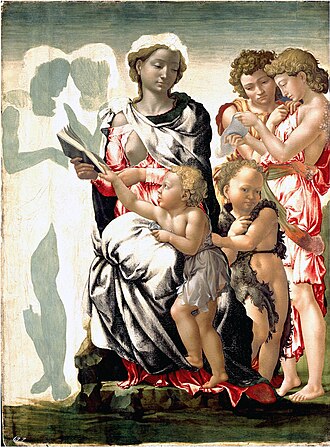 Madone de Manchester - Michelangelo (1494)
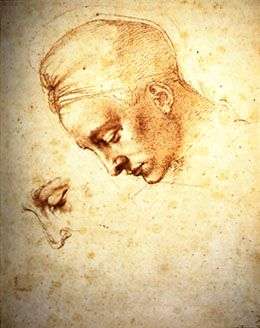 Léda - Michelangelo (1530)
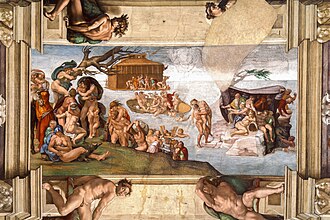 Le Déluge - Michelangelo (1508)
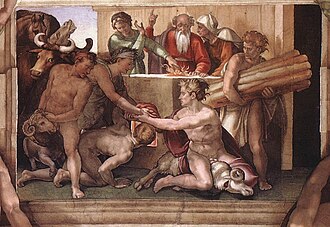 Le Sacrifice de Noé - Michelangelo (1508)
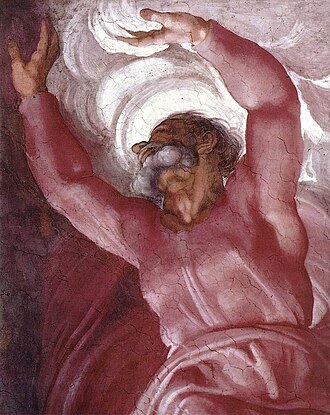 La Séparation de la lumière et des ténèbres - Michelangelo (1512)
Œuvres d'artistes liés
 La Madone Sixtine - Raphael (1510s)
 La Fornarina - Raphael
 Vénus d'Urbin - Titian (1538)
 L'Assomption de la Vierge - Titian (1510s)
 La Joconde - Leonardo da Vinci (1503-1519)
 La Dame à l'hermine - Leonardo da Vinci (1490)
 Autoportrait - Albrecht Dürer (1500)
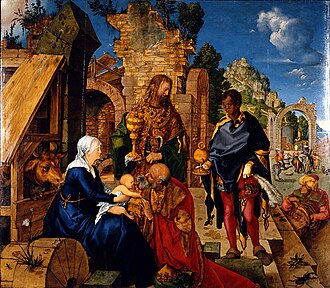 Adoration des mages - Albrecht Dürer (1504)
 La Naissance de Vénus - Sandro Botticelli (c. 1485)
 Le Printemps - Sandro Botticelli (1480s)
 Le Jardin des délices - Hieronymus Bosch
 La Nef des fous - Hieronymus Bosch (1500s)