Voûtain au-dessus de Roboam et Abia
Michel-Ange Buronarroti · 1511
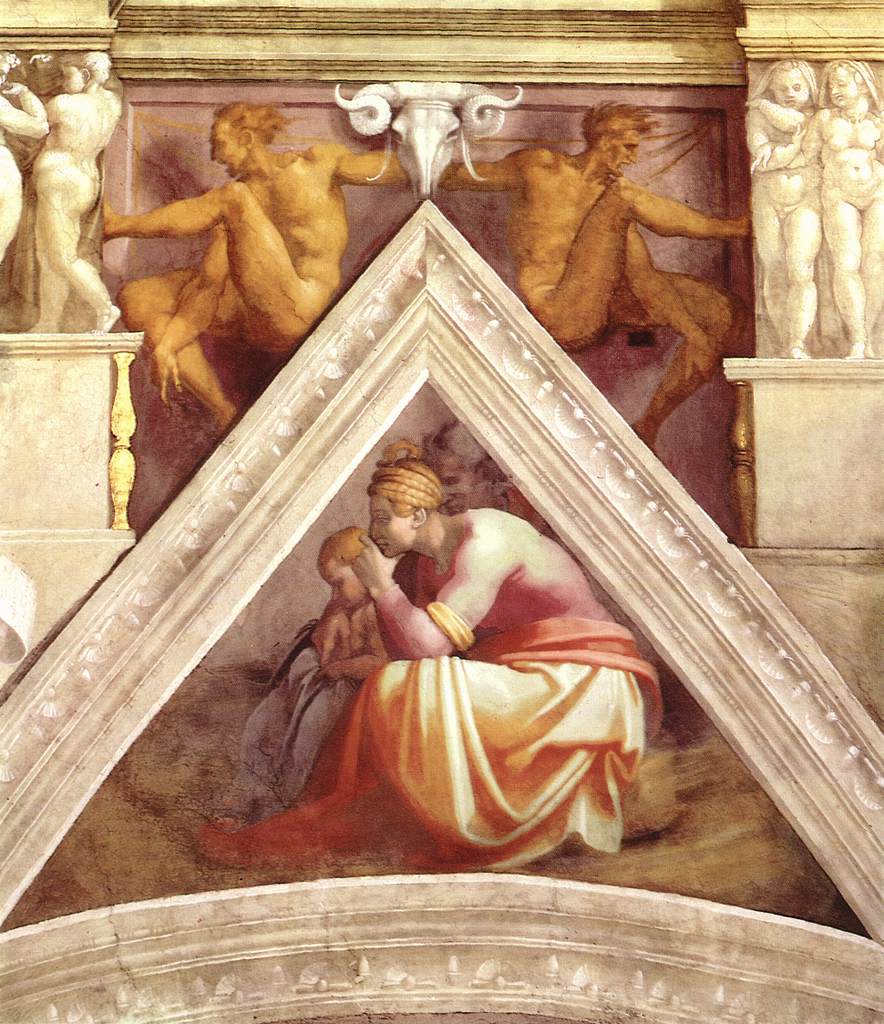
High on the Sistine ceiling, a woman sits with her chin on her hand like a thinker, holding a child behind her. Michelangelo painted her in just two days of fresco, one of the quiet families of Christ's ancestors.
The story behind the painting
Michelangelo painted this spandrel in fresco around 1511 to 1512 as part of the Sistine Chapel ceiling commissioned by Pope Julius II. The spandrels and the lunettes below them hold the series of the Ancestors of Christ, taken from the genealogy in the Gospel of Matthew; the names come from tablets in the lunettes. The ceiling was painted in two phases starting from the wall opposite the altar. The scaffolding was moved in summer 1511, and the second phase, begun in October 1511, ended a year later, in time for the unveiling on the eve of All Saints' Day 1512. This spandrel belongs to that last phase.
What to look for
The spandrels are concave triangles, so Michelangelo filled them with family groups seated on the ground against dark backgrounds, unlike the light grounds of the lunettes. In the foreground a woman in profile turns left, her torso bent, one arm holding her chin and her nose resting on her fingers, in what one would call the pose of a thinker. Her hair is elaborate and her close-fitting dress reveals the robust, very masculine musculature typical of his women. With her right arm she embraces a child behind her, and further back on the left an old man with white hair appears.
Meaning and intent
Scholars do not agree on who these families are, and here it is unclear whether the group is Rehoboam's or Abijah's. Michelangelo gave them no attributes; he may not have sought a clear identification at all, focusing instead on human types and attitudes. The foreground is lit and sharp while the background is darker and only sketched, a way of creating depth that he also used in sculpture through the unfinished, as in the Pitti and Taddei Tondi. Warm tones dominate: pink, orange, yellow, and violet behind.
Legacy
Above the spandrel, two bronze nudes, monochrome figures imitating bronze, twist in triangular spaces like howling demons, separated by a ram's skull hung with golden ribbons. They sit almost acrobatically along the frame, one leg raised, and both come from the same cartoon reversed, with small changes so the symmetry is not rigid: their hair blows to the right, as if in the same gust of wind. The spandrel, painted in just two days, shows how much life Michelangelo gave even to the less famous corners of the ceiling, now in the Vatican Museums.
Le saviez-vous ?
- Fresco by Michelangelo, around 1511-1512, Sistine Chapel ceiling.
- Painted in only two days of fresco.
- Part of the Ancestors of Christ from Matthew's genealogy.
- Flanked by two bronze nudes from the same reversed cartoon.
À propos de l'artiste
Michel-Ange Buronarroti (1475-1564)
Haute Renaissance · chapelle Sixtine
Autres œuvres de Michel-Ange Buronarroti
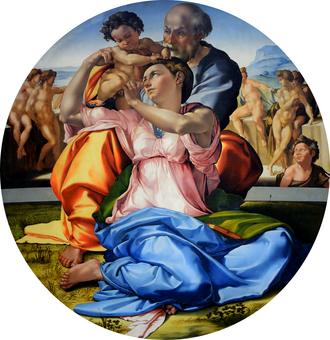 Tondo Doni - Michelangelo (1500s)
 Le Tourment de saint Antoine - Michelangelo (1487)
 La Mise au tombeau - Michelangelo (1500s)
 Madone de Manchester - Michelangelo (1494)
 Léda - Michelangelo (1530)
 Le Déluge - Michelangelo (1508)
 Le Sacrifice de Noé - Michelangelo (1508)
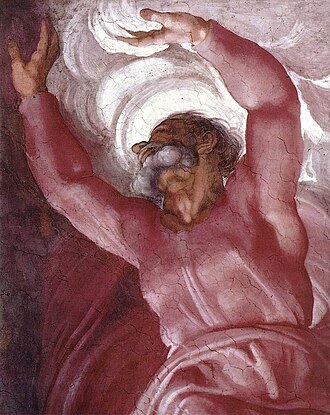 La Séparation de la lumière et des ténèbres - Michelangelo (1512)
Œuvres d'artistes liés
 La Madone Sixtine - Raphael (1510s)
 La Fornarina - Raphael
 Vénus d'Urbin - Titian (1538)
 L'Assomption de la Vierge - Titian (1510s)
 La Joconde - Leonardo da Vinci (1503-1519)
 La Dame à l'hermine - Leonardo da Vinci (1490)
 Autoportrait - Albrecht Dürer (1500)
 Adoration des mages - Albrecht Dürer (1504)
 La Naissance de Vénus - Sandro Botticelli (c. 1485)
 Le Printemps - Sandro Botticelli (1480s)
 Le Jardin des délices - Hieronymus Bosch
 La Nef des fous - Hieronymus Bosch (1500s)