Le Coucher de soleil
Paul Gauguin · 1892
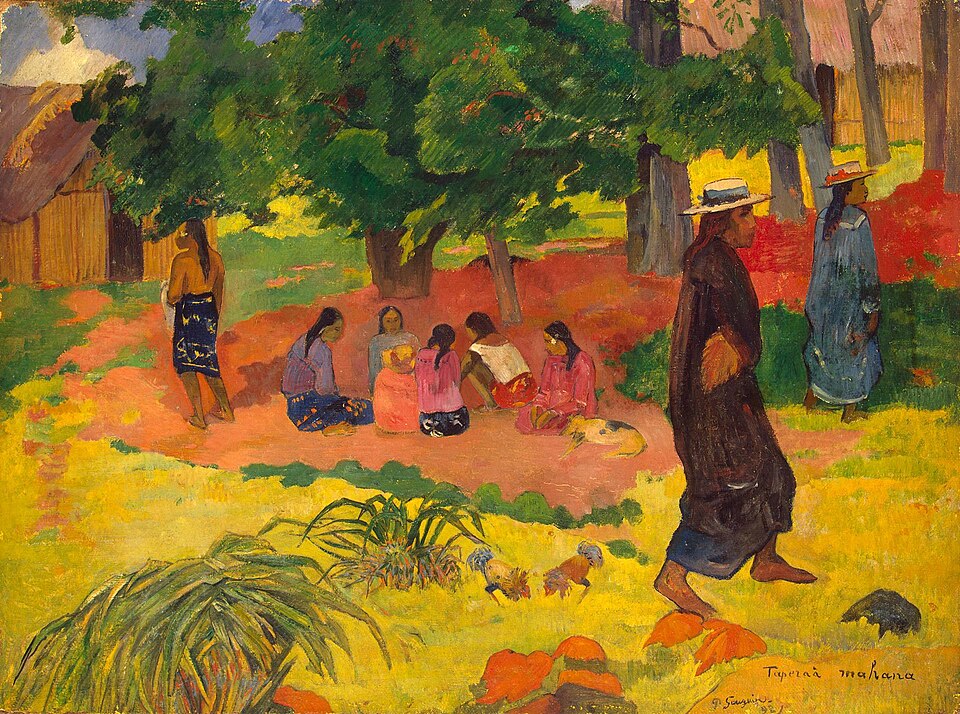
Late afternoon in Tahiti: women talk under a tree, two roosters fight, and the kitchen of Gauguin's own house peeks through the trees. For half a century the West believed this painting lost, until it reappeared in the Hermitage in 1995.
The story behind the painting
Gauguin painted Taperaa mahana, known in French as Coucher de soleil or Fin d'après-midi, sunset or late afternoon, in Tahiti in 1892, and it belongs to his Tahitian cycle. At the lower right he wrote the title in Tahitian and signed and dated it P Gauguin 92. A strip about 2 cm wide on every edge is folded over the stretcher, which suggests the canvas was probably sent to France rolled up and prepared for sale once it was already in Paris. After Gauguin's death the painting stayed for a long time with his family. It measures 72.3 by 97.5 cm.
What to look for
Six women sit under a tree, talking; a dog lies stretched out beside one of them. Three other women walk past in front of them, each going a different way. In the left and right corners, huts show behind the trees. In the foreground two roosters are fighting, a small burst of conflict below the calm conversation. Look at the lower right for the Tahitian words of the title, the signature and the date. At the edges, the folded margin is a physical trace of the painting's journey from Tahiti to Paris.
Meaning and intent
The scene draws on Gauguin's own surroundings. Bengt Danielsson, who researched Gauguin's life in Tahiti, identified the building on the left as the kitchen of Gauguin's own house there, which the painter showed more than once, for example in Tahitian Village with Walking Woman at the Ny Carlsberg Glyptotek in Copenhagen. Women seated under trees in conversation were a subject Gauguin returned to several times, most famously in The Conversation (Parau Parau) at the Hermitage and Words Spoken in a Whisper (Parau parau) at the Yale University Art Gallery. Here that quiet talk meets the end of the day.
Legacy
In 1928 the painting was shown at the Nedler Gallery in London and bought by the German industrialist Otto Krebs, who kept it at his estate at Holzdorf near Weimar; during the Second World War his collection was hidden in a strongroom built under an outbuilding. In 1945 Soviet troops occupied Holzdorf, trophy teams found and listed the collection, and it was sent to the Hermitage, where it stayed out of view for decades. In the West the Krebs collection was thought lost, and the painting was known only from an old black and white photograph at the Courtauld Institute. It was first shown in 1995, joined the permanent display in 2001, and since late 2014 hangs in the General Staff Building, room 411.
Le saviez-vous ?
- Painted in Tahiti in 1892, part of Gauguin's Tahitian cycle.
- The hut on the left is the kitchen of Gauguin's own house, per Bengt Danielsson.
- Taken from Otto Krebs's estate by Soviet trophy teams in 1945.
- Hidden in the Hermitage until shown publicly in 1995.
À propos de l'artiste
Paul Gauguin (1848-1903)
Autres œuvres de Paul Gauguin
 D'où venons-nous ? Que sommes-nous ? Où allons-nous ? - Paul Gauguin (1897-1898)
 Le Christ jaune - Paul Gauguin (1889)
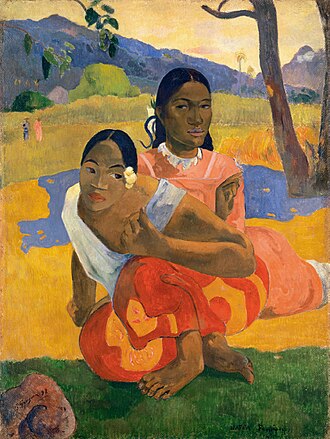 Quand te maries-tu ? - Paul Gauguin (1892)
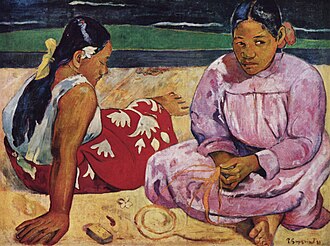 Femmes de Tahiti - Paul Gauguin (1890)
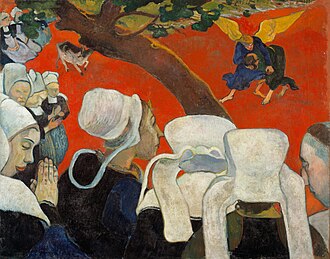 Vision après le sermon - Paul Gauguin (1888)
Manaò tupapaú - Paul Gauguin (1892)
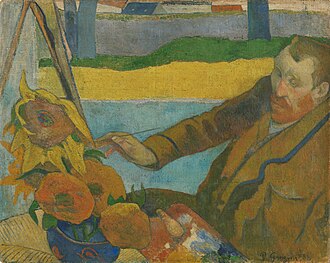 Vincent van Gogh peignant les tournesols - Paul Gauguin (1888)
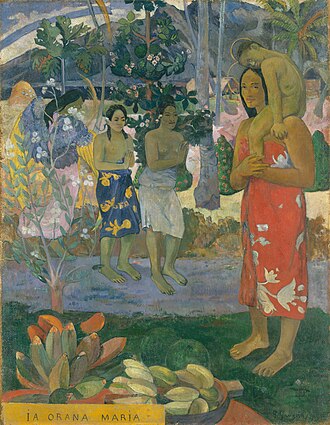 Ia Orana Maria - Paul Gauguin (1891)
Œuvres d'artistes liés
 La Nuit étoilée - Vincent van Gogh (1889)
 Terrasse du café le soir - Vincent van Gogh (1888)
 Promenade au bord de la mer - Joaquín Sorolla (1909)
 Triste héritage - Joaquín Sorolla (1898)
 Les Grandes Baigneuses - Paul Cézanne (1900s)
 Le Garçon au gilet rouge - Paul Cézanne
 Bal du moulin de la Galette - Pierre-Auguste Renoir (1876)
 Le Déjeuner des canotiers - Pierre-Auguste Renoir (1881)
 Au Moulin-Rouge - Henri de Toulouse-Lautrec (1892)
 La Toilette - Henri de Toulouse-Lautrec (1896)