Symphonie en blanc n° 3
James Abbott McNeill Whistler · 1860s
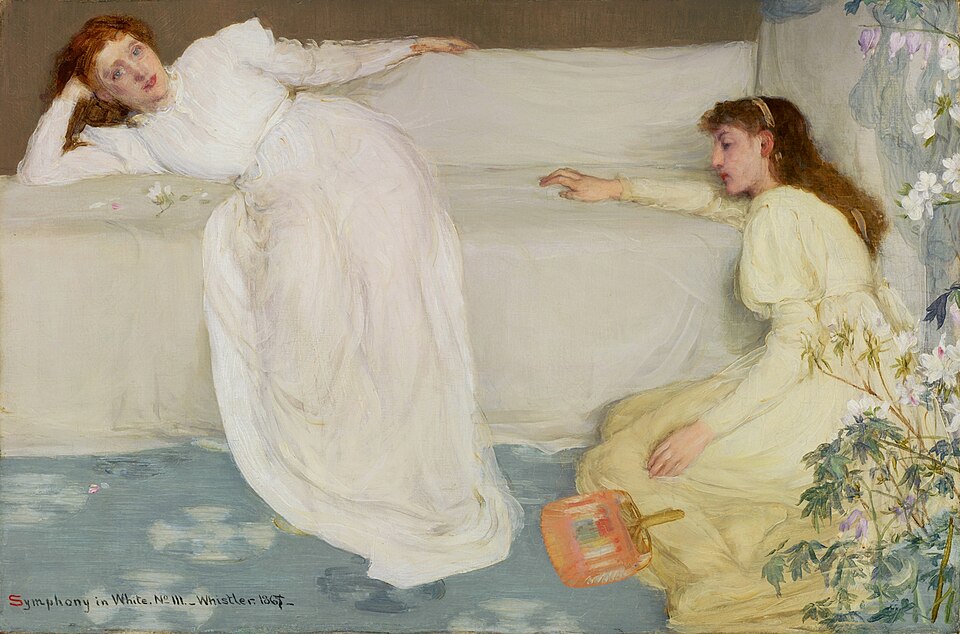
Two women rest in white and pale yellow, one on a sofa, one on the floor, a red fan at their feet. When a critic complained it was not all white, Whistler fired back that a symphony in F is not just F, F, F.
The story behind the painting
Whistler began this painting perhaps as early as July 1865. It was the last of his pictures for which Joanna Hiffernan, his lover, posed. The second model was Milly Jones, wife of an actor friend. By mid-August he had a complete sketch and kept working into September, but he went on reworking it until 1867. To mark the changes he painted over the final 5 in the date and replaced it with a 7. Wikidata dates the work only to the 1860s. William Michael Rossetti saw it in the studio in March 1867, then called The Two Little White Girls.
What to look for
Hiffernan reclines on a sofa in white, her head resting on her hand, while Jones sits on the floor leaning against the sofa in a yellowish dress. A fan lies on the floor and a plant with white flowers stands on the right. The fan is an oriental touch, a sign of Japonisme. Look for the many dainty tints within the white: brown and reddish hair, a bit of blue ribbon, green leaves and flesh tones. The canvas is wide and low, about 51 by 77 cm.
Meaning and intent
The musical title expressed Whistler's belief that composition mattered more than subject, and the theory of corresponding arts developed by the poet Charles Baudelaire. When Philip Hamerton wrote in 1867 that the picture was not precisely a symphony in white, Whistler answered in a letter the paper would not print, later published in The Gentle Art of Making Enemies, asking whether a symphony in F should repeat F, F, F. Whistler was working closely with Albert Joseph Moore, whose A Musician is so similar that it is hard to tell who influenced whom.
Legacy
The painting was shown at the Royal Academy in 1867, with its musical title from the first. Henri Fantin-Latour, Alfred Stevens, James Tissot and Edgar Degas admired it, and Degas drew on it for his portrait of Eugénie Fiocre in the ballet La Source. Not everyone agreed: in 1908, five years after Whistler's death, his former student Walter Sickert called it the low-water mark of the old manner, before the birth of the new. It was first bought by the collector Louis Huth and is now at the Barber Institute of Fine Arts in Birmingham.
Le saviez-vous ?
- Begun in 1865, finished in 1867; the date was changed from 5 to 7.
- Hiffernan's last sitting for Whistler; Milly Jones is the second model.
- Shown at the Royal Academy in 1867.
- Now at the Barber Institute of Fine Arts, Birmingham.
À propos de l'artiste
James Abbott McNeill Whistler (1834-1903)
Autres œuvres de James Abbott McNeill Whistler
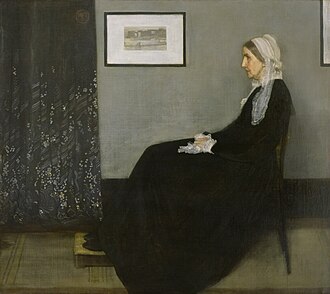 Arrangement en gris et noir n°1 - James McNeill Whistler (1871)
%201862.jpg) Symphonie en blanc n°1 : la jeune fille en blanc - James McNeill Whistler (1860s)
Symphonie en blanc n°1 : la jeune fille en blanc - James McNeill Whistler (1860s)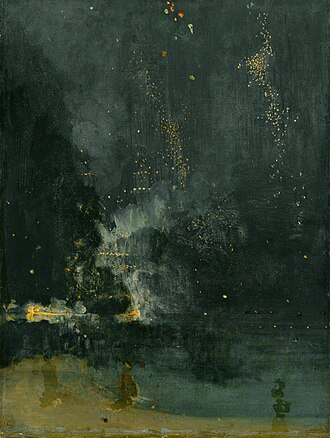 Nuit en noir et or, la fusée qui retombe - James McNeill Whistler (1875)
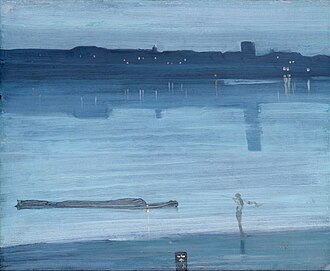 Nocturne: Blue and Silver – Chelsea - James McNeill Whistler (1871)
%201864.jpg) Symphony in White, No. 2: The Little White Girl - James McNeill Whistler (1864)
Symphony in White, No. 2: The Little White Girl - James McNeill Whistler (1864)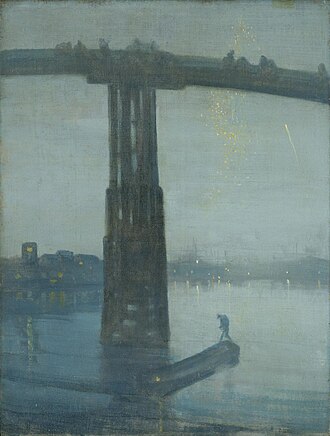 Nocturne en bleu et or - le Vieux Pont de Battersea - James McNeill Whistler (1872)
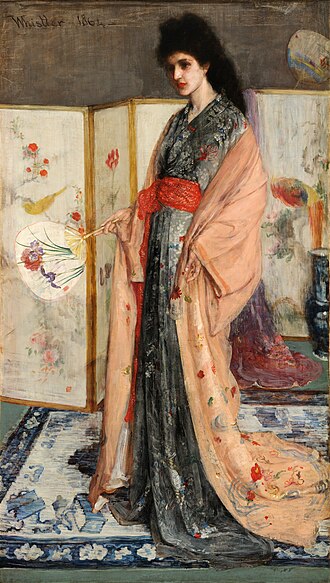 La Princesse du pays de la porcelaine - James McNeill Whistler (1860s)
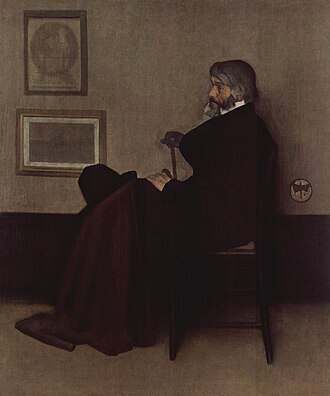 Arrangement en gris et noir n°2 - James McNeill Whistler (1870s)