Symphonie en blanc n°1 : la jeune fille en blanc
James Abbott McNeill Whistler · 1860s
%201862.jpg)
A red-haired woman in white stands on a wolf skin before a white curtain, a lily in her hand. Rejected in London and Paris, Whistler's White Girl drew more attention at the Salon des Refusés than Manet's Déjeuner sur l'herbe.
The story behind the painting
Whistler began The White Girl shortly after 3 December 1861, meaning to send it to the Royal Academy, and despite bouts of illness finished it by April 1862. His model was Joanna Hiffernan, his lover, whom he had met in London. He described the picture to George du Maurier as a woman in a beautiful white cambric dress against a window with a white muslin curtain, which, apart from the red hair, is one gorgeous mass of brilliant white. Wikidata dates the work only to the 1860s; he later reworked it between 1867 and 1872.
What to look for
The full-length figure stands on a wolf-skin rug, the wolf's head staring menacingly at the viewer, a lily in her left hand, in front of a beige curtain. Almost everything is white: the dress, the curtain, the light falling strongly from the right. It is an early experiment in white on white. Notice how the one strong accent is her red hair, and how the wolf's head breaks the calm at her feet. The canvas is tall, about 213 by 108 cm, close to life size.
Meaning and intent
Whistler insisted the work simply showed a girl dressed in white standing in front of a white curtain, one of his earliest statements of art for art's sake. Others read it differently: Castagnary saw an allegory of a bride's lost innocence, some saw an allusion to the Virgin Mary, and a London gallery titled it The Woman in White after Wilkie Collins' novel, which Whistler had never read. About ten years later he called it Symphony in White, No. 1, stressing composition over subject, perhaps inspired by Gautier's poem Symphonie en Blanc Majeur.
Legacy
The Royal Academy rejected the painting while accepting three of his etchings, perhaps fearing a scandal like the one around Landseer's The Shrew Tamed, and the Paris Salon refused it in 1863. At the Salon des Refusés it drew even more attention than Manet's Déjeuner sur l'herbe, and was admired by Manet, Courbet and Baudelaire; Zola later described the controversy in his novel L'Oeuvre. It stayed in the Whistler family until 1896, and in 1943 the Whittemore family gave it to the National Gallery of Art in Washington.
Le saviez-vous ?
- Begun in December 1861 with Joanna Hiffernan as model.
- Rejected by the Royal Academy and the Paris Salon.
- Shown at the Salon des Refusés in 1863.
- Given to the National Gallery of Art, Washington, in 1943.
À propos de l'artiste
James Abbott McNeill Whistler (1834-1903)
portrait · National Gallery of Art
Autres œuvres de James Abbott McNeill Whistler
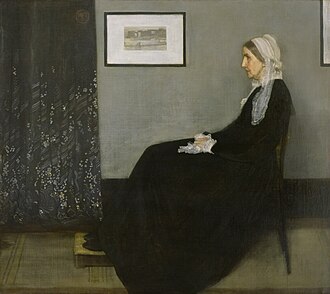 Arrangement en gris et noir n°1 - James McNeill Whistler (1871)
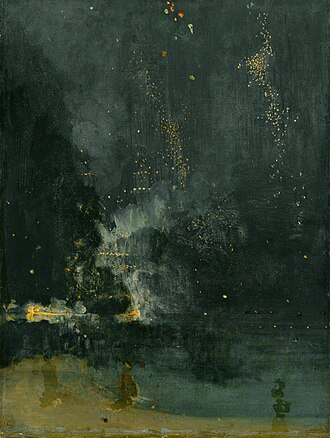 Nuit en noir et or, la fusée qui retombe - James McNeill Whistler (1875)
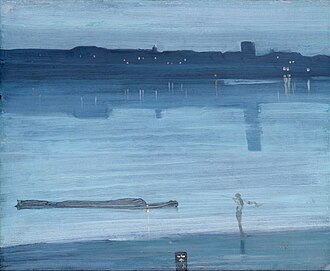 Nocturne: Blue and Silver – Chelsea - James McNeill Whistler (1871)
%201864.jpg) Symphony in White, No. 2: The Little White Girl - James McNeill Whistler (1864)
Symphony in White, No. 2: The Little White Girl - James McNeill Whistler (1864)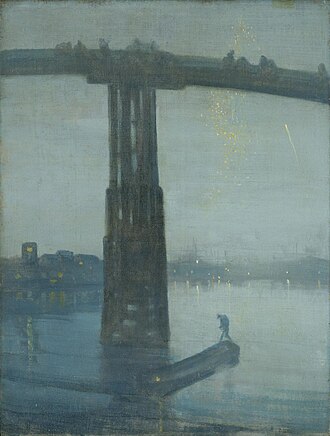 Nocturne en bleu et or - le Vieux Pont de Battersea - James McNeill Whistler (1872)
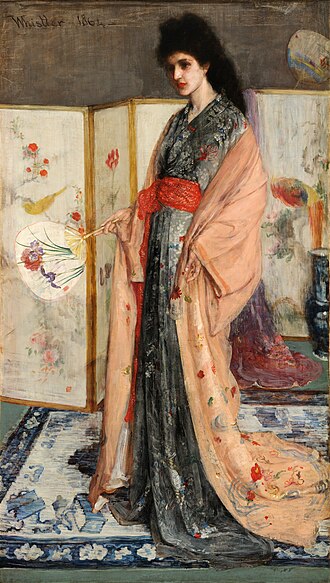 La Princesse du pays de la porcelaine - James McNeill Whistler (1860s)
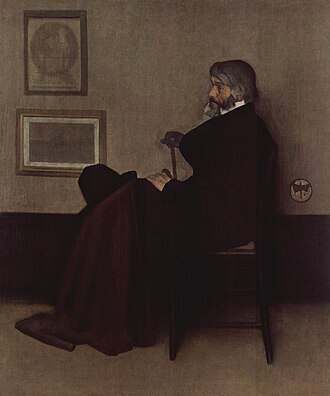 Arrangement en gris et noir n°2 - James McNeill Whistler (1870s)
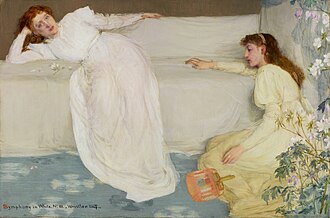 Symphonie en blanc n° 3 - James McNeill Whistler (1860s)