Arrangement en gris et noir n°2
James Abbott McNeill Whistler · 1870s
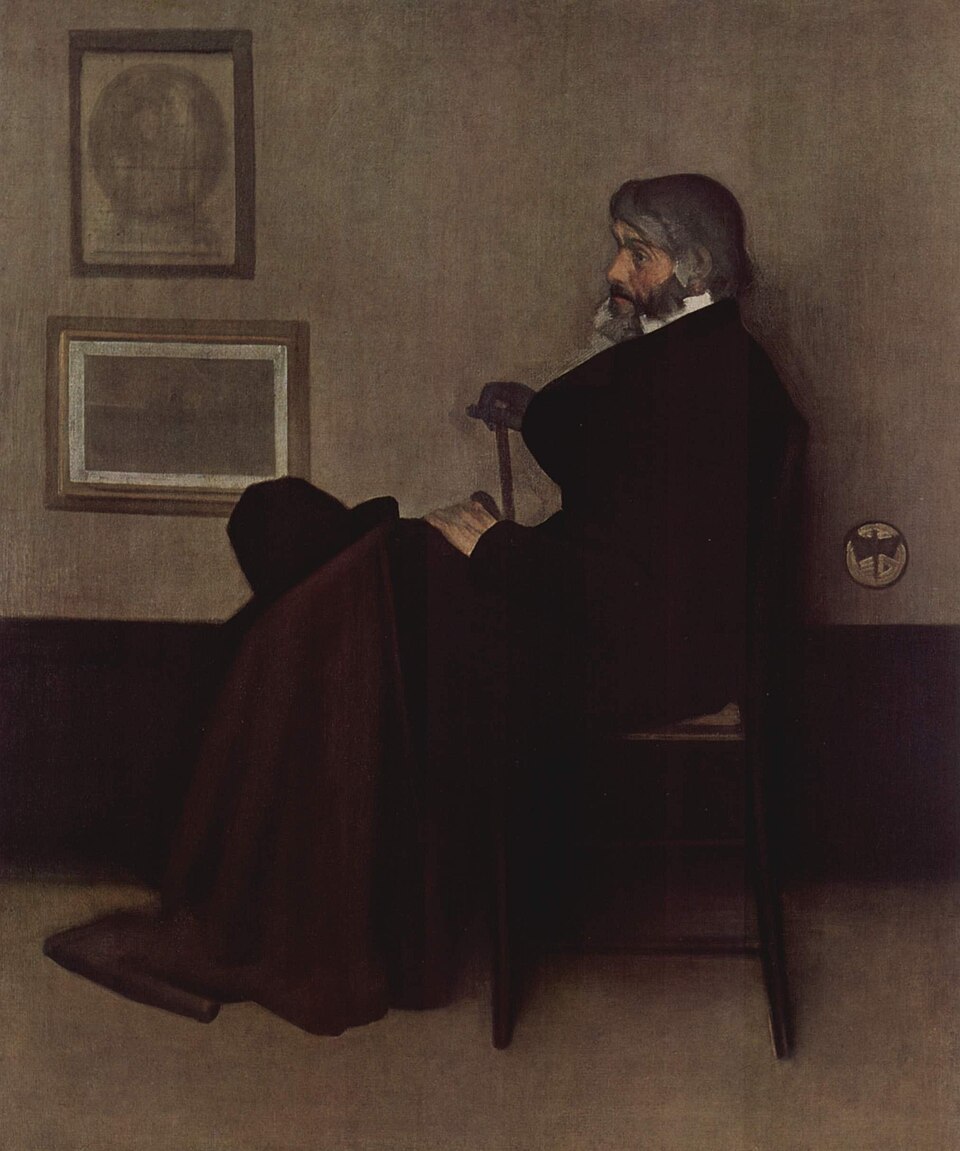
An old man sits in profile against a grey wall, a coat bunched on his lap, his head turned ever so slightly toward us. Thomas Carlyle saw Whistler's portrait of his mother and asked to be painted the same way.
The story behind the painting
By the time he sat for Whistler, Thomas Carlyle had lived in Chelsea for 47 years, at 24 Cheyne Row, very near Whistler's studio at Lindsey House. With a mutual friend he visited the studio and saw the portrait of the artist's mother. Whistler recalled that Carlyle liked its simplicity, the old lady with her hands in her lap, and said he would be painted. He came one morning soon after, sat down, and said: And now, mon, fire away! Whistler asked for two or three sittings, but Carlyle posed from 1872 into the summer of 1873.
What to look for
The composition echoes Whistler's Mother: a profile figure against a flat wall, painted in a range of dark tones. Yet this canvas, about 171 by 143.5 cm, is slightly larger, and the differences matter. Carlyle's head turns subtly toward the viewer, and his coat, thrown over his lap and bunched up, makes a broad, restless shape that recalls the mother's dress. Sketches in the Freer Gallery show Whistler tried other ideas, such as Carlyle at an angle to the wall without the coat, before returning to the flat, planar design.
Meaning and intent
Whistler painted the leading moral philosopher of his time as a nuanced study in shapes and colours, but the result carries a mood of psychological disturbance quite unlike his mother's calm pose. Years later Whistler wrote that he liked the gentle sadness about Carlyle, perhaps sensitive, perhaps misunderstood. That sadness may reflect Carlyle's remorse after the death of his wife Jane Welsh Carlyle in 1866. During the sittings Carlyle wrote in his journal that the world seemed ever more dreary, barren and ugly. The painter Hugh Cameron remembered Carlyle motionless like an Oriental sage while Whistler hopped about like a sparrow.
Legacy
There are four preparatory oil studies and several drawings connected to the painting. The finished portrait was shown at the Paris Salon of 1884, together with Miss Cicely Alexander. In 1891 it became the first painting by Whistler to enter a public collection, when the City of Glasgow acquired it at the insistence of the Glasgow Boys, a group of young painters. It hangs today in the Kelvingrove Art Gallery and Museum in Glasgow, while Carlyle's house on Cheyne Row is preserved as a museum.
Le saviez-vous ?
- Carlyle sat for Whistler from 1872 into summer 1873.
- Composition modelled on the portrait of Whistler's mother.
- Shown at the Paris Salon of 1884.
- Whistler's first painting in a public collection, Glasgow, 1891.
À propos de l'artiste
James Abbott McNeill Whistler (1834-1903)
Autres œuvres de James Abbott McNeill Whistler
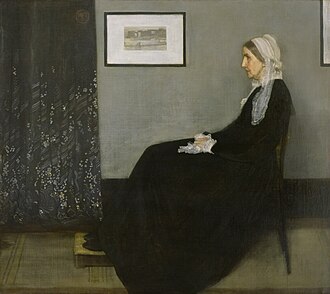 Arrangement en gris et noir n°1 - James McNeill Whistler (1871)
%201862.jpg) Symphonie en blanc n°1 : la jeune fille en blanc - James McNeill Whistler (1860s)
Symphonie en blanc n°1 : la jeune fille en blanc - James McNeill Whistler (1860s) Nuit en noir et or, la fusée qui retombe - James McNeill Whistler (1875)
 Nocturne: Blue and Silver – Chelsea - James McNeill Whistler (1871)
%201864.jpg) Symphony in White, No. 2: The Little White Girl - James McNeill Whistler (1864)
Symphony in White, No. 2: The Little White Girl - James McNeill Whistler (1864)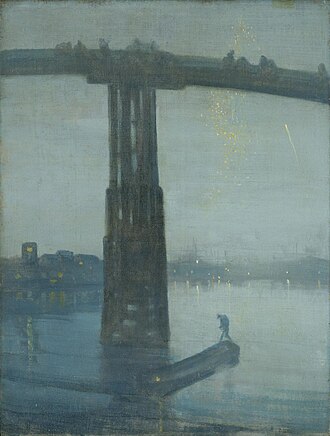 Nocturne en bleu et or - le Vieux Pont de Battersea - James McNeill Whistler (1872)
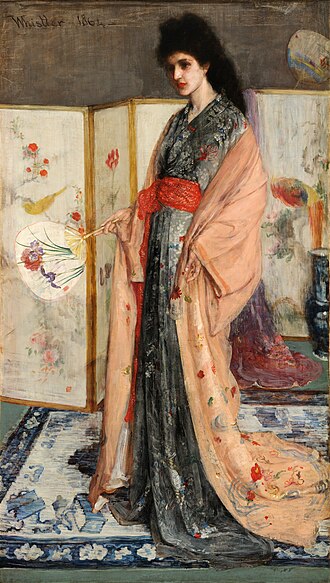 La Princesse du pays de la porcelaine - James McNeill Whistler (1860s)
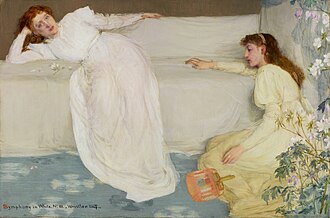 Symphonie en blanc n° 3 - James McNeill Whistler (1860s)