Autoportrait au chapeau tyrolien
Lovis Corinth · 1913
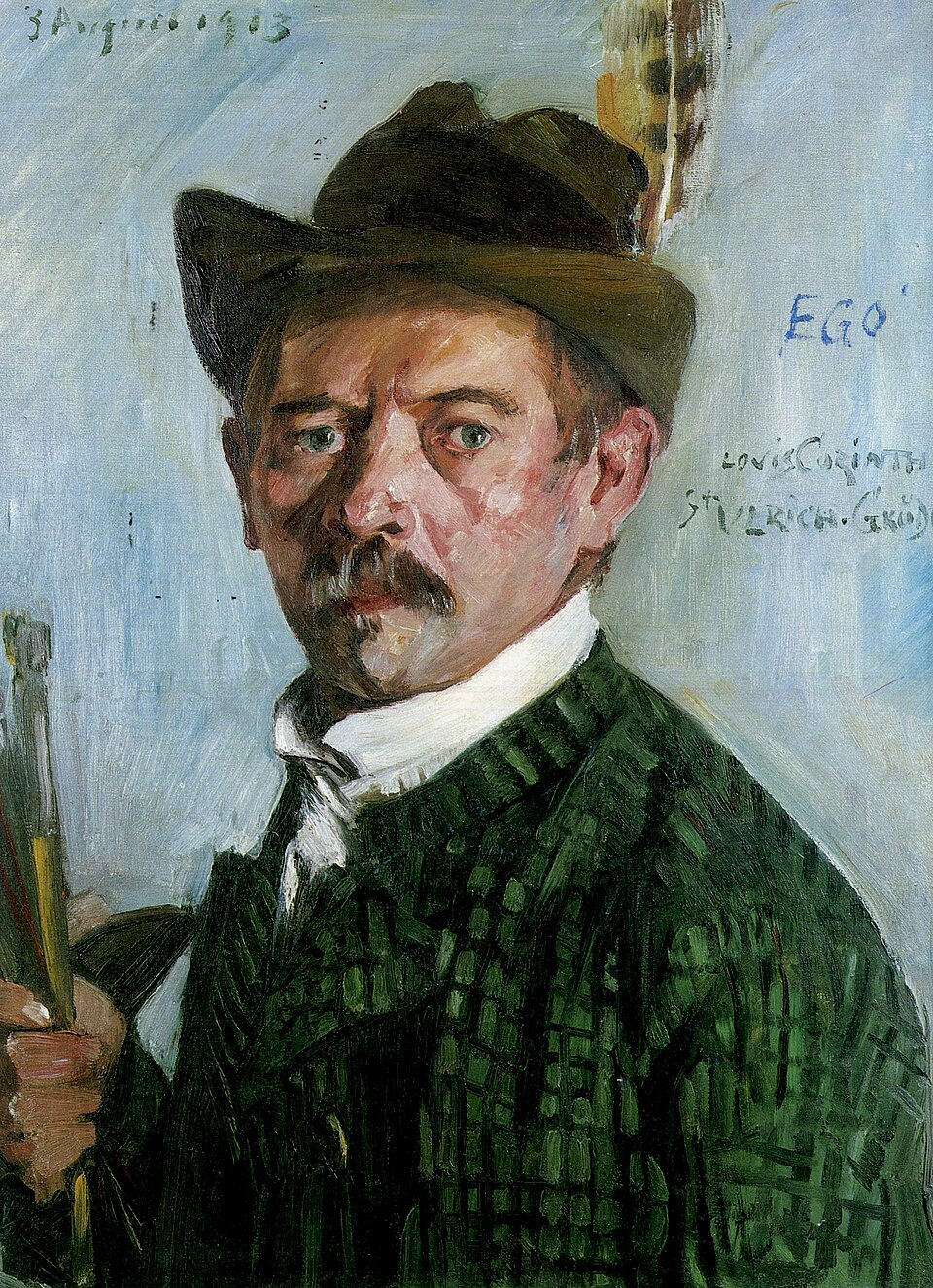
A Tyrolean hat with a pheasant feather, a checked jacket, brushes and palette in hand: on holiday in the Alps in 1913, a year and a half after a stroke, Lovis Corinth signed himself simply EGO.
The story behind the painting
Corinth painted this self-portrait in 1913 during a family holiday in St. Ulrich in Groden, in South Tyrol, a trip meant for rest and recovery. The family had stayed there before, in 1911. In December 1911 Corinth had suffered a first severe stroke that paralysed the right side of his face and parts of the right side of his body. During the 1913 holiday he also painted his daughter, his wife and the landscapes around St. Ulrich. The picture is dated in the upper left corner 5 August 1913, and beside the head it is inscribed EGO, Lovis Corinth, St. Ulrich, Groden.
What to look for
Corinth shows himself in a chest-length portrait in the local South Tyrolean dress: a checked jacket in green and black, which his wife Charlotte Berend-Corinth catalogued as a black linen jacket checked in green, over a white shirt with a high collar. On his head is a Tyrolean hat with a broad leather band and a pheasant feather. In the lower left corner his right hand holds several brushes and a palette. His chest turns left but his face looks straight at us, its right half slightly in shadow. The background is white and pale blue, so the strong colours of the figure stand out.
Meaning and intent
Corinth painted many self-portraits, usually one a year around his birthday, so that together they record his whole life. This one followed the Self-Portrait with Black Hat, the first after his stroke, which was marked by despair; Charlotte Berend-Corinth called that one the first of many self-portraits to carry a deeply sad expression. Compared with it, the Tyrolean hat portrait seems more balanced despite the stern gaze. The stroke also changed how he placed himself: after 1912 he usually painted the paralysed half of his face turned away and in shadow, and his self-portraits grew more serious.
Legacy
Until 1917 the painting belonged to the collector O. Hermes, and in 1918 the Museum Folkwang in Essen bought it. On 25 August 1937, under National Socialism, it was confiscated with about 1400 other works from the museum in the Degenerate Art campaign, and in 1938 it was kept for the German Reich without compensation. On 24 November 1939 it was exchanged with the dealer Bernhard A. Bohmer in Gustrow for a painting by Wilhelm Busch. It then passed into private hands, until in 1967 the Museum Folkwang bought it back through the Resch gallery in Gauting.
Le saviez-vous ?
- Painted on 5 August 1913 in St. Ulrich in Groden, South Tyrol.
- Made about a year and a half after Corinth's first stroke.
- Seized as Degenerate Art in 1937.
- Bought back by the Museum Folkwang in 1967.
À propos de l'artiste
Lovis Corinth (1858-1925)
homme · autoportrait · musée Folkwang · Lovis Corinth
Autres œuvres de Lovis Corinth
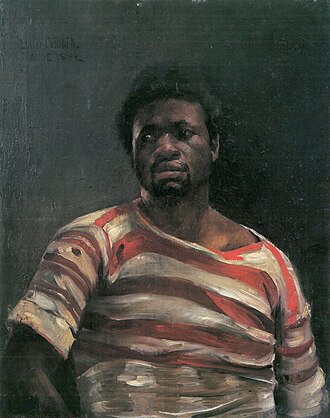 Le Nègre Othello - Lovis Corinth (1884)
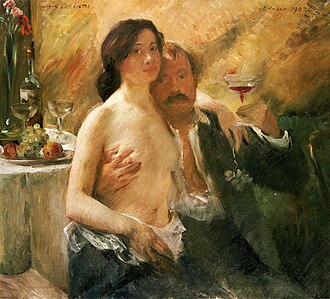 Self portrait with his wife Charlotte Berend-Corinth and a sekt glass - Lovis Corinth (1902)
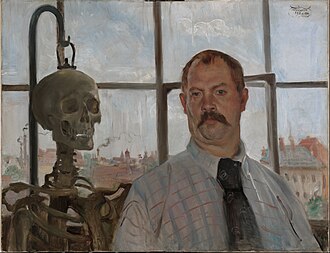 Autoportrait au squelette - Lovis Corinth (1896)
 Innocentia - Lovis Corinth (1890)
 Susanna in the Bath - Lovis Corinth (1890)
 The Red Christ - Lovis Corinth (1922)
 Reading Woman - Lovis Corinth (1911)
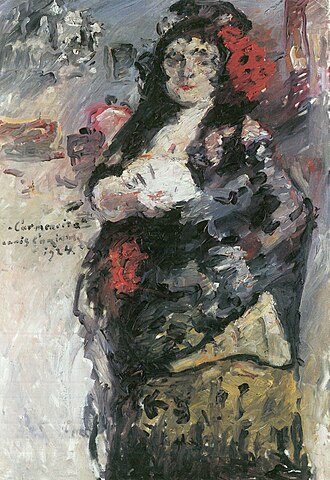 Carmencita - Lovis Corinth (1924)