Nature morte au profil de Laval
Paul Gauguin · 1886
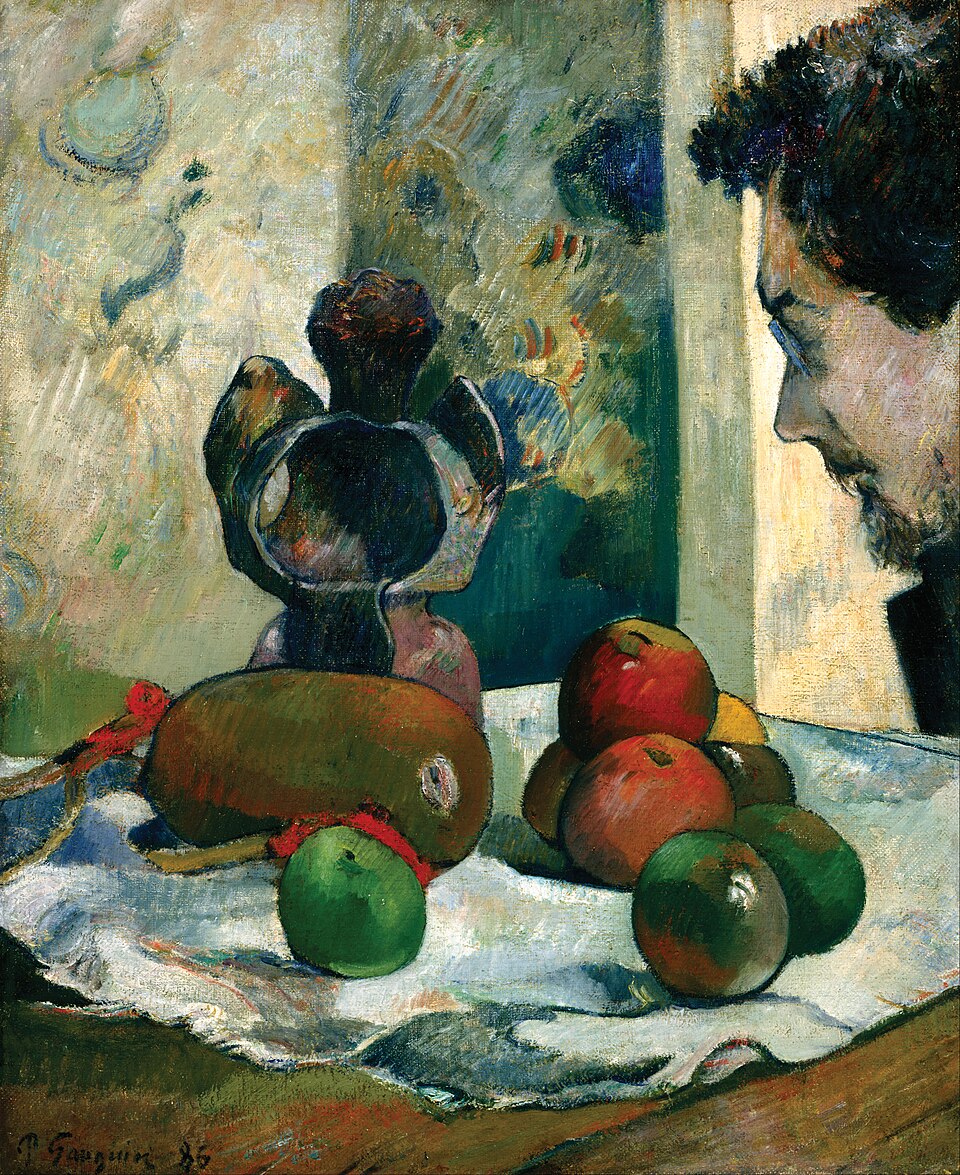
A young painter's face, cut off at the edge of the canvas, stares at a strange clay pot among the fruit. The pot was made by Gauguin himself, and so, in a way, is the riddle.
The story behind the painting
Gauguin painted this picture in 1886. Earlier that summer he had met Charles Laval, a younger artist who soon became his pupil. The ceramic pot in the painting helps date it to very late in 1886, after Gauguin had returned to Paris, because the pot was not made until at least October. Gauguin valued his ceramic experiments highly, both as art and as a source of income, and wrote to his wife Mette about this very pot. It cannot be located today and may have been destroyed.
What to look for
The picture is half portrait, half still life. Laval appears in profile at the edge, his face abruptly cut off. Before him lie fruit and other objects, and among them sits the odd ceramic pot Gauguin made, which Laval examines with a quizzical look. Notice the parallel brushstrokes in the fruit and the way the still life is set up: these recall Paul Cézanne. The sharp, off-centre cropping of the face is a tribute to the compositions of Edgar Degas.
Meaning and intent
Gauguin deliberately quotes the two most admired artists of modern life and still life, Degas and Cézanne, then refuses to bring them into harmony. He leaves them disrupted, even incoherent, and inserts himself through the pot, a strange interruption he called a monstrosity. This is the first in his series of paintings about the challenges of creativity. Laval's fixed gaze on his teacher's pot shows his role as pupil, and he stands in for the viewer, trying to guess what Gauguin will do next.
Legacy
The painting belongs to the circle of Pont-Aven, where Gauguin, Laval and Émile Bernard worked. Van Gogh suggested a portrait exchange among this small group to build a sense of community, a tradition known as the Freundschaftsbild, and by painting each other in new styles they announced their turn from naturalism to Symbolism. In 1998 the Indianapolis Museum of Art acquired this work in a group of Gauguin and Pont-Aven pieces assembled by the Swiss collector Samuel Josefowitz in the 1950s and 1960s. It hangs there under number 1998.167.
Le saviez-vous ?
- Painted late in 1886, after Gauguin met Charles Laval.
- The ceramic pot was made by Gauguin and is now lost.
- Quotes both Degas and Cézanne.
- Acquired by the Indianapolis Museum of Art in 1998.
À propos de l'artiste
Paul Gauguin (1848-1903)
portrait · homme · table · nature morte · Musée d'Art d'Indianapolis · fruit comestible · mur · pomme · pot
Autres œuvres de Paul Gauguin
 D'où venons-nous ? Que sommes-nous ? Où allons-nous ? - Paul Gauguin (1897-1898)
%201889.jpg) Le Christ jaune - Paul Gauguin (1889)
Le Christ jaune - Paul Gauguin (1889)%201892%2C%20oil%20on%20canvas%2C%20101%20x%2077%20cm.jpg) Quand te maries-tu ? - Paul Gauguin (1892)
Quand te maries-tu ? - Paul Gauguin (1892) Femmes de Tahiti - Paul Gauguin (1890)
.jpg) Vision après le sermon - Paul Gauguin (1888)
Vision après le sermon - Paul Gauguin (1888)Manaò tupapaú - Paul Gauguin (1892)
 Vincent van Gogh peignant les tournesols - Paul Gauguin (1888)
%20The%20Metropolitan%20Museum%20of%20Art1.jpg) Ia Orana Maria - Paul Gauguin (1891)
Ia Orana Maria - Paul Gauguin (1891)
Œuvres d'artistes liés
 La Nuit étoilée - Vincent van Gogh (1889)
.jpg) Terrasse du café le soir - Vincent van Gogh (1888)
Terrasse du café le soir - Vincent van Gogh (1888) Bal du moulin de la Galette - Pierre-Auguste Renoir (1876)
 Le Déjeuner des canotiers - Pierre-Auguste Renoir (1881)
 Les Grandes Baigneuses - Paul Cézanne (1900s)
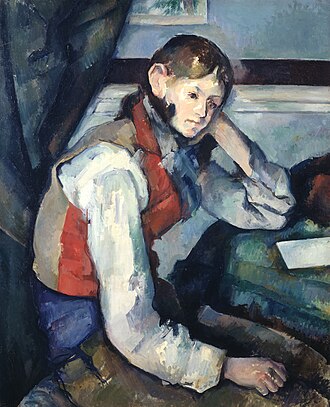 Le Garçon au gilet rouge - Paul Cézanne
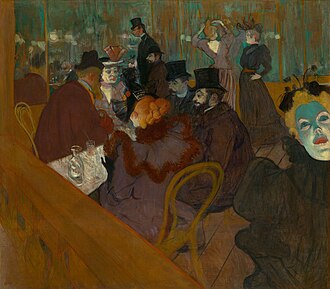 Au Moulin-Rouge - Henri de Toulouse-Lautrec (1892)
%20Rousse%20(La%20Toilette)%20-%201889%20-%20Henri%20de%20Toulouse-Lautrec%20-%20Mus%C3%A9e%20d'Orsay%2C%20Paris.jpg) La Toilette - Henri de Toulouse-Lautrec (1896)
La Toilette - Henri de Toulouse-Lautrec (1896)