Autoportrait aux lunettes
Francisco Goya · 1800
%20Autoportrait%20aux%20lunettes%2C%20Francisco%20de%20Goya%20y%20Lucientes%2C%20Mus%C3%A9e%20Goya.jpg)
A tired, serious man in green velvet studies us. Around 1800 Goya was at the height of his fame, deaf, and painting himself as a mature man looking back on how far he had come.
The story behind the painting
Around 1800 Goya was at the peak of his glory. He was painter to the king's court, a member of the Academy of San Fernando and the fashionable portraitist of the aristocracy and the wealthy. Struck by deafness, he was also working on more personal themes, wild pictures of witchcraft and cannibalism and the Caprichos. That same year he received the commission for The Family of Charles IV, painted in 1800. Both Jean-Louis Augé, curator of the museum in Castres, and the Goya Foundation in Aragon point out how close this pose is to the painter's own figure in that royal group.
What to look for
Goya shows himself in three-quarter view, his gaze serious and tired, watching the viewer, who is placed in the painter's own position. He wears green velvet and a wide white cravat wrapped around his whole neck, the shoulders barely suggested. Textures come from glazes and plays of light, which give volume to the buttons, while the face and jacket are only dimly lit from the front. The Castres museum notes that seen up close, the thickly laid glazes look almost anarchic, yet step back and their rightness appears. Take that step back and watch the face come together.
Meaning and intent
For the Goya museum in Castres, the work should above all be read beside the self-portrait Goya painted in his youth, between 1769 and 1775. It has the same format and similar colours, but the young man of the first canvas has become a mature man with some white hair. Set side by side, they measure the road the painter had travelled, comparing the mastery, the brilliance and the economy of means of his prime with those of his beginnings. It is a quiet self-reckoning rather than a display of rank.
Legacy
The picture is known in two versions, one at the Goya Museum in Castres and one at the Bonnat-Helleu Museum in Bayonne. Studies from 2015 state that the Bayonne canvas is the original and came before the one in Castres. Jean-Louis Augé, curator in Castres, agrees that the painting shown in his museum would be an autograph replica of the Bayonne canvas, meaning Goya himself repeated it. So two French museums, a short journey apart, each hold Goya looking at himself around 1800.
Le saviez-vous ?
- Oil on canvas, painted around 1800.
- Two versions exist, in Bayonne and in Castres.
- 2015 studies name the Bayonne canvas as the original.
- The pose recalls Goya's figure in The Family of Charles IV.
À propos de l'artiste
Francisco Goya (1746-1828)
autoportrait · Francisco de Goya · musée Goya
Autres œuvres de Francisco Goya
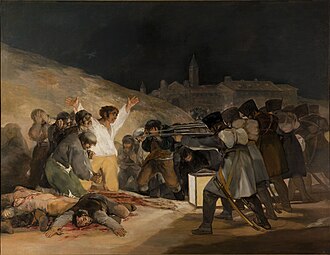 Tres de Mayo - Francisco Goya (1814)
.jpg) La Maja nue - Francisco Goya (1800)
La Maja nue - Francisco Goya (1800).jpg) Saturne dévorant un de ses enfants - Francisco Goya (1819)
Saturne dévorant un de ses enfants - Francisco Goya (1819)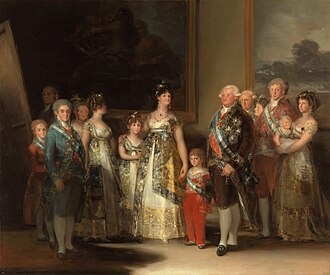 La Famille de Charles IV - Francisco Goya (1800)
 La Maja vêtue - Francisco Goya (1800)
 Dos de Mayo - Francisco Goya (1814)
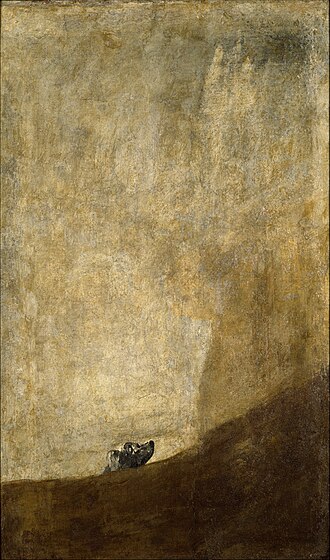 Le Chien - Francisco Goya (1819)
 Le Sabbat des sorcières - Francisco Goya (1820s)
Œuvres d'artistes liés
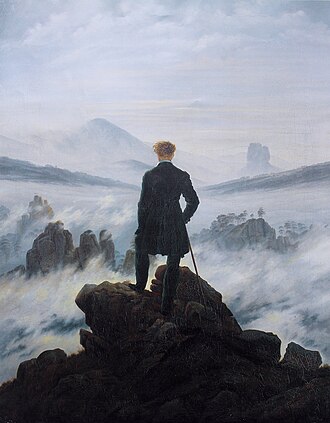 Le Voyageur contemplant une mer de nuages - Caspar David Friedrich (c. 1818)
 L'Abbaye dans une forêt de chênes - Caspar David Friedrich (1800s)
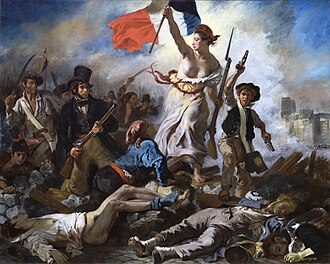 La Liberté guidant le peuple - Eugène Delacroix (1830)
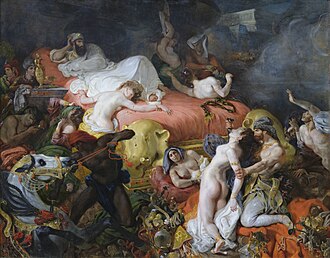 La Mort de Sardanapale - Eugène Delacroix (1827)
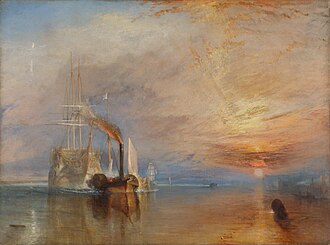 Le Dernier Voyage du Téméraire - J. M. W. Turner (1839)
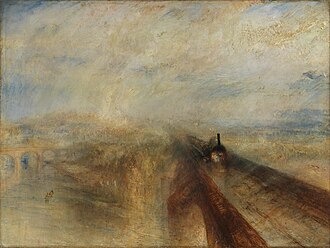 Pluie, Vapeur et Vitesse - J. M. W. Turner (1844)
.jpg) L'Enfant bleu - Thomas Gainsborough (1770)
L'Enfant bleu - Thomas Gainsborough (1770).jpg) Les Époux Andrews - Thomas Gainsborough (1748)
Les Époux Andrews - Thomas Gainsborough (1748)