Autoportrait en joueuse de luth
Artemisia Gentileschi · 1610s
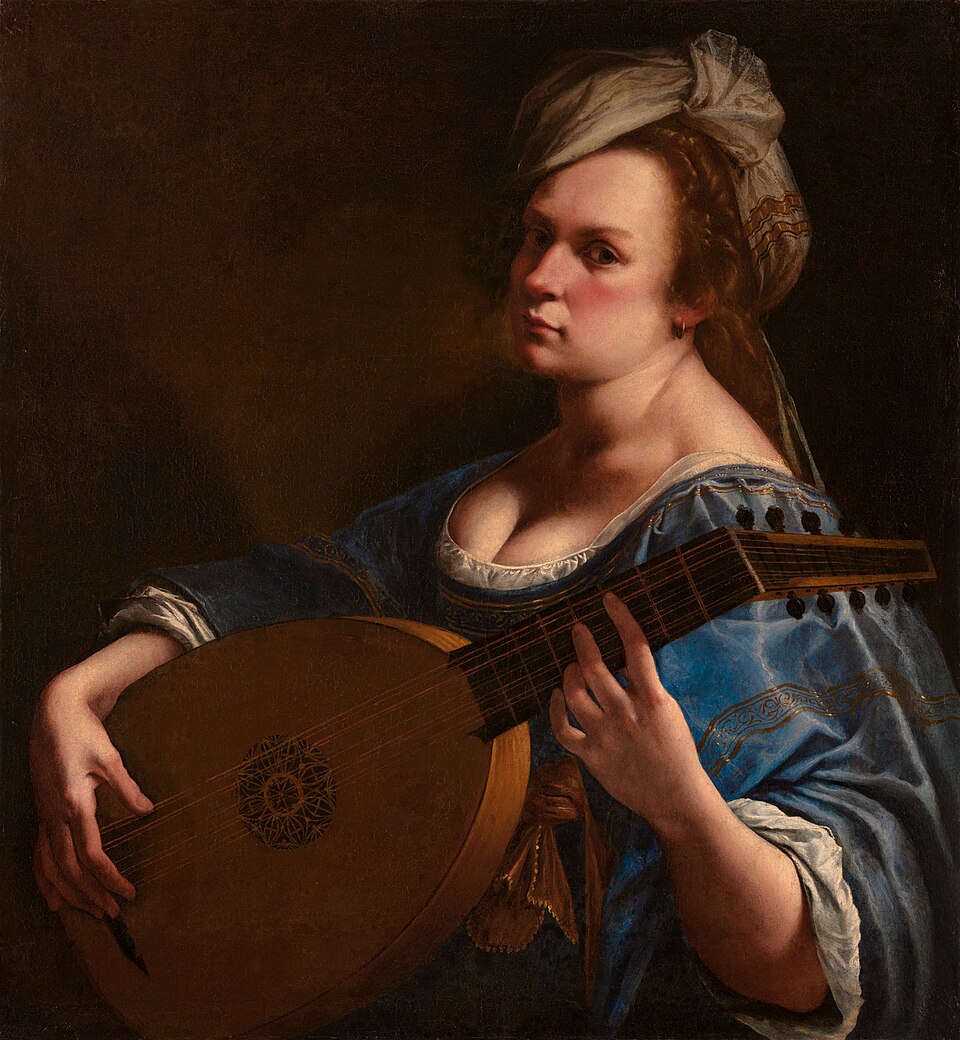
Out of a black ground, Artemisia Gentileschi turns her lute and her face towards us at once, dressed as a Romani musician in gold-stitched cloth. Is she a learned musician, a performer in costume, or simply playing with who she could be? Historians still disagree.
The story behind the painting
Gentileschi painted this self-portrait between 1615 and 1617 in Florence, where she had moved after marrying, following the fourteen-month rape trial against Agostino Tassi in Rome. Wikidata gives only the 1610s. A 1638 inventory of the Medici Villa at Artimino lists a portrait of Gentileschi playing a lute by her own hand, at a size matching this canvas, 77.5 by 71.8 centimetres. The timing and the Medici link suggest it may have been commissioned by Grand Duke Cosimo II. The Medici also supported her entry into the male-dominated Accademia del Disegno.
What to look for
She is shown from the waist up, body turned to the right, head tilted left towards us, lit as if by a spotlight against solid black, a Caravaggesque contrast learned through her father Orazio. Instead of holding the lute flat against her body, she turns it the same way as her face so we can see it, and the accurate fingering suggests she knew the instrument. A white cloth stitched with gold wraps her head, with chestnut hair slipping out. Her cheeks are pink, her blue overgown worked with gold thread, and she looks straight at us.
Meaning and intent
The interpretations differ. The headscarf and low-cut blouse mark her as a Romani musician, a figure of court entertainment; Mary Garrard links the turban to a drawing of Michelangelo, as a hidden sign of artistry. A Medici court record of the Ballo delle Zingare mentions a Signora Artimisia singing as a Romani, assumed to be her. Judith Mann raises the idea of a self-portrait as a courtesan, which Locker finds unlikely given her family's efforts to clear their name. Garrard sees her trying on an identity safely. The source notes she was known for singing, not lute playing.
Legacy
Since the missing deceived victim of the usual Romani scene is absent and she meets our eyes, the viewer may be the one being fooled, playing on painters' reputation as deceivers. The pose, head angle and turban closely match her self-portraits as Saint Catherine of Alexandria in the Uffizi and in London, suggesting she reused one outline to build her name in Florence. After 1638 the painting's whereabouts are unknown until a sale at Sotheby's London in 1998. It now hangs in the Wadsworth Atheneum Museum of Art in Hartford, Connecticut.
Le saviez-vous ?
- Painted around 1615 to 1617 in Florence, probably for the Medici.
- Listed in a 1638 inventory of the Medici Villa at Artimino.
- Shows the artist dressed as a Romani musician.
- Now in the Wadsworth Atheneum Museum of Art, Hartford.
À propos de l'artiste
Artemisia Gentileschi (1593-1653)
femme · autoportrait · musicien ou musicienne · luth · Artemisia Gentileschi · Wadsworth Atheneum
Autres œuvres de Artemisia Gentileschi
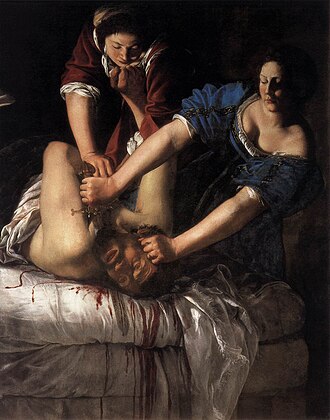 Judith décapitant Holopherne - Artemisia Gentileschi (1613)
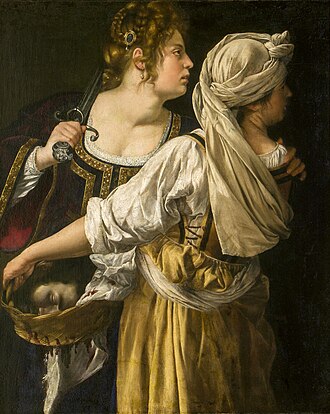 Judith et sa Servante - Artemisia Gentileschi (1618)
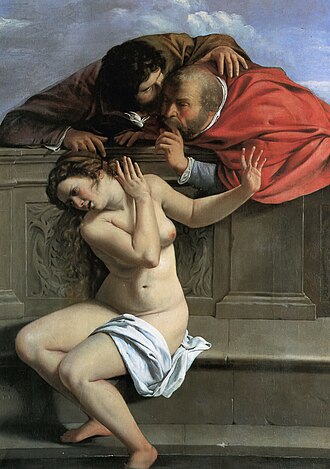 Suzanne et les Vieillards - Artemisia Gentileschi (1610)
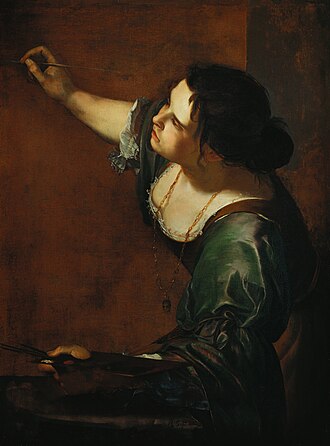 Autoportrait en allégorie de la Peinture - Artemisia Gentileschi (1638)
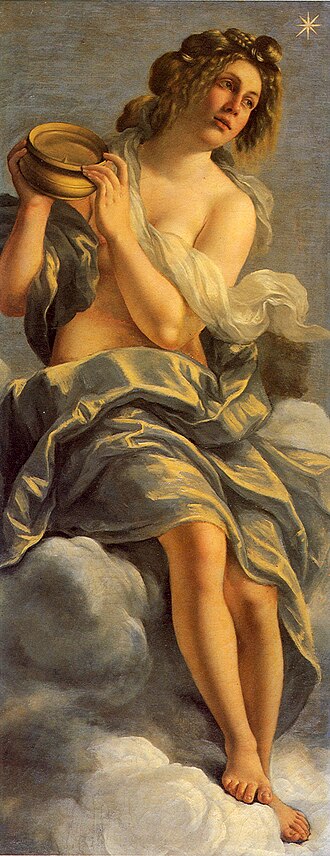 Allégorie de l'Inclination - Artemisia Gentileschi (1615)
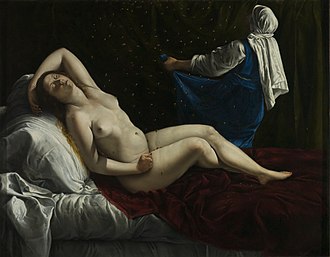 Danaé - Artemisia Gentileschi (1612)
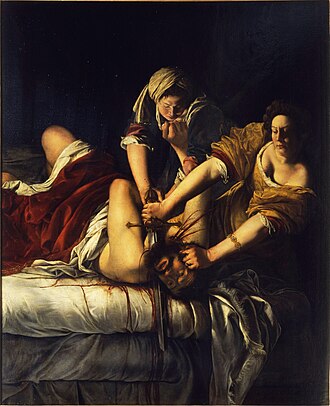 Judith décapitant Holopherne - Artemisia Gentileschi (1620)
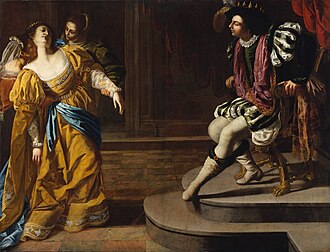 Esther et Assuérus - Artemisia Gentileschi (1620s)
Œuvres d'artistes liés
 Le Souper à Emmaüs - Caravaggio (1601)
 La Vocation de saint Matthieu - Caravaggio (1609)
 Les Ménines - Diego Velázquez (1656)
 La Reddition de Bréda - Diego Velázquez (1635)
 Saint Francis in Meditation - Francisco de Zurbarán (1639)
 The Immaculate Conception - Francisco de Zurbarán (1661)
 Triple portrait de Charles Ier - Anthony van Dyck (1635)
 Charles Ier à cheval avec Monsieur de Saint Antoine - Anthony van Dyck (1636)
 L'Érection de la croix - Peter Paul Rubens (1609)
 L'Enlèvement des filles de Leucippe - Peter Paul Rubens (1618)
 La Ronde de nuit - Rembrandt van Rijn (1642)
 Autoportrait - Rembrandt van Rijn (1659)