Autoportrait en allégorie de la Peinture
Artemisia Gentileschi · 1638
%20-%20Artemisia%20Gentileschi.jpg)
A woman leans hard into her work, brush raised, hair tumbling loose, a gold chain at her throat. Artemisia Gentileschi may have painted herself as Painting itself, something no male artist of her day could have done in quite the same way.
The story behind the painting
The canvas, 98.6 by 75.2 cm, was probably painted during Artemisia Gentileschi's stay in England between 1638 and 1639. Born in Rome in 1593, she trained in the workshop of her father Orazio. In the 1610s she was raped by Agostino Tassi, an older member of that workshop, an event that coloured the rest of her life and her art. The picture belonged to King Charles I. When the royal collection was dispersed it passed to a lawyer, John Jackson, recorded in 1651, and was recovered for Charles II after 1660.
What to look for
The figure is built on diagonals that carry her movement in toward the canvas and out toward us, with bold foreshortening. Light falls harshly from an unseen source on the left, and a sharp line divides light from dark across her forehead, cheeks, neck and shoulder. Look at the wisps of loose hair, the crinkled sleeve with spilled paint cracking near the wrist, and the dirty hands. The gold chain shimmers at the neck, while the mask pendant fades into brown. Her initials sit below the palette.
Meaning and intent
Cesare Ripa's Iconologia described Painting as a beautiful woman with dishevelled black hair, arched brows, a gold chain with a mask, holding brush and palette, her mouth covered by a cloth. Apart from the cloth, Artemisia follows this closely. Because allegories were female figures, art historian Mary Garrard argues that only a woman could show herself this way, as both self-portrait and allegory. Some critics found the idea egotistical. The reading as a self-portrait was first proposed by Michael Levey in the 20th century and is not universally accepted, since some historians find the features too different from her other portraits.
Legacy
The painting returned to the Royal Collection at the Restoration in 1660 and remains there. A cleaning in 1972 removed later overpainting, and the thin paint of the background still gives an unfinished impression. In 2015 it went on display in the Cumberland Gallery at Hampton Court Palace. Today it is often overshadowed by her more dramatic scenes such as Judith Slaying Holofernes, yet it stands as a rare and bold statement from a time when women seldom held professions, let alone became famous for them.
Le saviez-vous ?
- Probably painted in England in 1638-1639.
- Owned by Charles I and back in the Royal Collection since 1660.
- Follows Cesare Ripa's description of Painting, except the cloth over the mouth.
- Its status as a self-portrait is debated.
À propos de l'artiste
Artemisia Gentileschi (1593-1653)
femme · cheveux longs · autoportrait · allégorie · cheveux noirs · Royal Collection · chignon · artiste peintre · pinceau · palette
Autres œuvres de Artemisia Gentileschi
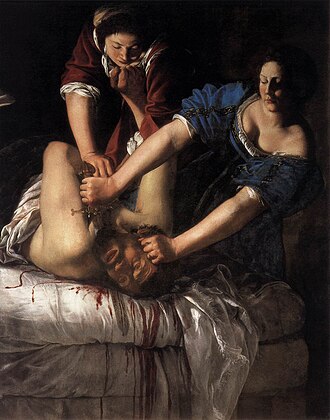 Judith décapitant Holopherne - Artemisia Gentileschi (1613)
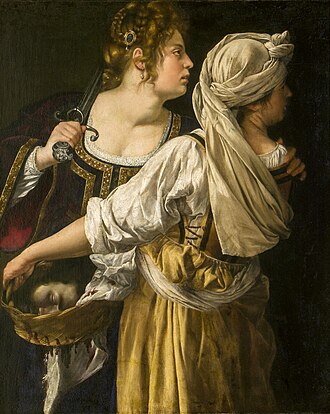 Judith et sa Servante - Artemisia Gentileschi (1618)
%2C%20Artemisia%20GentileschiFXD.jpg) Suzanne et les Vieillards - Artemisia Gentileschi (1610)
Suzanne et les Vieillards - Artemisia Gentileschi (1610)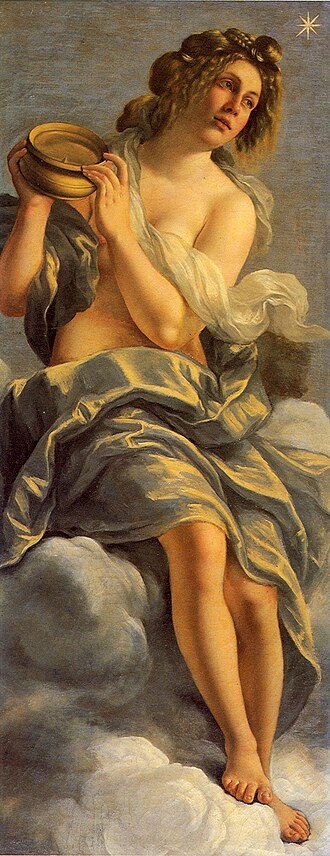 Allégorie de l'Inclination - Artemisia Gentileschi (1615)
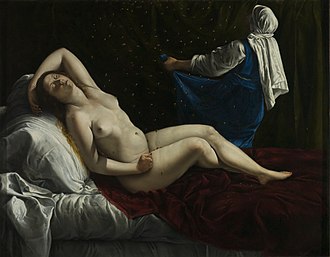 Danaé - Artemisia Gentileschi (1612)
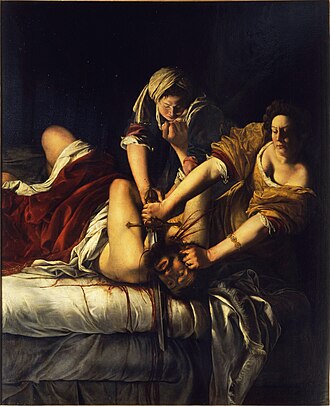 Judith décapitant Holopherne - Artemisia Gentileschi (1620)
 Esther et Assuérus - Artemisia Gentileschi (1620s)
 Marie Madeleine - Artemisia Gentileschi (1616)