Scène de la vie tahitienne
Paul Gauguin · 1896
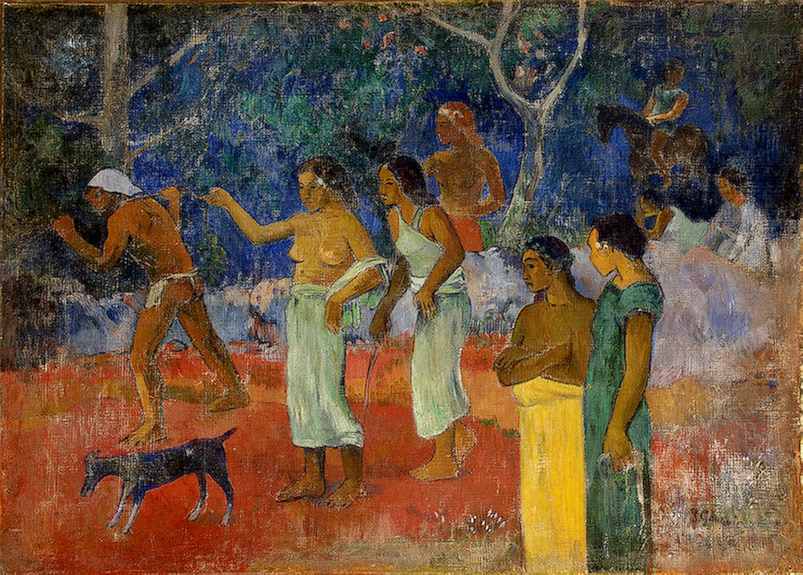
Under a dusky blue sky, a man with a dog walks past, and every other figure turns to look at him. Gauguin painted this Tahitian scene in 1896 with cheap paints, and the canvas has been fading ever since.
The story behind the painting
Gauguin painted the picture in 1896, during his Tahitian period, and it is now in the Hermitage Museum in Saint Petersburg. As soon as it reached Paris it was shown at Ambroise Vollard's gallery. In November 1908 it was bought by the Moscow industrialist and collector Sergei Shchukin. Its title is uncertain: according to N. Semenova, it received its present name while in Shchukin's collection, but Pyotr Pertsov, who first catalogued that collection in 1921, says it was listed under the short title Tahitians. The canvas measures 89 by 124 cm.
What to look for
The Tahitian men and women fall into four groups against a twilight blue ground. First, a man in a loincloth and white hat, a dog at his feet, carries a stick, perhaps a spear, on his shoulders. Next come three women: one points toward the man with the dog, the second leans toward her as if listening closely, the third, further back, watches the man. Two more women stand and look on with indifference. Far off at upper right, a rider sits motionless under a tree, and at the horse's feet two women, one lying and one sitting, also watch. At lower right are the remains of the signature, P Gauguin.
Meaning and intent
The source does not tell us what the gathering means, and that is part of its pull. The painting is built on looks: almost every figure is turned toward the man with the dog and the women pointing and listening, while two others stand apart, indifferent. Even the distant rider and the women at his horse's feet are drawn into this circle of attention. Whatever news or event has caught them, Gauguin leaves it unspoken, and the viewer becomes one more watcher in the crowd, trying to read the scene from gestures alone.
Legacy
Gauguin used poor-quality paints, and the picture has deteriorated badly. The lower right corner with the signature suffered most: in 1918, when the work was registered at the Museum of New Western Art in Moscow, a date, 96, was noted beside the signature, and it can no longer be read. It has been suggested that the damage happened before Shchukin bought it, perhaps during the sea voyage from Tahiti to Paris, and a reproduction in Apollo magazine in 1910 already shows it damaged. After the October Revolution the collection was nationalised; the painting was in Moscow from 1923 and moved to the Hermitage in 1930. Since late 2014 it has hung in room 413 of the General Staff Building.
Le saviez-vous ?
- Painted in Tahiti in 1896.
- Bought by Moscow collector Sergei Shchukin in 1908.
- Badly deteriorated because Gauguin used poor-quality paints.
- In the Hermitage Museum since 1930.
À propos de l'artiste
Paul Gauguin (1848-1903)
Autres œuvres de Paul Gauguin
 D'où venons-nous ? Que sommes-nous ? Où allons-nous ? - Paul Gauguin (1897-1898)
 Le Christ jaune - Paul Gauguin (1889)
 Quand te maries-tu ? - Paul Gauguin (1892)
 Femmes de Tahiti - Paul Gauguin (1890)
 Vision après le sermon - Paul Gauguin (1888)
Manaò tupapaú - Paul Gauguin (1892)
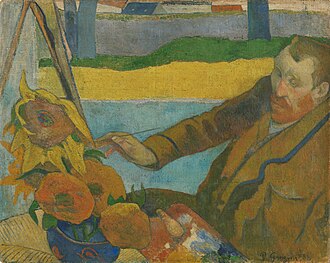 Vincent van Gogh peignant les tournesols - Paul Gauguin (1888)
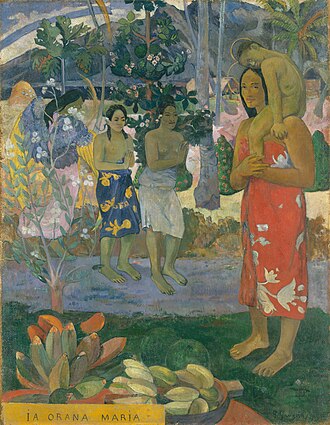 Ia Orana Maria - Paul Gauguin (1891)
Œuvres d'artistes liés
 La Nuit étoilée - Vincent van Gogh (1889)
 Terrasse du café le soir - Vincent van Gogh (1888)
 Promenade au bord de la mer - Joaquín Sorolla (1909)
 Triste héritage - Joaquín Sorolla (1898)
 Les Grandes Baigneuses - Paul Cézanne (1900s)
 Le Garçon au gilet rouge - Paul Cézanne
 Bal du moulin de la Galette - Pierre-Auguste Renoir (1876)
 Le Déjeuner des canotiers - Pierre-Auguste Renoir (1881)
 Au Moulin-Rouge - Henri de Toulouse-Lautrec (1892)
 La Toilette - Henri de Toulouse-Lautrec (1896)