Saint Martin et le Mendiant
Antoine van Dyck · 1621
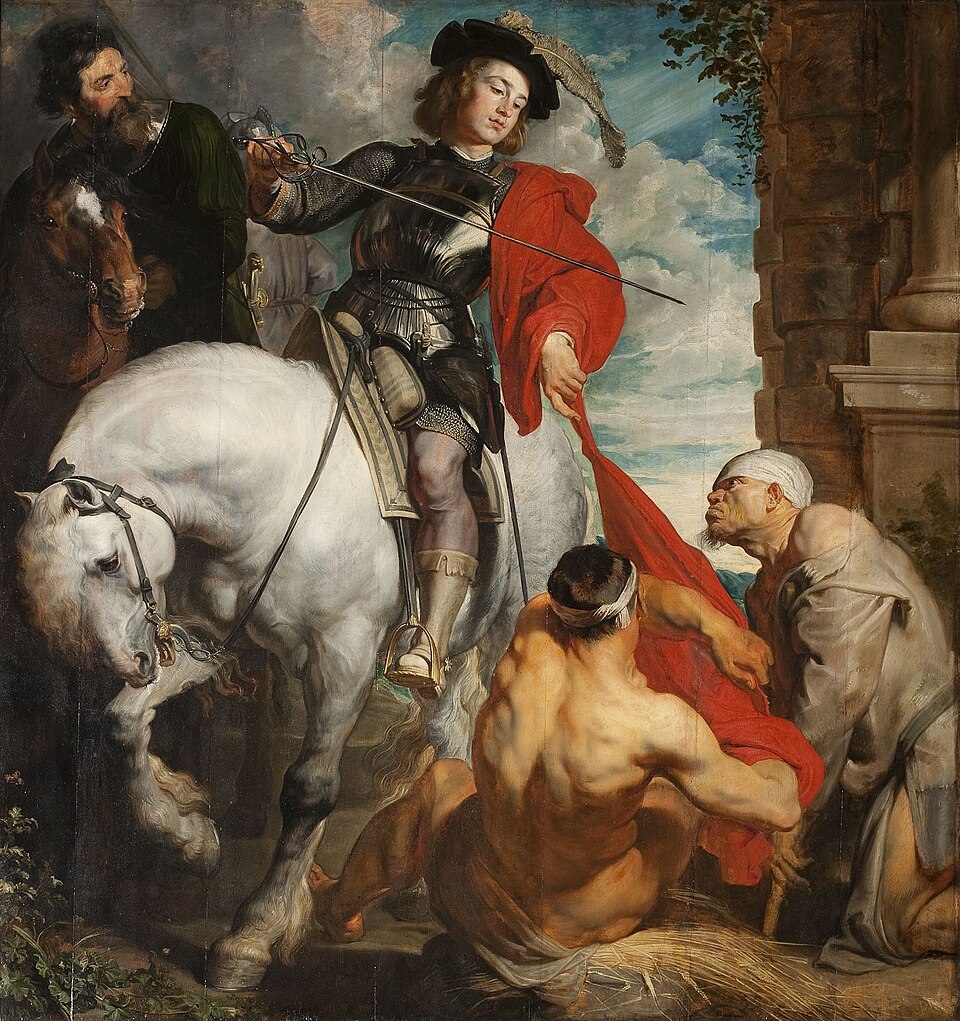
A young soldier on a white horse slices his fire-red cloak in two for a naked beggar. Van Dyck painted this altarpiece while still in Rubens's orbit, and it has hung in a village church in Zaventem for most of four centuries.
The story behind the painting
The scene comes from Sulpicius Severus's life of Martin of Tours. On a winter's day, riding out of the gates of Amiens, the young soldier saw a poor man shivering and cut his cloak in half for him. That night Christ appeared to him wearing the half he had given away. Julius Held suggested the commission first went to Rubens, who handed it to van Dyck, then his assistant. Van Dyck completed it around 1618, and it stayed in his studio until 1621, when Ferdinand van Boisschot, Chancellor of Brabant, gave it to the church of Saint Martin in Zaventem. Wikidata uses 1621, the source about 1618.
What to look for
Martin wears armour and a fashionable hat on a splendid white horse. With the sword in his right hand he has almost cut through his red cloak, while a naked beggar on the ground pulls at one half. Beside him another beggar in rags kneels on crutches. Behind them, a wall with ivy and a column suggests a city gate. Top left, an older rider watches with astonishment, and behind the riders is the silhouette of a helmeted man, then a wide cloudy sky that opens up the depth. The paint is smooth and opaque, almost sculptural, unlike van Dyck's usual loose brushwork.
Meaning and intent
In the legend, Christ told the angels: see how Martin has covered me with his cloak. Martin, a soldier at his father's wish, then left the army to devote himself to his faith. The painting catches the instant before that change, when a privileged young man shares what he has with someone who has nothing. It is regarded as one of van Dyck's most Rubensian works: the figures, the red cloak, the flesh tones bluish in shadow and the whites and greys of the horse all follow Rubens's style.
Legacy
A legend that van Dyck lingered in Zaventem for love of a local woman, Anna van Ophem, has been debunked. Around 1672, during the campaigns of Louis XIV, the painting was taken to Baron van Boisschot's residence in Brussels for safety. In August 1794 the French government had it removed to Paris, where it was shown in the Musée Central in the Louvre. It was returned in 1815 and back in the church in 1816. A later, larger version from around 1620, with a woman, two children and a dog among the beggars, is in the Royal Collection at Windsor Castle.
Le saviez-vous ?
- Painted by van Dyck around 1618, installed in Zaventem in 1621.
- Possibly a commission first given to Rubens.
- Taken to Paris in 1794 and returned in 1815-1816.
- A larger version is in the Royal Collection at Windsor.
À propos de l'artiste
Antoine van Dyck (1599-1641)
Autres œuvres de Antoine van Dyck
 Triple portrait de Charles Ier - Anthony van Dyck (1635)
 Charles Ier à cheval avec Monsieur de Saint Antoine - Anthony van Dyck (1636)
 Charles Ier à la chasse - Anthony van Dyck (1635)
 Autoportrait au tournesol - Anthony van Dyck (1632)
 Lord John Stuart et son frère, lord Bernard Stuart - Anthony van Dyck (1638)
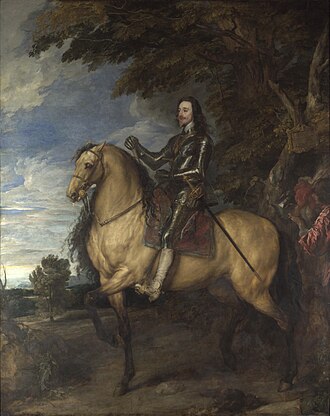 Portrait équestre de Charles Ier - Anthony van Dyck (1637)
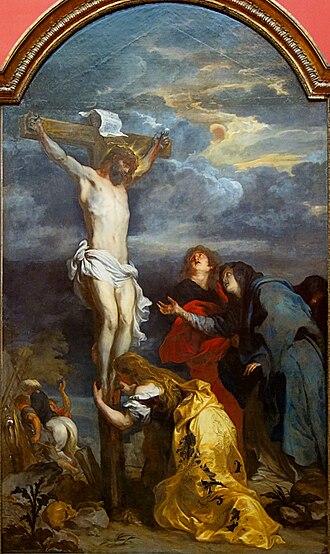 Le Christ en croix - Anthony van Dyck
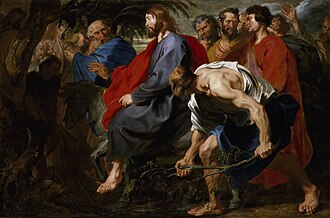 L'Entrée du Christ à Jérusalem - Anthony van Dyck (1617)
Œuvres d'artistes liés
 Le Souper à Emmaüs - Caravaggio (1601)
 La Vocation de saint Matthieu - Caravaggio (1609)
 Les Ménines - Diego Velázquez (1656)
 La Reddition de Bréda - Diego Velázquez (1635)
 Saint Francis in Meditation - Francisco de Zurbarán (1639)
 The Immaculate Conception - Francisco de Zurbarán (1661)
 L'Érection de la croix - Peter Paul Rubens (1609)
 L'Enlèvement des filles de Leucippe - Peter Paul Rubens (1618)
 La Ronde de nuit - Rembrandt van Rijn (1642)
 Autoportrait - Rembrandt van Rijn (1659)
 Le Joyeux Buveur - Frans Hals (1620s)
 Le Cavalier riant - Frans Hals (1624)