Saint Georges terrassant le dragon
Rogier van der Weyden · 1435
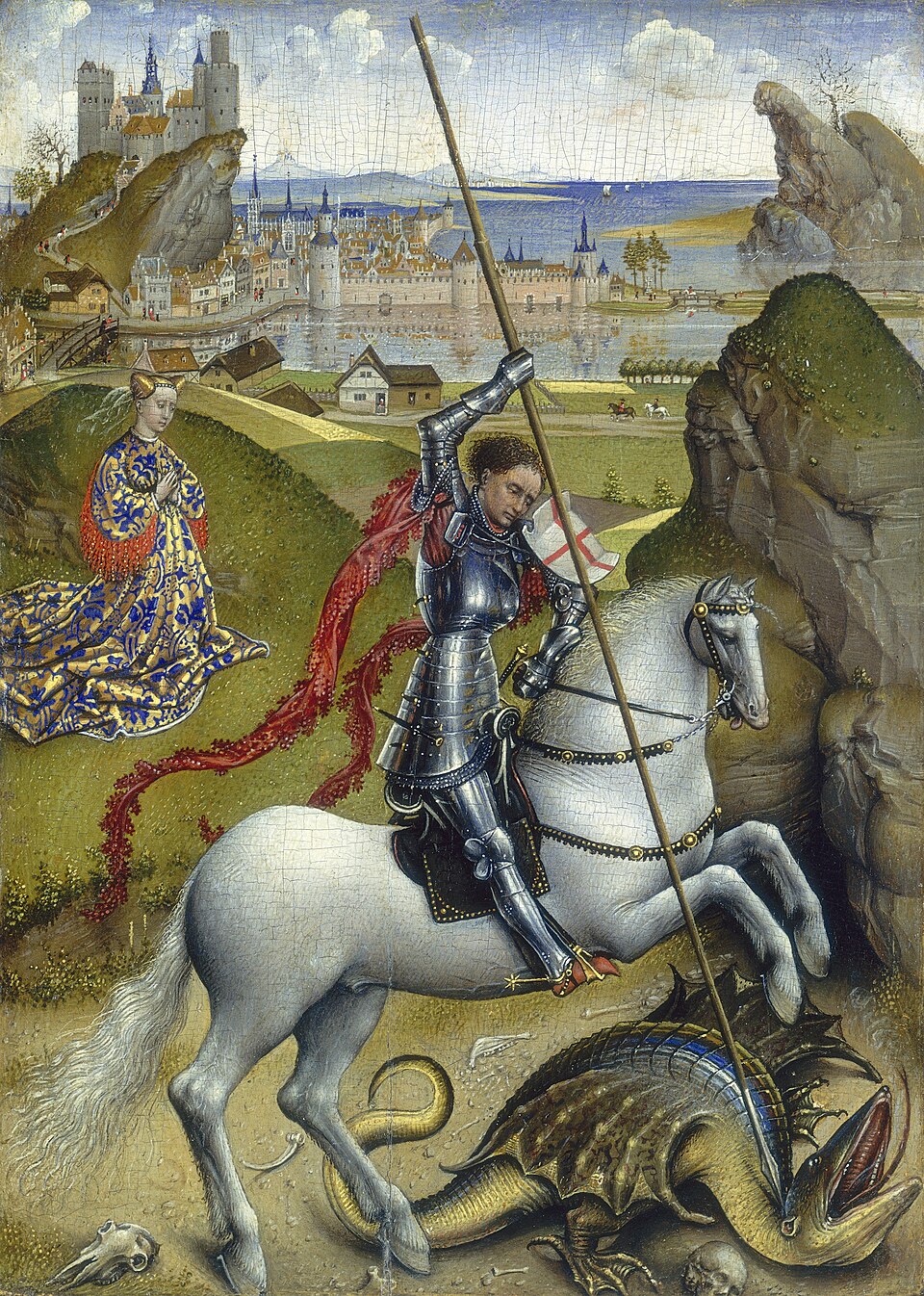
The whole painting is about the size of a postcard, yet behind the knight lies a walled town with people hurrying through the streets and tiny ships on the horizon. Many of them can only be seen with a magnifying glass.
The story behind the painting
Rogier van der Weyden painted this oil on wood panel around 1432 to 1435, early in his career. The legend of Saint George tells of a Roman soldier from Cappadocia who slays a dragon and saves a young woman. In one version the dragon is killed at once; in another it is only subdued, and Princess Cleodolinda, who was to be its sacrifice, ties her girdle around its neck and leads it to the saint for the final blow. Here, as the historians Martha Wolff and John Hand note, the dragon seems pinned to the ground rather than killed.
What to look for
The painted surface is only 14.3 by 10.5 cm, set into a slightly larger board, and both are mounted on a third panel. Saint George, in shining black armour that catches bright reflections, drives his lance into the dragon while the princess kneels behind him in a lavish gown, hands clasped. Behind them stands a realistic but probably imaginary Belgian town, ringed by water, with an oddly shaped cliff rising to a castle. John Hand writes that the astonishing detail must have needed a magnifying device to paint, and infrared images show the princess was not in the underdrawing at all: she was added later, over the already painted hill.
Meaning and intent
The panel may have been made for private devotion, perhaps as one half of a diptych that has since been separated. The legend is set in Anatolia, yet Rogier moves it to a town his viewers might have recognised, blending the realism of Early Netherlandish painting with fantasy in the strange cliff. Saint George becomes an image of chivalry itself. The reflections on the armour and water show the influence of Jan van Eyck, the background cliffs and town echo Robert Campin, and the composition borrows motifs from illuminated manuscripts such as those of the Boucicaut Master.
Legacy
For a long time nobody agreed who painted it. It has been given to Jan and Hubert van Eyck, to Campin and to an unknown follower of either Campin or Jan van Eyck. The historian Hulin de Loo first recognised Rogier's hand, probably during or just after his apprenticeship, and that attribution is now generally accepted, although John Oliver Hand cautions that a workshop member or follower cannot be ruled out. Today the tiny panel is in the National Gallery of Art in Washington.
Le saviez-vous ?
- Painted around 1432 to 1435, an early work by Rogier van der Weyden.
- The painted surface is only 14.3 by 10.5 cm.
- Infrared shows the princess was added after the underdrawing.
- Now in the National Gallery of Art, Washington.
À propos de l'artiste
Rogier van der Weyden (1390s-1464)
art religieux · Primitifs flamands · National Gallery of Art · Georges de Lydda · dragon
Autres œuvres de Rogier van der Weyden
 La Descente de Croix - Rogier van der Weyden (1440s)
 Portrait d'une dame - Rogier van der Weyden (1460)
 Le Jugement dernier - Rogier van der Weyden (1443)
 Saint Luc dessinant la Vierge - Rogier van der Weyden (1490)
 Columba triptyque - Rogier van der Weyden (1450s)
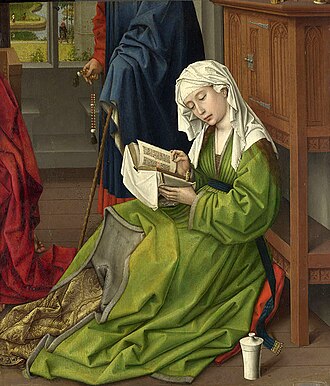 Marie Madeleine lisant - Rogier van der Weyden (1435)
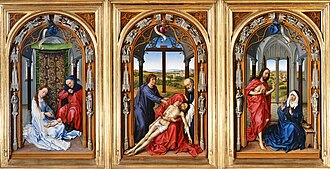 Retable de Miraflores - Rogier van der Weyden (1443)
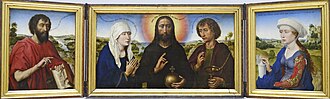 Triptyque de la famille Braque - Rogier van der Weyden (1452)
Œuvres d'artistes liés
 Les Époux Arnolfini - Jan van Eyck (1434)
 L'Agneau mystique - Jan van Eyck (1432)
 L'Annonciation - Hans Memling (1480s)
 Scènes de la Passion du Christ - Hans Memling (1470)
 Le Jardin des délices - Hieronymus Bosch
 La Nef des fous - Hieronymus Bosch (1500s)
 Les Chasseurs dans la neige - Pieter Bruegel the Elder (1565)
 Les Proverbes flamands - Pieter Bruegel the Elder (1551)