Triptyque de la famille Braque
Rogier van der Weyden · 1452
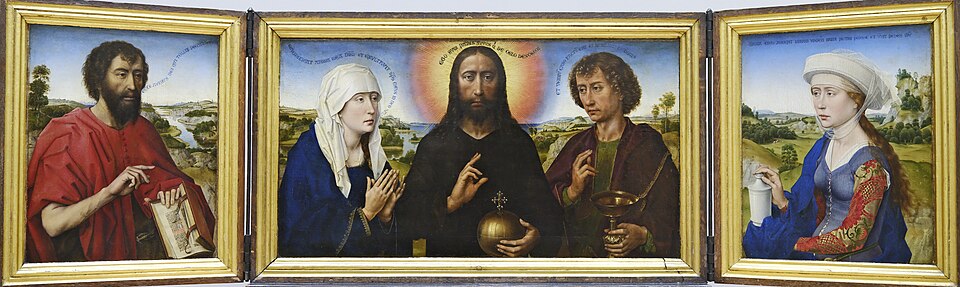
Open it and Christ blesses between the Virgin, two Johns and Mary Magdalene, their words floating in the air. Close it and a skull speaks to you. Rogier van der Weyden painted it for a young widow who never stopped loving her husband.
The story behind the painting
The triptych dates from about 1452 and is the only surviving devotional work by van der Weyden known to have been painted for private rather than public display. It was probably commissioned by Jehan Braque of Tournai or, more likely, by his wife Catherine de Brabant, possibly after Jehan's sudden early death in 1452. They had married in 1450 or early 1451, when she was 20 and some 12 or 13 years younger than he was. Almost 50 years later, though she had remarried, she asked to be buried beside him.
What to look for
Inside, three half-length panels show John the Baptist, Christ as Salvator Mundi between the Virgin and John the Evangelist, and Mary Magdalene in sumptuous, detailed dress, counted among van der Weyden's finest female portraits. The centre panel, 68 cm wide, is almost twice as broad as the wings. Latin words curve from the Baptist's mouth and flow into the Virgin's, while the Magdalene's text runs flat and her raised hand stops the movement. Outside, a yellow-brown skull rests on a broken brick beside the Braque arms, a sheaf of wheat, facing a cross.
Meaning and intent
The texts come from the Gospel of John, except the Virgin's, from Luke. The Magdalene's line is not spoken by her but written about her, which may be why, in Alfred Acres's view, it lacks the grace of the others. On the frame the skull says in French that its body was once beautiful and is now food for worms, and it is meant as a likeness of the dead Jehan. The panel is one of the earliest known skulls in a vanitas. Some historians instead read it as Adam, or a piece of Golgotha.
Legacy
Catherine's will of 1497 left the triptych to her grandson Jehan Villain, and her heirs kept it until 1586. A priest in England then bought it, and it later belonged to the English painter Richard Evans. The Louvre acquired it from Lady Theodora Guest in 1913, seen then as its most important acquisition since 1878. It is still displayed there in its original oak frame, behind glass because of its fragility.
Le saviez-vous ?
- Painted around 1452 in oil on oak.
- The only surviving van der Weyden devotional work made for private display.
- Its closed wings show one of the earliest known vanitas skulls.
- In the Louvre since 1913.
À propos de l'artiste
Rogier van der Weyden (1390s-1464)
art religieux · femme · Marie · département des peintures du musée du Louvre · Jésus-Christ · cheveux longs · Primitifs flamands · Marie de Magdala · livre · Jean le Baptiste · Jean
Autres œuvres de Rogier van der Weyden
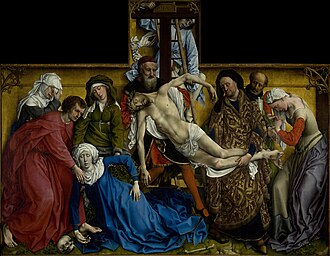 La Descente de Croix - Rogier van der Weyden (1440s)
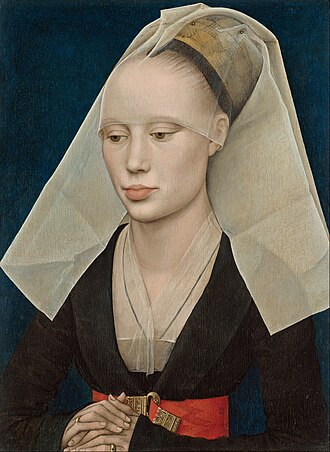 Portrait d'une dame - Rogier van der Weyden (1460)
.jpg) Le Jugement dernier - Rogier van der Weyden (1443)
Le Jugement dernier - Rogier van der Weyden (1443)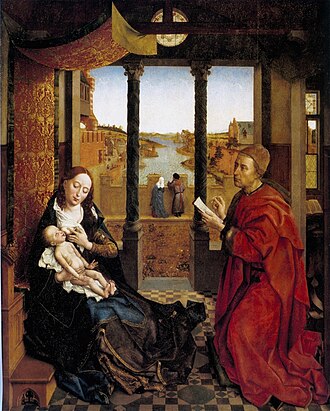 Saint Luc dessinant la Vierge - Rogier van der Weyden (1490)
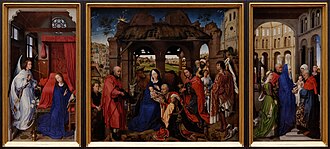 Columba triptyque - Rogier van der Weyden (1450s)
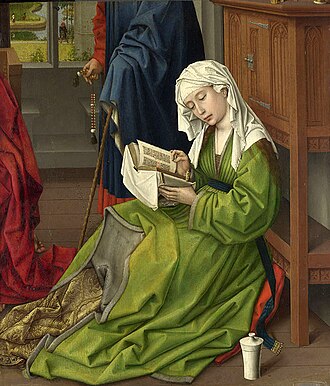 Marie Madeleine lisant - Rogier van der Weyden (1435)
%20-%20Prado%20P02722.jpg) Madone Durán - Rogier van der Weyden (1430s)
Madone Durán - Rogier van der Weyden (1430s)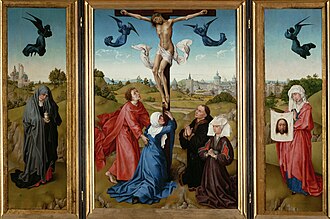 Triptyque de la Crucifixion - Rogier van der Weyden (1440s)
Œuvres d'artistes liés
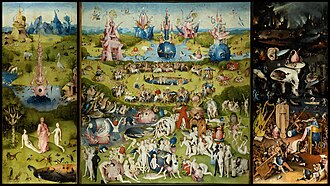 Le Jardin des délices - Hieronymus Bosch
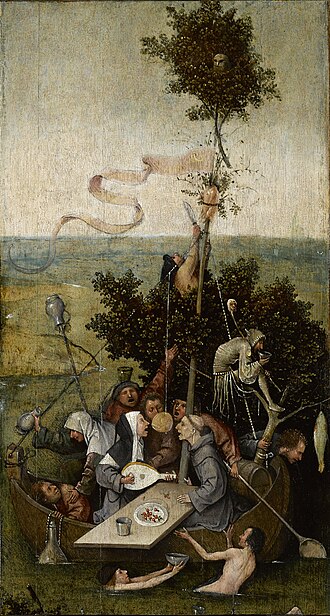 La Nef des fous - Hieronymus Bosch (1500s)
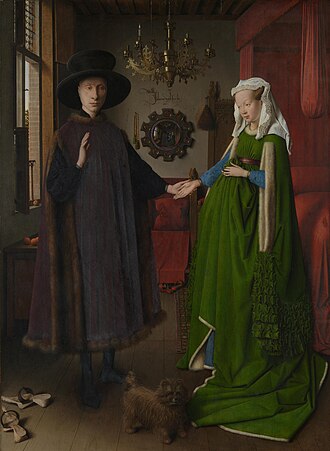 Les Époux Arnolfini - Jan van Eyck (1434)
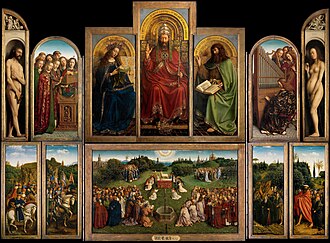 L'Agneau mystique - Jan van Eyck (1432)
%20-%20Google%20Art%20Project.jpg) Les Chasseurs dans la neige - Pieter Bruegel the Elder (1565)
Les Chasseurs dans la neige - Pieter Bruegel the Elder (1565)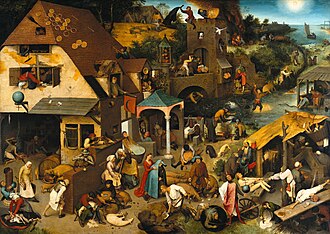 Les Proverbes flamands - Pieter Bruegel the Elder (1551)