Paysage d'Auvers sous la pluie
Vincent van Gogh · 1890
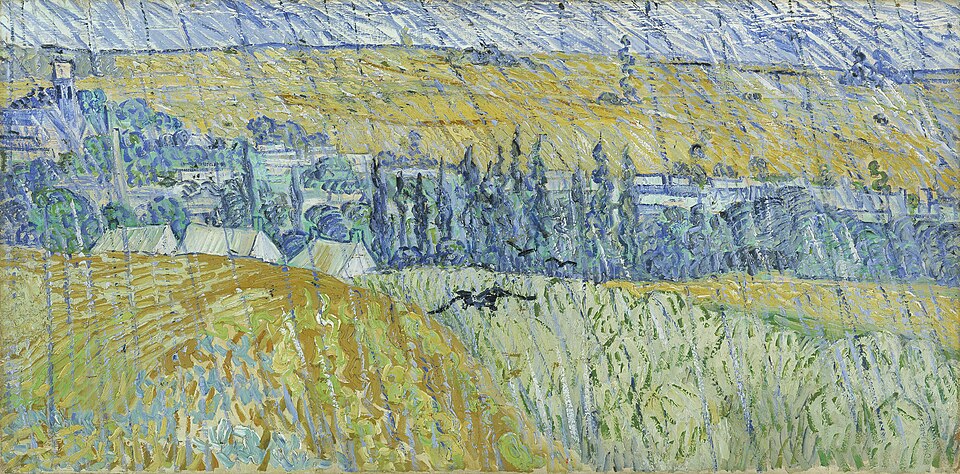
Dark diagonal strokes of rain fall across wide fields, thatched roofs and a far-off village. Van Gogh painted this panorama in July 1890, just days before his death, in a long double-square canvas built for boundless landscapes.
The story behind the painting
Van Gogh lived in Auvers-sur-Oise, north of Paris, from May to 27 July 1890, and in about seventy days he painted more than seventy works. He wrote mostly to his brother Theo and was watched over by Doctor Paul Gachet. In the last weeks he painted a group of double-square canvases of the fields and gardens around the village, probably meant as a series, and this was one of them, completed within the last three days before his death. The researcher Wouter van der Veen located the spot: the easel stood on the hills of Mery-sur-Oise, looking at the eastern part of Auvers.
What to look for
The canvas is about 50 by 100 cm, twice as wide as it is high, a format van Gogh borrowed from Daubigny for sweeping landscapes. The horizon sits high, giving a bird's eye view, while the foreground tilts so that we feel inside the grassy hills and above them at once. Thatched roofs, old cottages, meadows and dark trees spread out, and no sign of the railway or industry appears. Across everything run dark diagonal lines of rain, inspired by Hiroshige's woodcut Sudden Shower over Shin-Ohashi Bridge and Atake, which van Gogh had copied in 1887.
Meaning and intent
The source calls the painting an example of the visceral link between nature and emotion in van Gogh's late work, with its raised horizon, expressive brushwork and bold colour. It has been read as a symbol of the cycle of human suffering set against a sense of hope. The cooler, rainier north had revived him: he wrote of beautiful greenery in abundance and a sense of well-being in the air. In his final letter to Theo he said he was absorbed in the immense plain with wheatfields against the hills.
Legacy
It is one of van Gogh's last paintings, and the only one of his final period not made in the village itself. The Welsh collector Gwendoline Davies bought it in Paris in 1920, and it came to the National Museum of Wales in Cardiff with her bequest in 1952. Researchers have since studied the Auvers canvases with digital analysis, concluding that in Auvers van Gogh simplified his compositions while raising contrast and colour, proof that he was still changing to the very end.
Le saviez-vous ?
- Painted in July 1890, within the last three days before van Gogh's death.
- A double-square canvas, about 50 by 100 cm.
- The rain lines were inspired by a woodcut by Hiroshige.
- Bequeathed by Gwendoline Davies to the National Museum of Wales in 1952.
À propos de l'artiste
Vincent van Gogh (1853-1890)
paysage · champ · pluie · Musée national du pays de Galles · Auvers-sur-Oise
Autres œuvres de Vincent van Gogh
 La Nuit étoilée - Vincent van Gogh (1889)
.jpg) Terrasse du café le soir - Vincent van Gogh (1888)
Terrasse du café le soir - Vincent van Gogh (1888) Les Tournesols - Vincent van Gogh (1888)
 Amandier en fleurs - Vincent van Gogh (1890)
 Champ de blé aux corbeaux - Vincent van Gogh (1890)
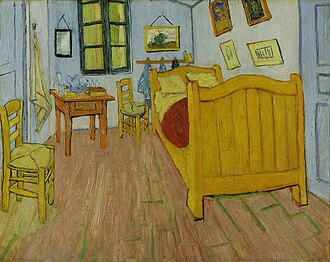 La Chambre à coucher - Vincent van Gogh (1888)
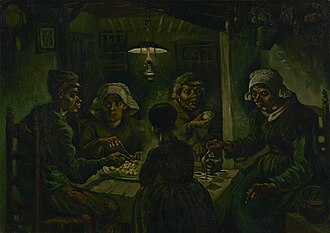 Les Mangeurs de pommes de terre - Vincent van Gogh (1885)
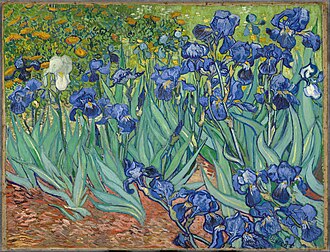 Iris - Vincent van Gogh (1889)
Œuvres d'artistes liés
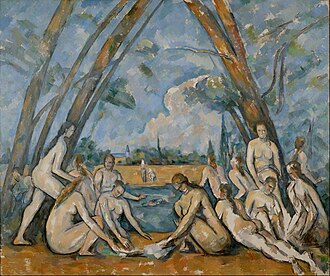 Les Grandes Baigneuses - Paul Cézanne (1900s)
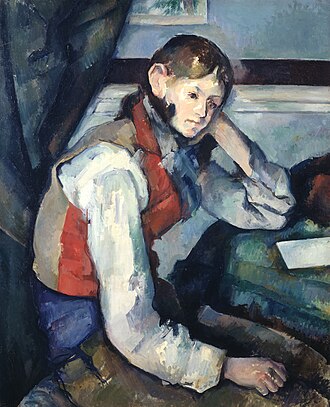 Le Garçon au gilet rouge - Paul Cézanne
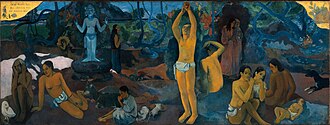 D'où venons-nous ? Que sommes-nous ? Où allons-nous ? - Paul Gauguin (1897-1898)
%201889.jpg) Le Christ jaune - Paul Gauguin (1889)
Le Christ jaune - Paul Gauguin (1889).jpg) L'Érection de la croix - Peter Paul Rubens (1609)
L'Érection de la croix - Peter Paul Rubens (1609)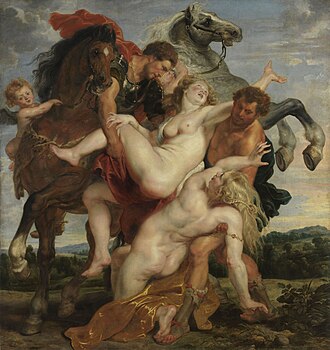 L'Enlèvement des filles de Leucippe - Peter Paul Rubens (1618)
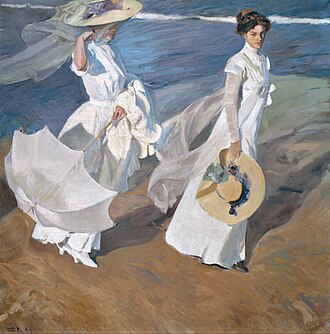 Promenade au bord de la mer - Joaquín Sorolla (1909)
 Triste héritage - Joaquín Sorolla (1898)
 Bal du moulin de la Galette - Pierre-Auguste Renoir (1876)
 Le Déjeuner des canotiers - Pierre-Auguste Renoir (1881)
 Au Moulin-Rouge - Henri de Toulouse-Lautrec (1892)
%20Rousse%20(La%20Toilette)%20-%201889%20-%20Henri%20de%20Toulouse-Lautrec%20-%20Mus%C3%A9e%20d'Orsay%2C%20Paris.jpg) La Toilette - Henri de Toulouse-Lautrec (1896)
La Toilette - Henri de Toulouse-Lautrec (1896)