Portrait de Louis Guillaume
Paul Cézanne · 1882
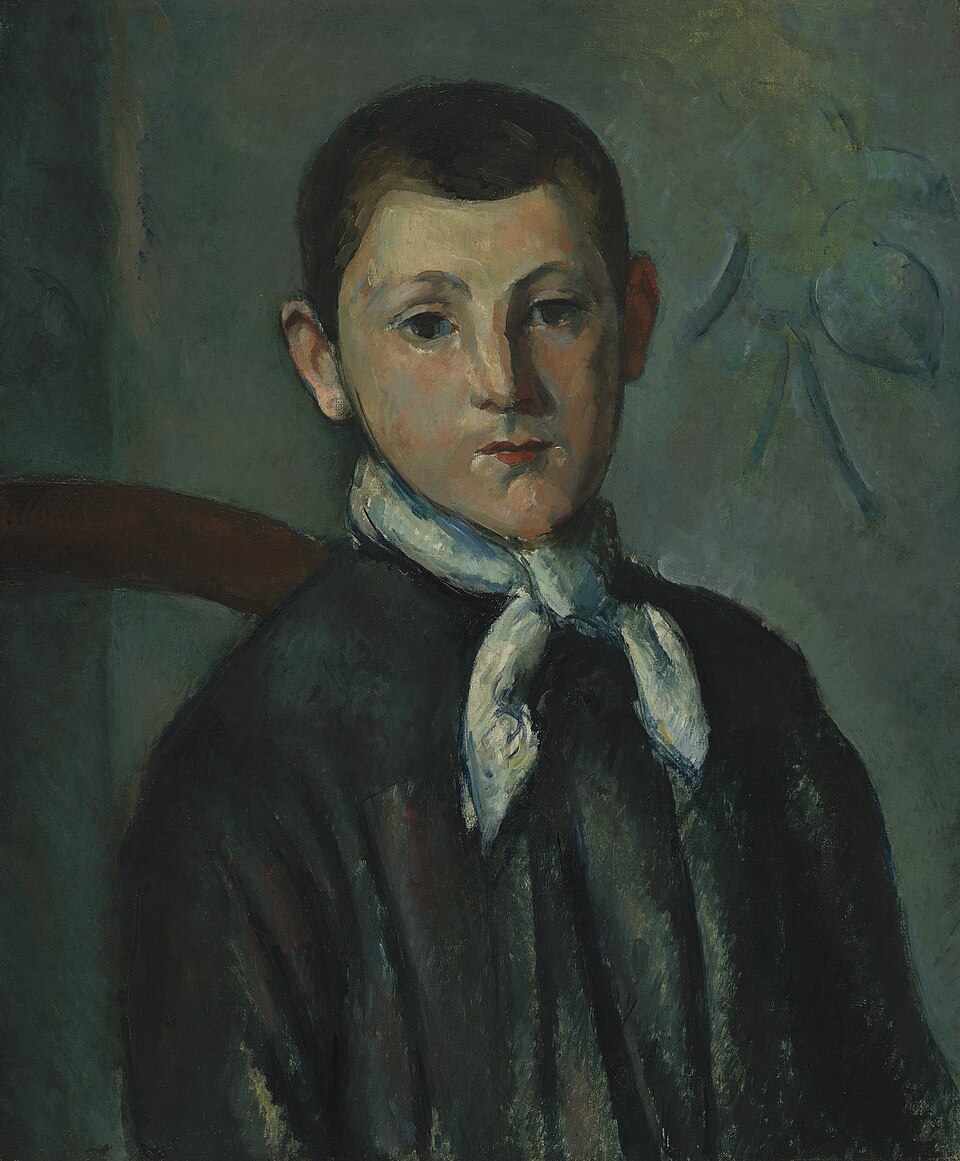
A boy with cropped black hair, pearly skin and eyes that are only dark hollows. Cézanne painted the son of friends around 1882 as solidly as a still life, yet small signs of warmth hide in the cheeks, the wall and the cravat.
The story behind the painting
Louis Guillaume was the son of friends of Paul Cézanne and a friend of the painter's own son, Paul. Cézanne, the French Post-Impressionist, painted this oil-on-canvas portrait of him around 1882. The Wikipedia article says little more about how the sittings came about, but it places the work among his portraits of people close to him and notes that, in form and complexity, the painting was ahead of its time. Wikidata gives its size as 55.9 by 46.7 cm. The boy is shown seated, a modest subject that Cézanne treated with the same attention he gave to apples on a table.
What to look for
The colours are low-key, mostly greys, whites and dark greens, and they give the picture a sombre tone that matches the shy reserve on the boy's face. His skin is painted in pearly white, giving the surface a lively sheen, which contrasts with his black, closely cropped hair and dark clothes. His heavy-lidded eyes are only black hollows; the art historian Meyer Schapiro wrote that they are without spiritual light and belong to a world of shadow. Look too at the delicate tones of the cheeks, the ornament of the wall, the folds of the clothing, and the cravat, which echoes the vertical lines of the face and the wall.
Meaning and intent
The face is almost expressionless and the body still, shaped like simple solid forms. These abstractions, especially in the head and body, anticipate a technique later taken up and developed by Henri Matisse. One critic famously wrote that Cézanne painted the heads of friends as if they were apples, and this cool detachment is clear here: the picture has the formal qualities of a still life or a landscape. At first it seems to show what has been called the abyss between human beings, yet the Wikipedia article also finds signs of hope and connection in the gentle colours and the rhyming lines.
Legacy
Ambroise Vollard had bought the painting by 1906. Around 1907 it was sold to a collector in Florence, and in 1927 it was sold to Chester Dale in New York. In 1963 Dale gave the work to the National Gallery of Art in Washington, D.C., where it belongs to his collection. Wikidata lists the museum under its Spanish name, Galería Nacional de Arte. Today the portrait is valued as an early example of the simplified, solid forms that would shape painting in the next century.
Le saviez-vous ?
- Painted by Cézanne about 1882.
- The sitter was a friend of Cézanne's son and the son of family friends.
- Its simplified forms anticipate Henri Matisse.
- Given by Chester Dale to the National Gallery of Art, Washington, in 1963.
À propos de l'artiste
Paul Cézanne (1839-1906)
portrait · homme · position assise · National Gallery of Art · chaise
Autres œuvres de Paul Cézanne
 Les Grandes Baigneuses - Paul Cézanne (1900s)
 Le Garçon au gilet rouge - Paul Cézanne
 La Corbeille de pommes - Paul Cézanne (1893)
 Rideau, cruchon et compotier - Paul Cézanne (1890s)
 Maison devant la Sainte-Victoire près de Gardanne - Paul Cézanne (1880s)
 Une moderne Olympia - Paul Cézanne (1873)
 La Femme à la cafetière - Paul Cézanne (1895)
 Pyramide de crânes - Paul Cézanne (1899)
Œuvres d'artistes liés
 La Nuit étoilée - Vincent van Gogh (1889)
 Terrasse du café le soir - Vincent van Gogh (1888)
 D'où venons-nous ? Que sommes-nous ? Où allons-nous ? - Paul Gauguin (1897-1898)
 Le Christ jaune - Paul Gauguin (1889)
 Promenade au bord de la mer - Joaquín Sorolla (1909)
 Triste héritage - Joaquín Sorolla (1898)
 Bal du moulin de la Galette - Pierre-Auguste Renoir (1876)
 Le Déjeuner des canotiers - Pierre-Auguste Renoir (1881)
 Au Moulin-Rouge - Henri de Toulouse-Lautrec (1892)
 La Toilette - Henri de Toulouse-Lautrec (1896)