Portrait de Francesco Maria della Rovere
Titien · 1530s
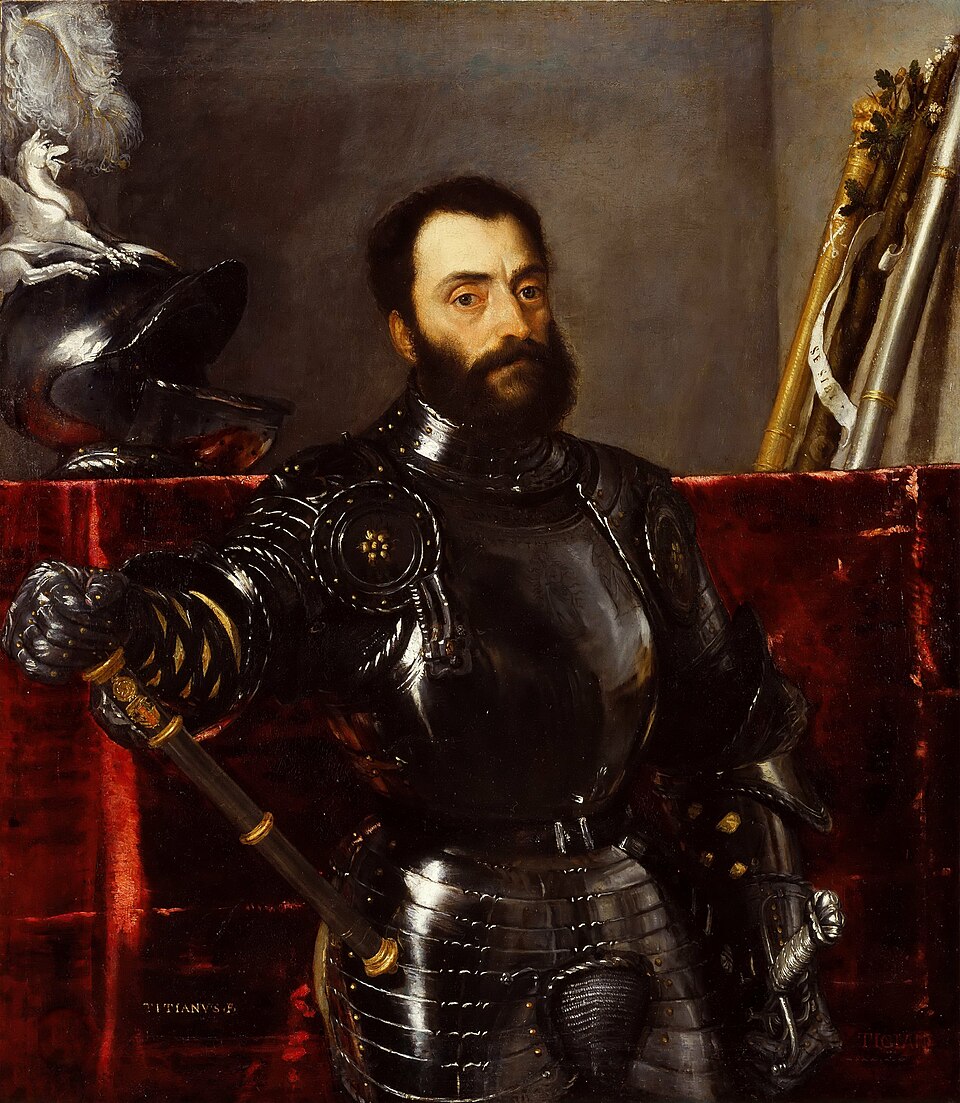
A duke in shining armour turns toward us, his commander's baton at his side, his face marked by time. Titian painted Francesco Maria della Rovere, Duke of Urbino, in 1536 to 1538, as one half of a pair with his wife.
The story behind the painting
Titian painted this oil on canvas between 1536 and 1538. It shows Francesco Maria I della Rovere, Duke of Urbino, and it is signed TITIANVS F., Titian made it. It forms a pair with Titian's portrait of the duke's wife, Eleonora Gonzaga della Rovere, and both are now in the Uffizi in Florence. The pose was chosen to recall Titian's portrait of the emperor Charles V in the Ducal Palace of Mantua, part of a series of the Twelve Caesars that is now lost and known only from engravings.
What to look for
The duke stands at nearly three quarter length in armour, his torso slightly turned, resting a commander's baton at his side while his right arm reaches toward the hilt of his sword. His eyes are fixed on us, set against the dark wall, while a red velvet drape covers a shelf behind him. On it lie his helmet with a dragon crest and plumes, two more batons, an oak branch with new buds and a small scroll with his motto SE SIBI. Titian varies his brushwork: rapid for the feathers, rough and creamy for the red cloth, dense for the skin, smooth with white touches for the gleaming armour.
Meaning and intent
Every object speaks of his career. The baton in his hand is the generalship given by Venice; the others bear the insignia of the Papal State and the Florentine Republic. With his own duchy, they sum up a life leading armies. The dragon on the helmet alludes to his ties with the House of Aragon. The cut oak branch putting out new leaves refers to his winning the fief of Urbino after the Montefeltro line died out. The motto SE SIBI may express his will to fight for himself and his family. Yet the painting is striking for its human intensity: the signs of age on his skin seem to show courage and nobility.
Legacy
Despite its ceremonial pose, the portrait belongs to a style Titian pursued in these years, also seen in his portraits of the pope and the emperor, where power and personality are shown together. Framed by dark hair and beard, the duke's face catches a beam of light that searches out its details. The painting still hangs with its companion, the portrait of Eleonora Gonzaga, in the Uffizi, so husband and wife remain side by side.
Le saviez-vous ?
- Oil on canvas by Titian, 1536-1538, about 114 by 103 cm.
- Signed TITIANVS F.
- Pairs with Titian's portrait of the duke's wife, Eleonora Gonzaga.
- In the Uffizi, Florence.
À propos de l'artiste
Titien (1488-1576)
portrait · École vénitienne · galerie des Offices
Autres œuvres de Titien
 Vénus d'Urbin - Titian (1538)
 L'Assomption de la Vierge - Titian (1510s)
 Amour sacré et Amour profane - Titian (1510s)
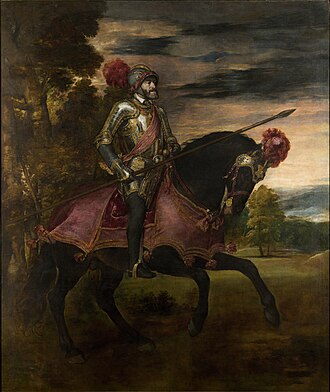 Charles Quint à cheval à Mühlberg - Titian (1548)
 Flore - Titian (1517)
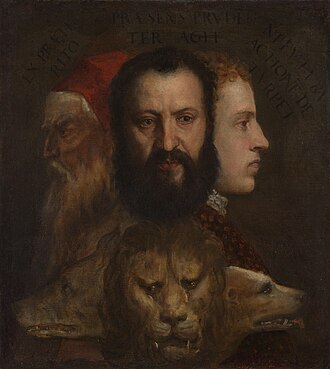 Allégorie du Temps gouverné par la Prudence - Titian (1550)
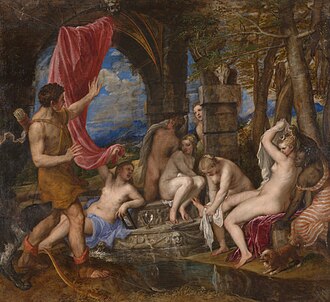 Diane et Actéon - Titian (1550s)
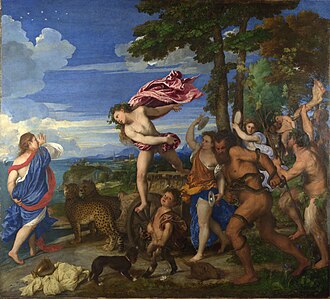 Bacchus et Ariane - Titian (1520s)
Œuvres d'artistes liés
 La Cène - Jacopo Tintoretto (1563)
 Miracle de l'esclave - Jacopo Tintoretto (1540s)
 Les Noces de Cana - Paolo Veronese (1560s)
 Le Repas chez Levi - Paolo Veronese (1573)