Place de la Concorde
Edgar Degas · 1875
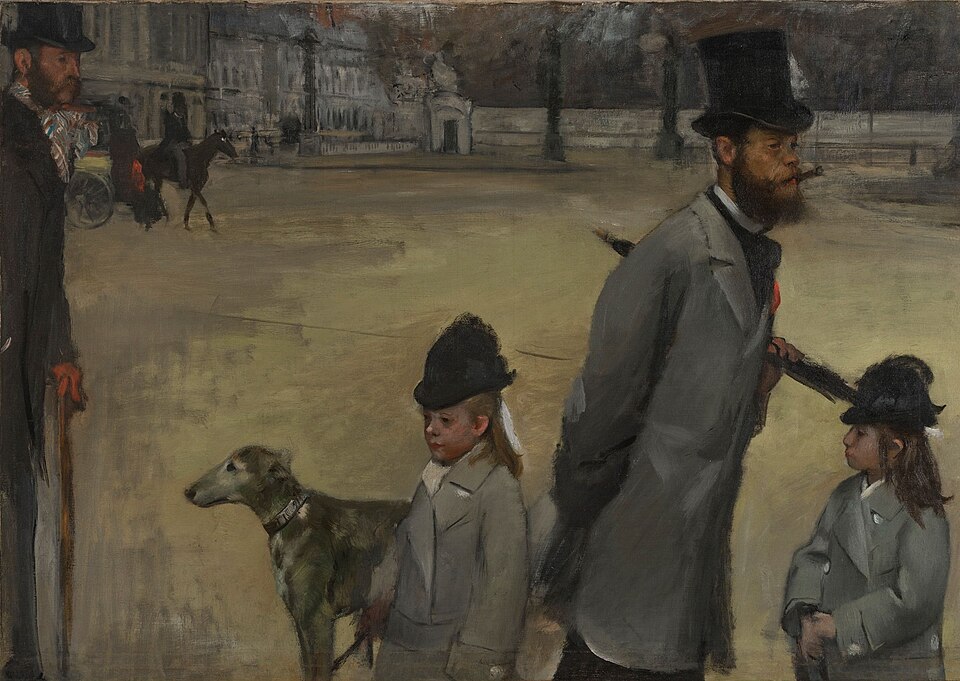
A man with a cigar strolls one way, his two small daughters drift another, a dog looks back, and a stranger is cut off at the edge. Degas left a great empty square in the middle. The painting itself was thought lost for half a century.
The story behind the painting
Painted in 1875, the picture shows Viscount Ludovic-Napoléon Lepic, his daughters Eylau and Jeanine and his dog Albrecht crossing the Place de la Concorde in Paris. The tall man on the left may be the playwright Ludovic Halévy, a close friend of Degas until the Dreyfus affair. Lepic never owned the painting, and Degas probably did not make it for him. Urban outdoor scenes like this are rare in Degas's work.
What to look for
Lepic walks carelessly, umbrella under his arm and cigar in his mouth, the red patch of the Legion of Honour on his coat, while his daughters face the other way. Eylau, the elder, stands more confidently; Jeanine stays tentatively by her father. Behind them are the Tuileries Garden and the Hôtel de la Marine, and the monument to Strasbourg, nearly hidden by Lepic's hat, would then have been draped in black for the city lost to Prussia. X-rays show the umbrella and dog were painted complete beneath the girls, and a study and the real square place a lamp post where the tall man stands.
Meaning and intent
The empty space, cropping and figures facing every way have been linked to photography, such as Hippolyte Jouvin's instant views of Paris, and to Japanese prints that Degas collected; Kirk Varnedoe argued instead for an older tradition of experiment. André Dombrowski reads the emptiness as the fragmentation of France after the Franco-Prussian War and the Commune, others as the isolation of Haussmann's rebuilt city, and Albert Boime as a public space reclaimed by the bourgeoisie.
Legacy
Degas kept the painting, which he never exhibited himself, until he sold it to Paul Durand-Ruel; in 1911 the German collector Otto Gerstenberg bought it, and after his death in 1935 it passed to his daughter Margarete Scharf. Stored in Berlin during the Second World War, it was taken by Soviet forces after the war and widely thought lost. In 1994 it was revealed in the Hermitage's Hidden Treasures Revealed exhibition, and it remains in the Hermitage.
Le saviez-vous ?
- Painted in 1875, about 78 by 118 cm.
- Shows Viscount Lepic, his daughters Eylau and Jeanine, and his dog.
- Taken by Soviet forces after the Second World War.
- Revealed at the Hermitage in 1994.
À propos de l'artiste
Edgar Degas (1834-1917)
portrait · musée de l'Ermitage · paysage urbain · parapluie · haut-de-forme
Autres œuvres de Edgar Degas
 L'Absinthe - Edgar Degas (1875)
 La Famille Bellelli - Edgar Degas (1858)
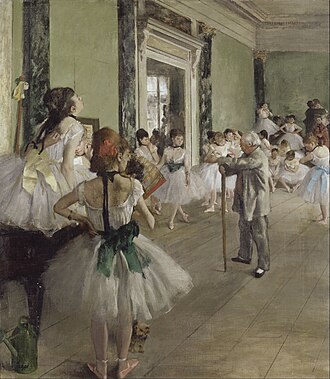 La Classe de danse - Edgar Degas (1871)
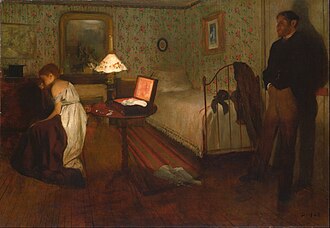 Intérieur - Edgar Degas (1868)
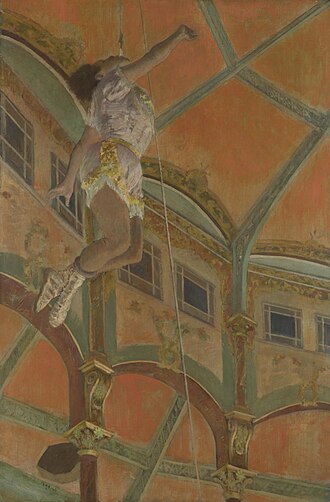 Mademoiselle La La au cirque Fernando - Edgar Degas (1879)
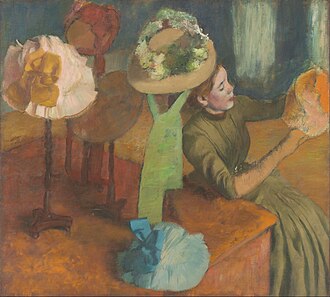 Chez la modiste - Edgar Degas
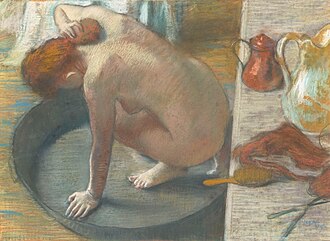 Le Tub - Edgar Degas (1886)
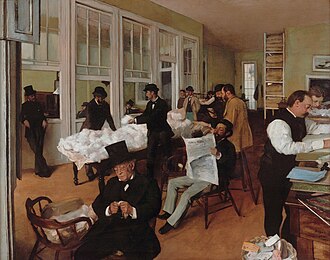 Le Bureau de coton à La Nouvelle-Orléans - Edgar Degas (1873)
Œuvres d'artistes liés
 Impression, soleil levant - Claude Monet (1872)
 Nymphéas - Claude Monet (1906)
 Le Déjeuner sur l'herbe - Édouard Manet (1863)
 Olympia - Édouard Manet (1863)
 Bal du moulin de la Galette - Pierre-Auguste Renoir (1876)
 Le Déjeuner des canotiers - Pierre-Auguste Renoir (1881)
 Le Berceau - Berthe Morisot (1872)
 Jour d'été - Berthe Morisot (1879)
 Le Canal du Loing - Alfred Sisley (1892)
 L'Abreuvoir à Marly-Le-Roi, gelée blanche - Alfred Sisley (1876)
 Rue de Paris, temps de pluie - Gustave Caillebotte (1877)
 Les Raboteurs de parquet - Gustave Caillebotte (1875)