Œdipe et le Sphinx
Gustave Moreau · 1864
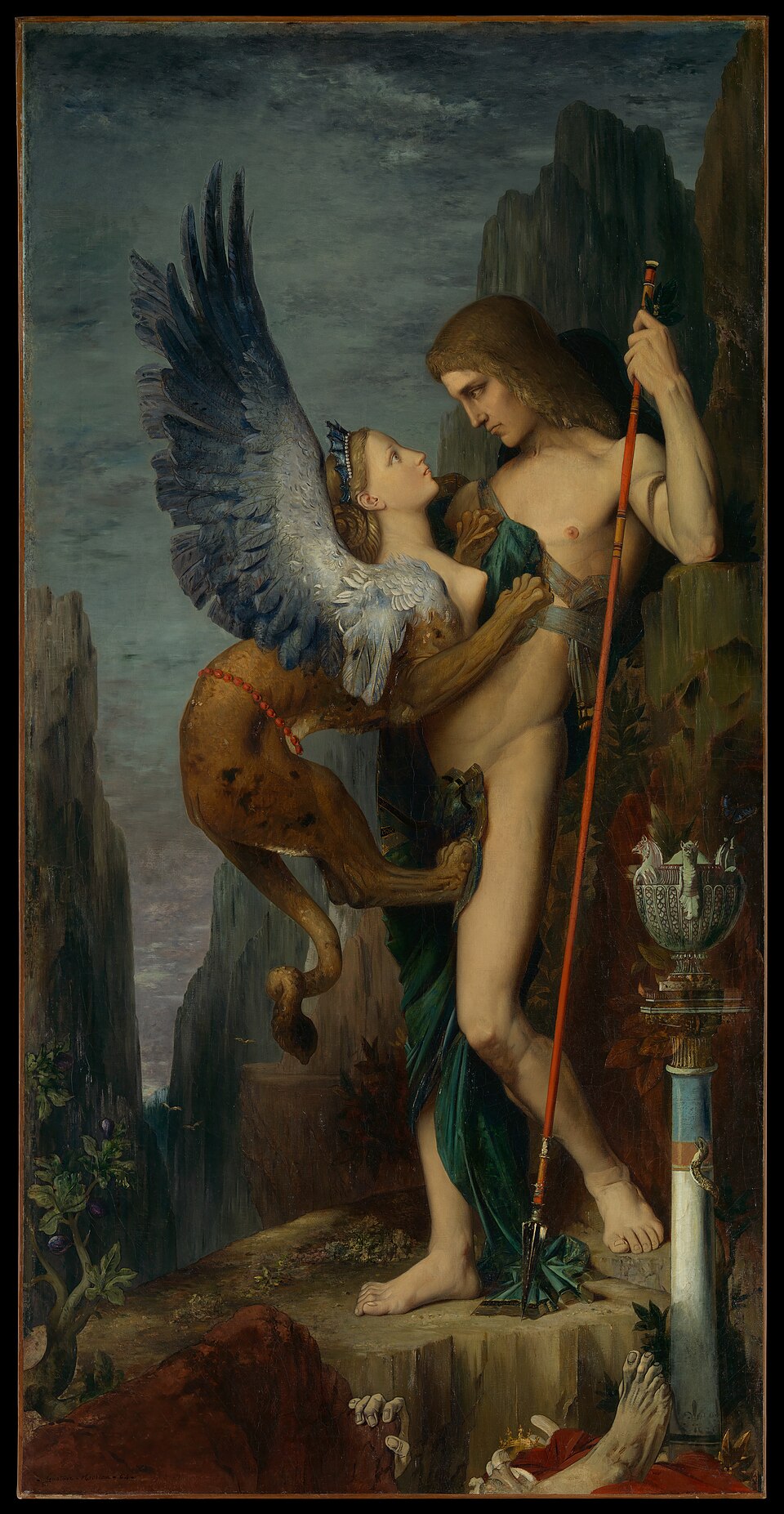
A winged Sphinx clings to the chest of a calm young Oedipus, their eyes locked inches apart. At the Salon of 1864 this painting turned an obscure Gustave Moreau into the hero of the exhibition overnight.
The story behind the painting
The subject comes from Sophocles's Oedipus Rex. On the road outside Thebes, Oedipus meets the Sphinx, who asks what walks on four feet in the morning, two in the afternoon and three at night. A wrong answer means his death and that of the besieged Thebans. He answers: man, who crawls as a baby, walks upright as an adult and leans on a stick in old age. Astounded, the Sphinx throws herself into the sea. Moreau had sketched Ingres's 1808 version of the scene in Paris, a likely source, and the influence of Andrea Mantegna has also been detected. His father had recently died when he painted it.
What to look for
In Ingres's version Oedipus dominates and the Sphinx is on the defensive. Here she is on the attack, half-woman and half-vulture, clawing at his body, and his victory does not yet seem certain. Yet Oedipus stands almost nonchalant, while evidence of the Sphinx's deadly nature lies around them. Look at her face: refined, almost noble, more feminine than monstrous, pressed close to his. The intense shared gaze has been called typical of Moreau, an ambiguous mirror image of two beings who recognise each other all too well.
Meaning and intent
Moreau deliberately turned away from the realism in vogue and chose an archaic manner and a myth. Critics read the Sphinx as a femme fatale, matter and sensuality, and Oedipus as moral strength. Ragnar von Holten saw a battle of good and evil and of the sexes, inspired by a Heine poem in which the Sphinx wins. A Freudian reading links her to Moreau's mother. Henri Dorra instead traced the poses to the Greek meaning of sphinx, to clutch or cling, discussed by Michel Bréal in 1863. The interpretations differ, and the painting leaves them open.
Legacy
The Salon of 1864 was seen as mediocre, and one critic said that if it was saved from discredit, it was thanks to Oedipus and the Sphinx. Others complained about the harsh embrace of Mantegna, or compared it to Carpaccio. Prince Napoléon bought it that same year; it then passed to Paul Durand-Ruel and to William H. Herriman, who gave it to the Metropolitan Museum of Art in 1920. It is one of the few important Moreau paintings outside France, since he left the rest of his work to the nation.
Le saviez-vous ?
- First shown at the Paris Salon of 1864, an immediate success.
- Inspired in part by Ingres's 1808 version of the subject.
- Bought by Prince Napoléon in 1864.
- Given to the Metropolitan Museum of Art in 1920.
À propos de l'artiste
Gustave Moreau (1826-1898)
peinture mythologique · Metropolitan Museum of Art · académisme · cadavre · montagne · lance
Autres œuvres de Gustave Moreau
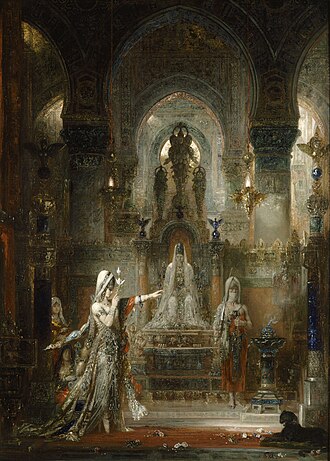 Salomé dansant devant Hérode - Gustave Moreau (1876)
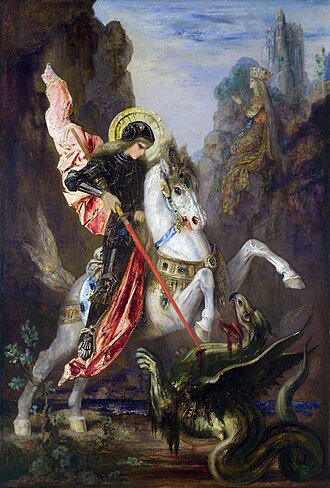 Saint Georges et le Dragon - Gustave Moreau (1880s)
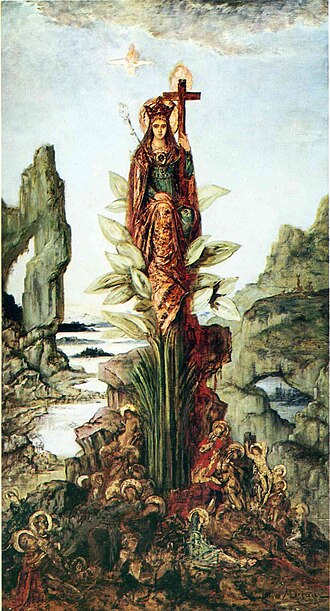 Fleur mystique - Gustave Moreau (1890)
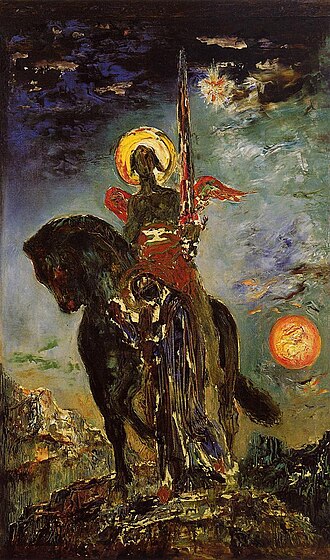 La Parque et l'Ange de la Mort - Gustave Moreau (1890)
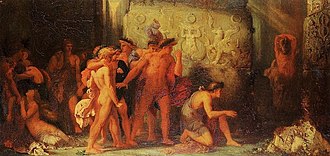 Les Athéniens livrés au Minotaure dans le labyrinthe de Crète - Gustave Moreau (1855)
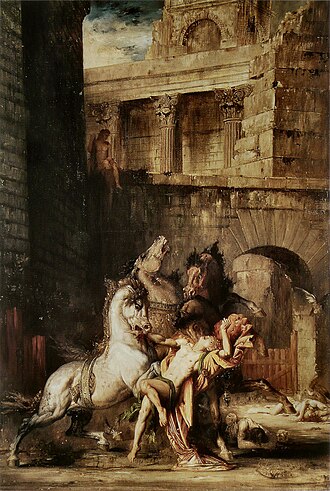 Diomède dévoré par ses chevaux - Gustave Moreau (1865)
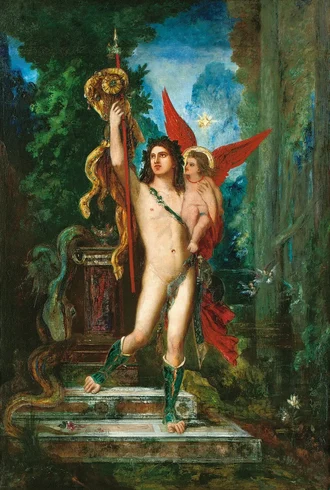 Jason et Éros - Gustave Moreau (1891)
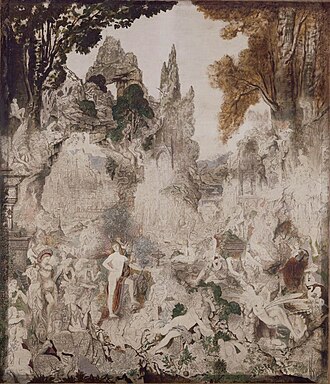 Les Chimères - Gustave Moreau (1884)
Œuvres d'artistes liés
 Pollice verso - Jean-Léon Gérôme (1872)
 Le Marché aux esclaves - Jean-Léon Gérôme (1866)
 Le Déjeuner sur l'herbe - Édouard Manet (1863)
 Olympia - Édouard Manet (1863)
 L'Origine du monde - Gustave Courbet (1866)
 Un enterrement à Ornans - Gustave Courbet (2020)
 Œillet, lys, lys, rose - John Singer Sargent (1885-1886)
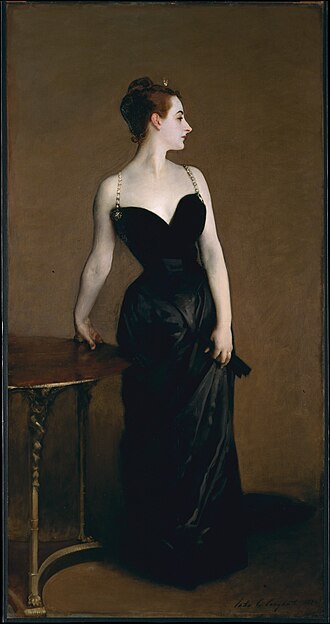 Madame X - John Singer Sargent (1884)
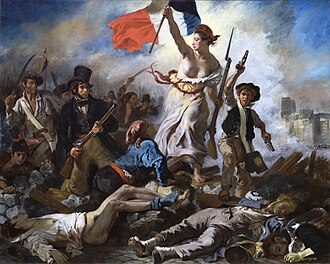 La Liberté guidant le peuple - Eugène Delacroix (1830)
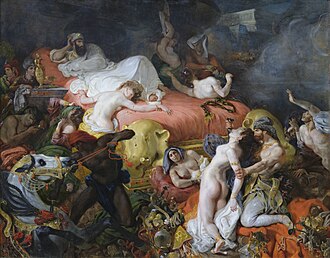 La Mort de Sardanapale - Eugène Delacroix (1827)
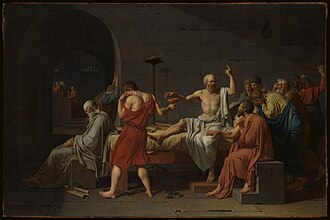 La Mort de Socrate - Jacques-Louis David (1787)
 Le Serment des Horaces - Jacques-Louis David (1784)