Midas devant Bacchus
Nicolas Poussin · 1630
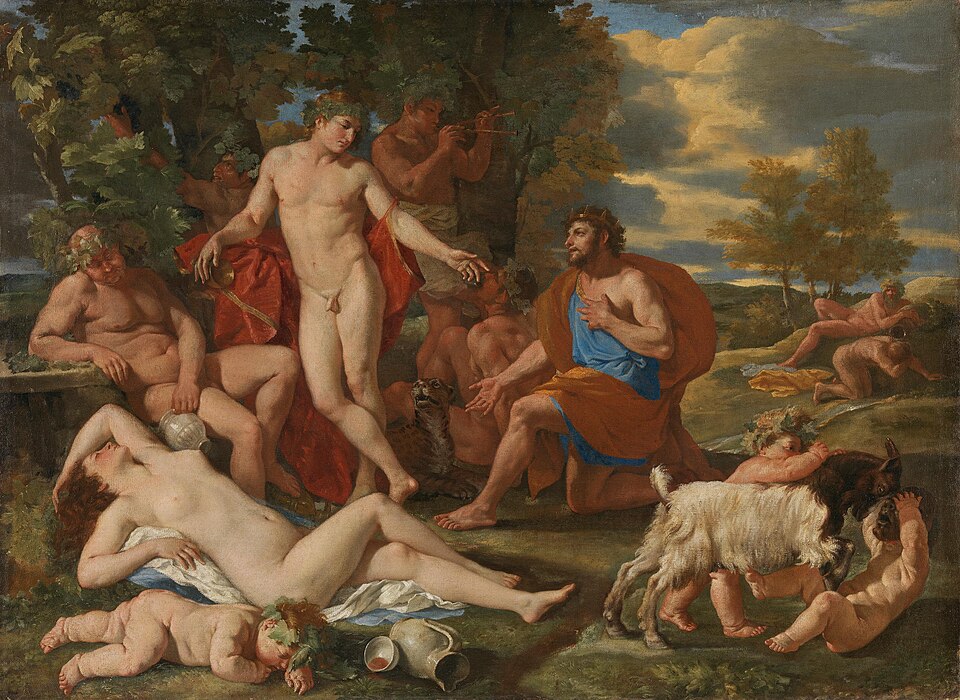
A king kneels and begs a god to take back the gift he once wanted most: the power to turn everything he touches into gold. Around them, an Arcadian world drinks, sleeps and plays.
The story behind the painting
In the myth, the greedy King Midas of Phrygia was granted by Bacchus the power of turning whatever he touched into gold, and soon found it a curse. The painting shows the moment he asks the god to take that power back. It is usually attributed to Nicolas Poussin and dated to about 1624 to 1629, in his early years; Wikidata gives 1630. The canvas measures about 98 by 153 cm.
What to look for
Midas, in a blue garment and yellow mantle, kneels on one knee before Bacchus, who holds a cup in one hand and stretches the other compassionately toward him. Silenus lies nearby, and a nymph sleeps naked in the foreground with an infant at her side. Beyond, three fauns drink, play a double pipe and gather fruit. On the right, two boys play with a goat, and further off lie a river god and a youth kneeling by a stream, in a beautiful Arcadian landscape.
Meaning and intent
The picture sets a lesson inside abundance. The one figure who wanted more than he needed kneels in distress, while all around him others simply enjoy the fruits of nature: drinking, sleeping, playing music, gathering fruit. Bacchus answers with compassion rather than anger, with his free hand stretched toward the king. Meanwhile the calm Arcadian landscape is the world Midas nearly lost, where nothing needs to be gold to be precious.
Legacy
Its authorship has been questioned. Anthony Blunt in 1966, citing the confused iconography and awkward space, tentatively gave it to the so-called Heytesbury Master, but Christopher Wright in 2007 and the Alte Pinakothek accept it as an early Poussin. First recorded at Nymphenburg Palace in 1751, it moved to the Alte Pinakothek in Munich in 1836. It covers a whole wall in Fassbinder's film The Bitter Tears of Petra von Kant.
Le saviez-vous ?
- Dated about 1624-1629 by Wikipedia.
- Attribution doubted by Blunt, accepted by Wright and the museum.
- In the Alte Pinakothek, Munich, since 1836.
- Seen in Fassbinder's The Bitter Tears of Petra von Kant.
À propos de l'artiste
Nicolas Poussin (1594-1665)
peinture mythologique · Collection de peintures de l'État de Bavière · Dyonisos
Autres œuvres de Nicolas Poussin
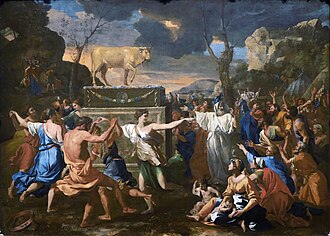 L'Adoration du Veau d'or - Nicolas Poussin (1634)
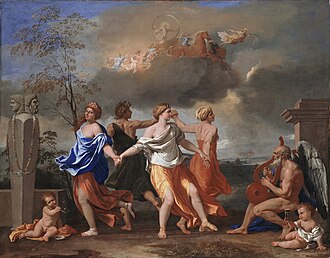 La Danse de la vie humaine - Nicolas Poussin (1630s)
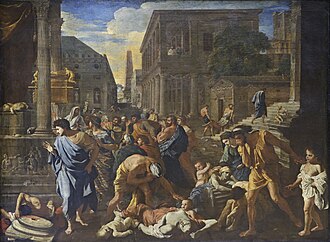 La Peste d'Asdod - Nicolas Poussin (1630)
.jpg) Le Jugement de Salomon - Nicolas Poussin (1649)
Le Jugement de Salomon - Nicolas Poussin (1649)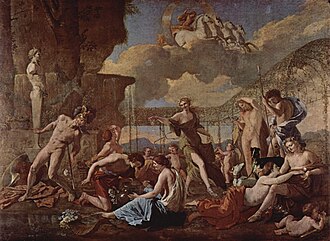 L'Empire de Flore - Nicolas Poussin (1631)
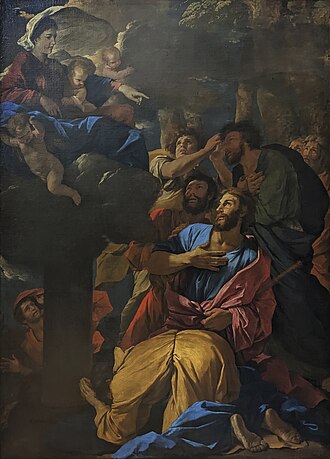 L'Apparition de la Vierge à saint Jacques le Majeur - Nicolas Poussin (1620s)
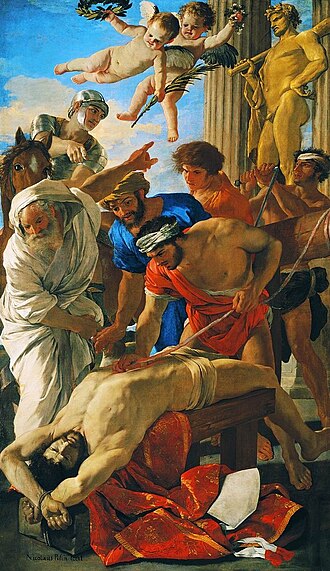 Le Martyre de saint Érasme - Nicolas Poussin (1628)
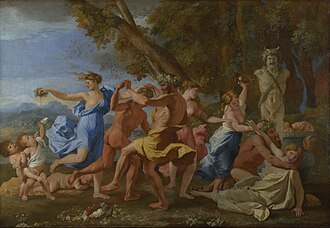 Bacchanale devant un terme - Nicolas Poussin (1630s)