Souvenir du jardin à Etten
Vincent van Gogh · 1888
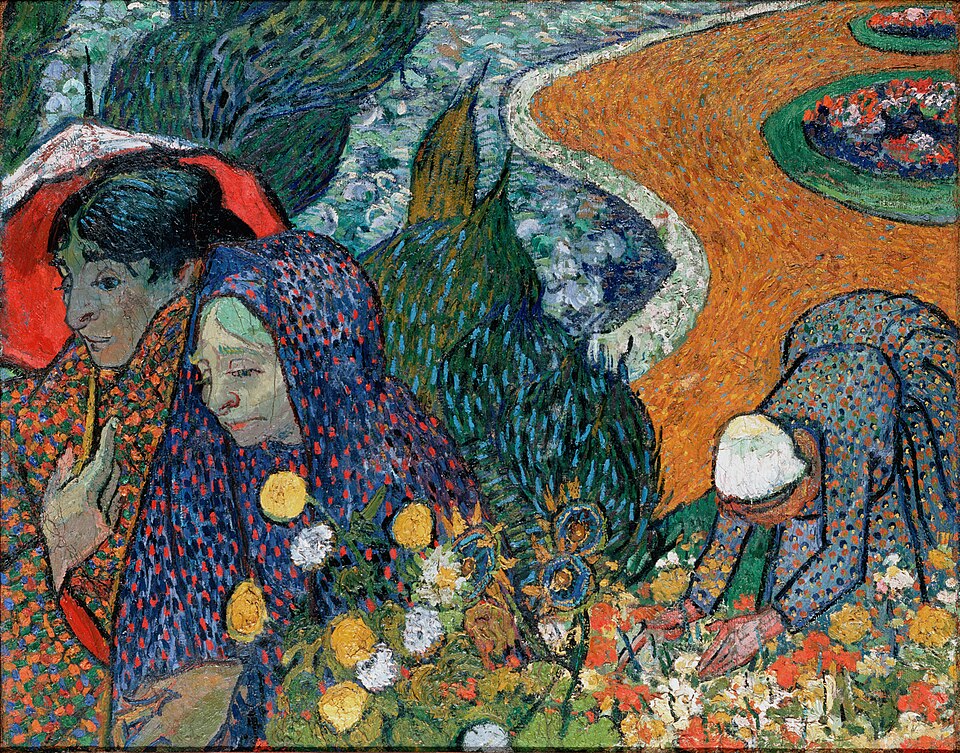
Van Gogh painted this garden not from life but from memory, in a small yellow house in Arles, far from the Dutch village where his life as an artist began.
The story behind the painting
In November 1888, Vincent van Gogh was living in the Yellow House in Arles, where Paul Gauguin had joined him in the hope of founding an artists' commune. There he painted Memory of the Garden at Etten, also called Ladies of Arles, as a decoration for his own bedroom. The garden he recalled belonged to the parsonage at Etten, in the Netherlands, where his father was pastor. Vincent had stayed there in 1881, the year he committed himself to becoming an artist, drawing in earnest and sketching the surrounding heaths. It was also where he fell for his widowed cousin Kee Vos-Stricker, who rejected him, and where a bitter quarrel with his father drove him from home. In his letters, Vincent made clear he was deliberately working from imagination, as Gauguin encouraged.
What to look for
Van Gogh described the colours himself in a letter to his sister Willemien. The younger of two women walking wears a Scottish shawl with green and orange checks and carries a red parasol. The older one wears a blue-violet shawl, almost black, against which a bunch of dahlias, lemon yellow and variegated pink and white, seems to explode. Behind them stand emerald-green cypress or cedar bushes, and beyond, a bed of pale green and red cabbages edged with little white flowers. The sandy path is a raw orange; in the middle ground a maidservant in blue tends plants bursting with white, pink, yellow and vermilion flowers. Notice the lines too: he called them bizarre, snaking all over the canvas. Scholars have compared the whole to medieval stained glass.
Meaning and intent
The two women are generally taken to be Vincent's mother and his sister Willemien, though the biographer Marc Edo Tralbaut believed the younger figure might, consciously or not, recall Kee Vos-Stricker. Van Gogh himself was enigmatic. He told Willemien he did not seek a likeness: the dark violet blotched with lemon-yellow dahlias suggested their mother's personality, while the plaid figure against the cypress reminded him of a character from Dickens. His aim, he wrote, was to show that one can speak poetry simply by arranging colours well, the way music can offer comfort, and to draw the garden as if seen in a dream, truer in character yet stranger than reality. Later he said he had spoiled it, and even called it the garden at Nuenen.
Legacy
The painting is now in the Hermitage Museum. It stands at a turning point in Van Gogh's art: scholars such as Jan Hulsker have weighed how far its radical changes reflect Gauguin's influence and the Synthetic Symbolist approach then emerging. The exchange ran both ways, for the picture in turn influenced Gauguin's own Arlésiennes (Mistral), painted about a month later, in which the older woman is recognisably Madame Ginoux of the Café de la Gare. Hulsker, puzzled that Vincent thought he had ruined it, called the work fascinating and enigmatic, rich in subdued yet sparkling colours. It offers a rare glimpse of Van Gogh painting not what he saw, but what he remembered and felt.
Le saviez-vous ?
- It was meant to hang in Van Gogh's bedroom in the Yellow House.
- Van Gogh described every colour in a letter to his sister Willemien.
- It is also known as Ladies of Arles.
- It inspired Gauguin's Arlésiennes (Mistral), painted about a month later.
À propos de l'artiste
Vincent van Gogh (1853-1890)
femme · scène de genre · fleur · musée de l'Ermitage · jardin
Autres œuvres de Vincent van Gogh
 La Nuit étoilée - Vincent van Gogh (1889)
.jpg) Terrasse du café le soir - Vincent van Gogh (1888)
Terrasse du café le soir - Vincent van Gogh (1888) Les Tournesols - Vincent van Gogh (1888)
 Amandier en fleurs - Vincent van Gogh (1890)
 Champ de blé aux corbeaux - Vincent van Gogh (1890)
 La Chambre à coucher - Vincent van Gogh (1888)
 Les Mangeurs de pommes de terre - Vincent van Gogh (1885)
 Iris - Vincent van Gogh (1889)
Œuvres d'artistes liés
 D'où venons-nous ? Que sommes-nous ? Où allons-nous ? - Paul Gauguin (1897-1898)
%201889.jpg) Le Christ jaune - Paul Gauguin (1889)
Le Christ jaune - Paul Gauguin (1889) Le Déjeuner sur l'herbe - Édouard Manet (1863)
 Olympia - Édouard Manet (1863)