Marriage A-la-Mode: 6. The Lady's Death
William Hogarth · 1743
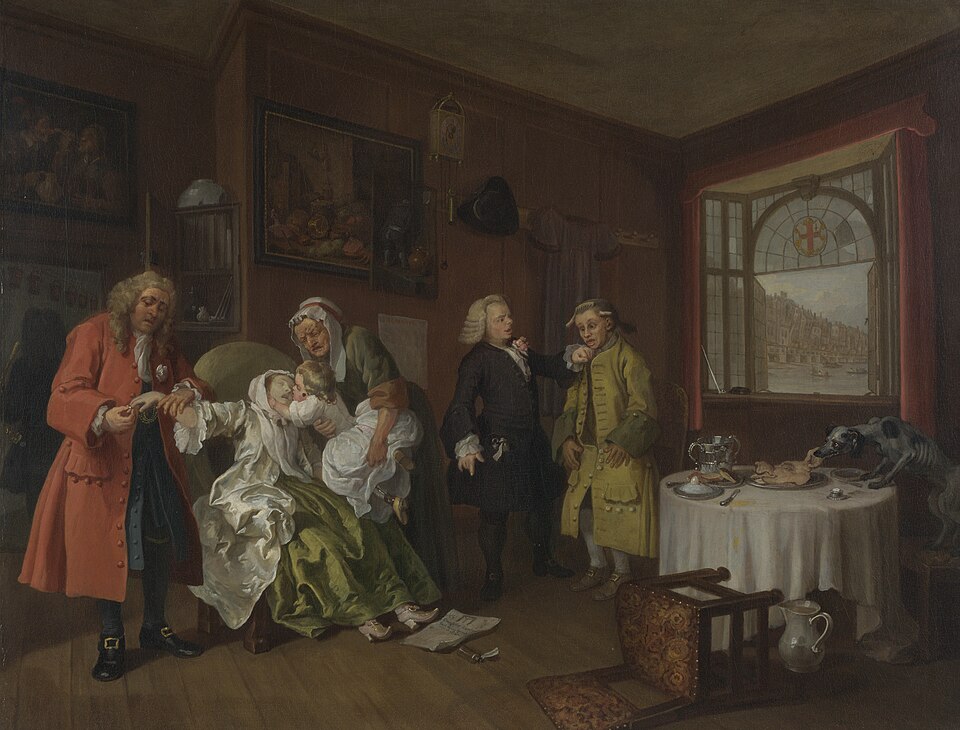
A bare room, an empty vial, a broadsheet about a hanging. In the last scene of Marriage A-la-Mode, the Countess dies, and the only ones who grieve are her small daughter and an old maid, while her father slips the ring from her finger.
The story behind the painting
The Lady's Death is the sixth and final canvas of William Hogarth's satirical series Marriage A-la-Mode, dated 1743 and held by the National Gallery in London. After her husband's murder, the Countess has returned to her father's house. Her lover Silvertongue has been hanged at Tyburn for the killing. Torn by guilt and despair, she has bribed her father's dim-witted servant to fetch her laudanum, and has taken her own life. The moral drama ends here, moving from dissipation and vice to misery, shame and death.
What to look for
The empty vial lies on the floor beside a broadsheet announcing Silvertongue's execution, with the Tyburn Tree drawn at its head and his last dying speech printed below. The apothecary scolds the servant who brought the poison, and the doctor leaves through the door at far left. The little daughter wears calipers on her legs, a sign of rickets, and a black patch on her neck that may mean syphilis or scrofula. On the table is only half a pig's head, about to be carried off by an emaciated dog. Through the window stands old London Bridge with its ramshackle houses.
Meaning and intent
Everything in the room speaks of a frugal merchant: a cobweb over the window, a repaired chair, leather fire buckets, his clock and hat. The father removes the ring from his daughter's finger; as a suicide, her inherited property is forfeit to the state, and he would lose the dowry. The child, as a girl, cannot inherit the family titles, so the family tree the old Earl showed off in the first scene ends here. The Dutch low-life pictures on the wall mock the taste of the time, and an overturned chair marks discord.
Legacy
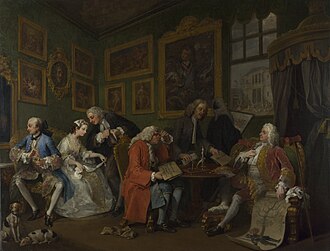
The scene answers the first painting of the series point by point: a frugal merchant's house instead of the old Earl's mansion, decaying houses on London Bridge instead of a new stately home seen through a window. The bridge view is based on the view from the house of Hogarth's uncle, which he visited as a child; those houses were demolished in 1757. The canvas measures about 43.2 by 53.3 cm according to Wikidata. With it, Hogarth closes his story of a marriage arranged for money and rank.
Le saviez-vous ?
- Sixth and final scene of Hogarth's Marriage A-la-Mode, dated 1743.
- The Countess takes laudanum after her lover is hanged at Tyburn.
- The window shows old London Bridge, whose houses were demolished in 1757.
- Held by the National Gallery, London.
À propos de l'artiste
William Hogarth (1697-1764)
femme · homme · National Gallery · chien · cadavre · enfant · groupe d'humains · salle
Autres œuvres de William Hogarth
 Les Enfants Graham - William Hogarth (1742)
 Hogarth's Servants - William Hogarth (1750s)
 The Distrest Poet - William Hogarth (1730s)
 Mariage à la mode 2 : le tête-à-tête - William Hogarth (1743)
 David Garrick en Richard III - William Hogarth (1745)
 The Orgy - William Hogarth (1735)
Le Dernier Enjeu de la dame - William Hogarth (1759)
 Marriage A-la-Mode: 1. The Marriage Settlement - William Hogarth (1743)