Mariage à la mode 2 : le tête-à-tête
William Hogarth · 1743
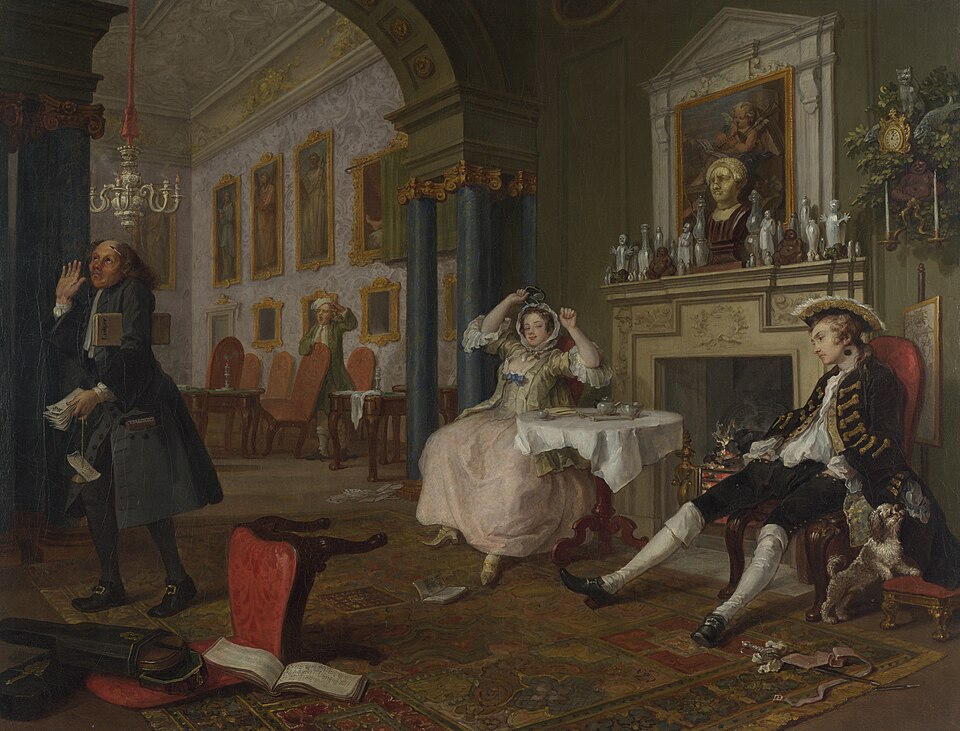
The clock says twenty past twelve, the candles are still burning, and husband and wife sit slumped on either side of the fireplace. Hogarth leaves us to decide whether it is midnight or noon. Either way, the marriage is already failing.
The story behind the painting
The Tête à Tête is the second canvas in Hogarth's series of six satirical paintings, Marriage A-la-Mode. After the deal struck in the first scene, we now see the couple at home, the Viscount and his new wife. It is the sparsest scene of the series, with only four people: the Viscount seated on the right, the Viscountess opposite him, a Methodist steward walking out, and another servant in the far room. Some details are still debated, especially the time of day, one of the most disputed questions in the whole series, but the main meaning is clear: the two have no interest in each other.
What to look for
The clock reads 12:20. The husband is dishevelled, his waistcoat open, his stockings slipping down, the black patch still on his neck; the dog sniffs a lady's nightcap in his pocket. At his feet lies his sword, broken in its scabbard. The wife stretches with satisfaction, an overturned card game and a book on whist at her feet, holding up a pocket mirror as if signalling to someone. The steward, with a book on Regeneration and a clutch of unpaid bills, turns away in disgust. On the mantelpiece stand a jumble of ornaments and a Roman bust with a broken nose; above, Cupid plays bagpipes amid ruins, with no string on his bow.
Meaning and intent
If it is past midnight, there has been a wild party; if it is past noon, nothing has been cleaned and the candles have burned all night. Either way the household is collapsing. The broken sword and the broken nose suggest impotence; the nightcap suggests a night at a brothel. The wife's sly pleasure contrasts with her husband's exhaustion and points to her own affair. The single receipt on the spike against the steward's bills shows the Viscount is a spendthrift like his father. An overturned chair, a favourite Hogarth device, signals discord, and a covered painting with a bare foot hints at lust.
Legacy
Tradition gives faces to some figures: the husband is said to be based on Hogarth's friend Francis Hayman, and the steward on Edward Swallow, butler to Thomas Herring, Archbishop of York. The neo-Palladian interior, a style Hogarth despised, is said to be based on the drawing room of Horace Walpole's house at 5 Arlington Street in London, though Walpole admired Hogarth. The ridiculous clock mixing Chinoiserie and Rococo, with a Buddha, a fish and a cat, mocks such clashes of taste. The painting hangs in the National Gallery, London; Wikidata dates it 1743.
Le saviez-vous ?
- Second of the six paintings of Marriage A-la-Mode.
- The clock reads 12:20, and whether it is day or night is disputed.
- The husband is said to be modelled on Francis Hayman.
- In the National Gallery, London.
À propos de l'artiste
William Hogarth (1697-1764)
femme · homme · scène de genre · National Gallery · chien · salle
Autres œuvres de William Hogarth
 Les Enfants Graham - William Hogarth (1742)
 Hogarth's Servants - William Hogarth (1750s)
 The Distrest Poet - William Hogarth (1730s)
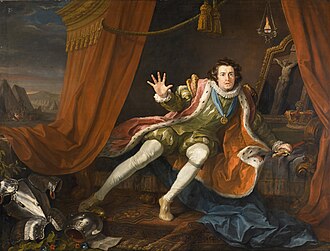 David Garrick en Richard III - William Hogarth (1745)
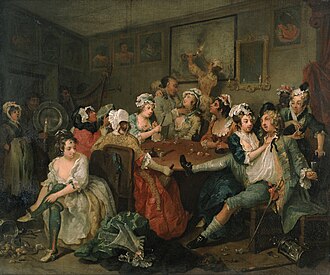 The Orgy - William Hogarth (1735)
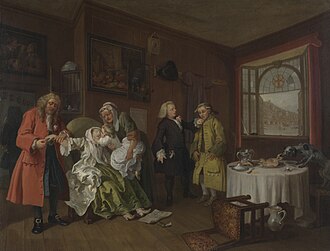 Marriage A-la-Mode: 6. The Lady's Death - William Hogarth (1743)
Le Dernier Enjeu de la dame - William Hogarth (1759)
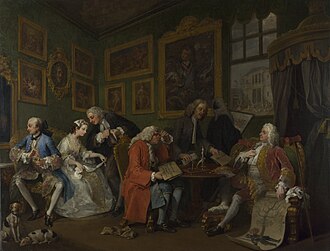 Marriage A-la-Mode: 1. The Marriage Settlement - William Hogarth (1743)