Les Majas au balcon
Francisco Goya · 1808
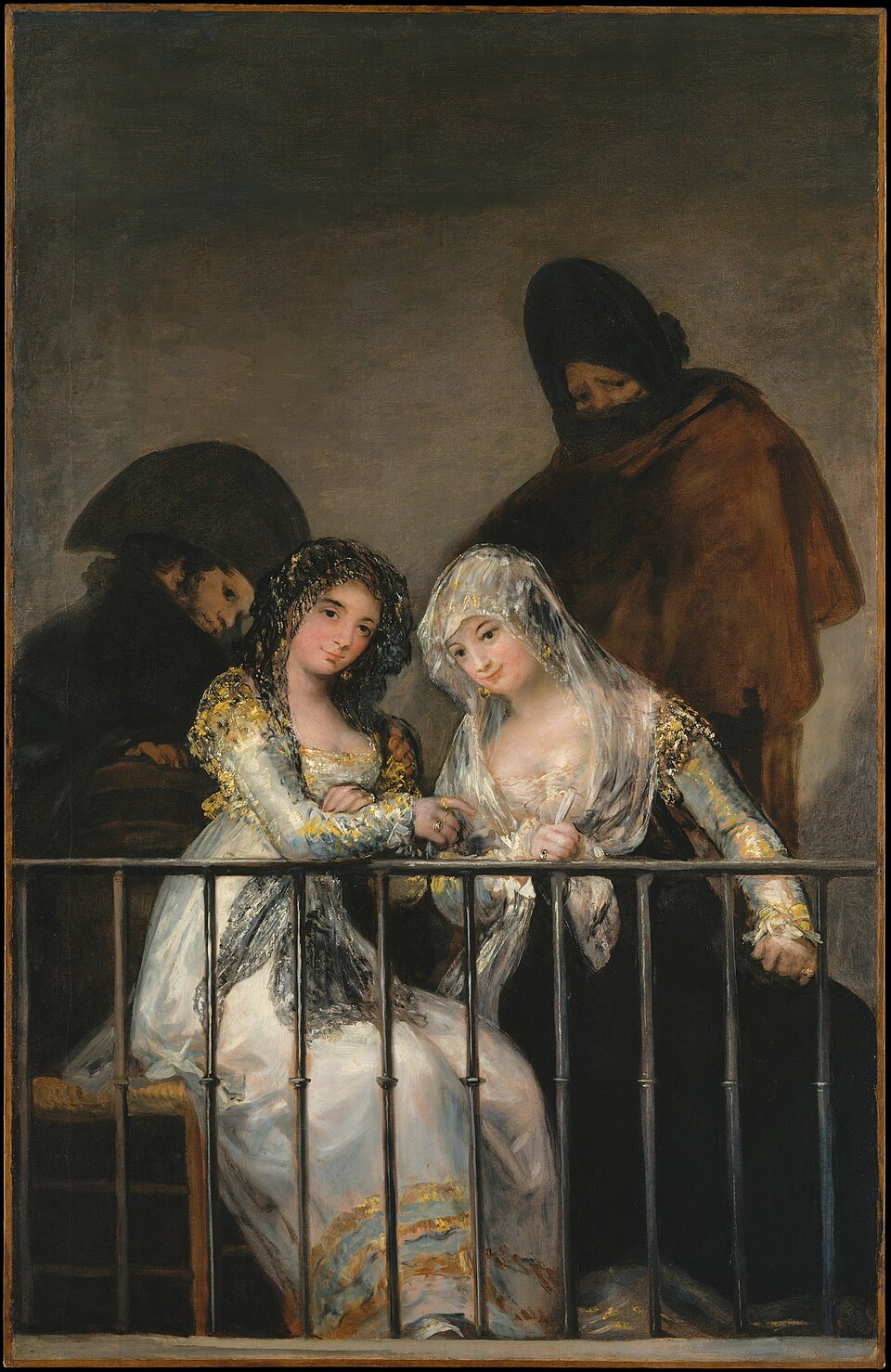
Two women in bright finery sit at a balcony, and behind them two men are almost reduced to shadows. This version hangs in the Metropolitan Museum of Art, attributed to Goya, and it later inspired Manet.
The story behind the painting
The canvas shows two majas, Spanish women of the people or aristocrats dressed in their style. It was painted between 1808 and 1814, while Spain was at war after the Napoleonic invasion. According to the French Wikipedia article, Goya was then looking for lighter subjects than his Disasters of War, including a series of majas in different settings. The work is described as attributed to Goya and is kept at the Metropolitan Museum of Art. Wikidata gives the year 1808.
What to look for
The intense colour of the foreground contrasts with the blackness behind it, and the foreground feels almost theatrical, leaving the reality of life in the background. The composition follows a strict geometry: the balustrade forms a rectangle, and above it the rest is organised as a square. The two women are built on a diamond formed by the diagonals of the lower squares. Everything seems cool and stylised, as if a scene from life had become a set of schematic symbols. The canvas measures about 194.8 by 125.7 cm.
Meaning and intent
The painting is linked to Maja and Celestina on the Balcony, a harsh image of bought beauty and prostitution. Here the theme is the same, with two women and, behind them, two figures read as their protectors, nearly reduced to shadows. Some have called Goya's art one of sad irony. The picture belongs to a transition between his sunny, ironic views of Spanish society and the bitterness of the Black Paintings.
Legacy
Sixty years later, the image inspired Edouard Manet's The Balcony. It carries both sides of Goya's turning point: the radiance of the courtesans and the ghostly darkness of the men behind them. Today the canvas hangs at the Metropolitan Museum of Art in New York, where it is presented as attributed to Goya rather than as a certain work by his hand. Its Spanish title is Las majas en el balcon.
Le saviez-vous ?
- Painted between 1808 and 1814, during the Peninsular War.
- This version is at the Metropolitan Museum of Art, attributed to Goya.
- Built on a strict geometric scheme.
- Inspired Manet's The Balcony.
À propos de l'artiste
Francisco Goya (1746-1828)
femme · homme · scène de genre · position assise · Metropolitan Museum of Art · balcon · balustrade · majo
Autres œuvres de Francisco Goya
 Tres de Mayo - Francisco Goya (1814)
.jpg) La Maja nue - Francisco Goya (1800)
La Maja nue - Francisco Goya (1800).jpg) Saturne dévorant un de ses enfants - Francisco Goya (1819)
Saturne dévorant un de ses enfants - Francisco Goya (1819) La Famille de Charles IV - Francisco Goya (1800)
 La Maja vêtue - Francisco Goya (1800)
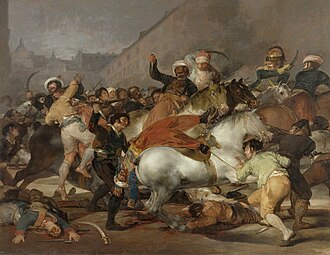 Dos de Mayo - Francisco Goya (1814)
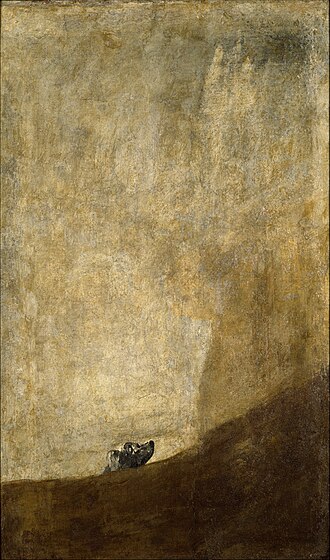 Le Chien - Francisco Goya (1819)
 Le Sabbat des sorcières - Francisco Goya (1820s)
Œuvres d'artistes liés
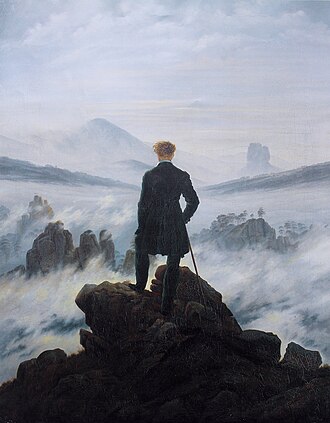 Le Voyageur contemplant une mer de nuages - Caspar David Friedrich (c. 1818)
 L'Abbaye dans une forêt de chênes - Caspar David Friedrich (1800s)
 Le Dernier Voyage du Téméraire - J. M. W. Turner (1839)
 Pluie, Vapeur et Vitesse - J. M. W. Turner (1844)
 La Liberté guidant le peuple - Eugène Delacroix (1830)
 La Mort de Sardanapale - Eugène Delacroix (1827)