La Vierge au lapin
Titien · 1530
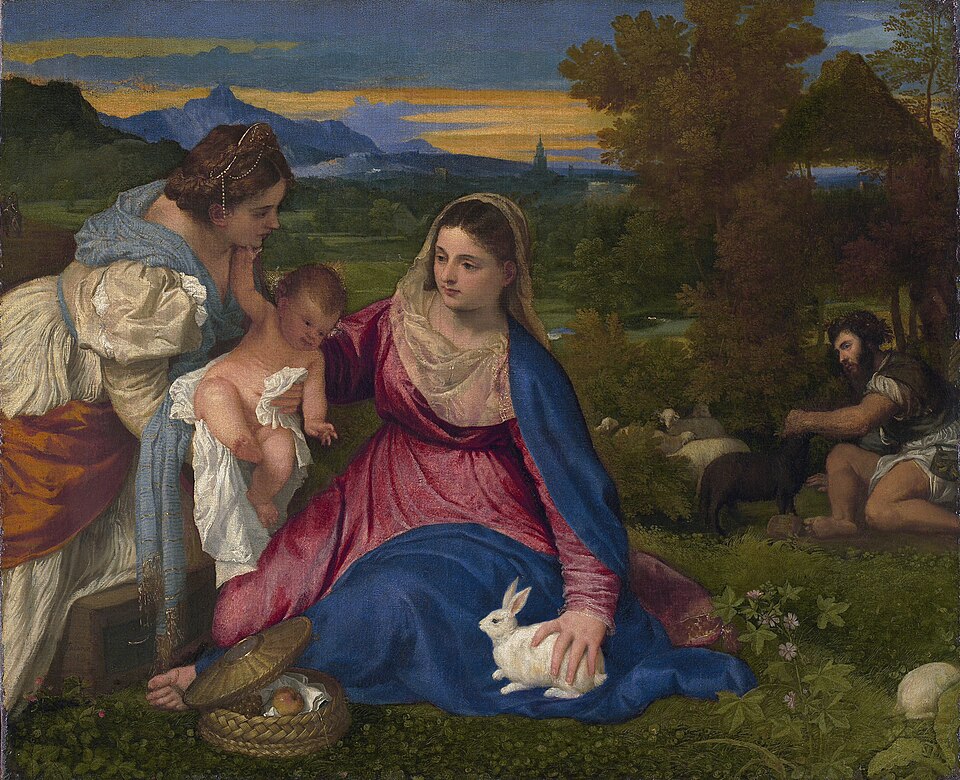
Mary strokes a white rabbit while a young woman hands her the Christ Child in a meadow at dusk. Titian painted this gentle scene in the year his wife died giving birth, and his grief may be hidden in it.
The story behind the painting
Records show that Federico Gonzaga of Mantua commissioned three paintings from Titian in 1529, and one of them can, with some security, be identified as this one. Its small size, about 71 by 87 cm, shows it was meant for private devotion. It is dated 1530 and signed Ticianus f. That year was hard for the painter. On 6 August 1530 his wife Cecilia died giving birth to their third child, Lavinia, who was entrusted to Titian's sister Orsa. Letters sent to Mantua by the ambassador Benedetto Agnello show that Titian was mourning and melancholic until at least October.
What to look for
The painting takes its name from the white rabbit that Mary holds in her left hand. Saint Catherine of Alexandria, dressed as a maid of honour, has her traditional broken wheel at her feet. She and Mary sit in a meadow beside a basket of fruit: apples for original sin, grapes for the Eucharist and redemption. In the background a shepherd looks on, a motif drawn from Giorgione. Wildflowers fill the foreground, and the sky shows orange streaks over a blue twilight, typical of Titian's mature landscape painting. An X-ray shows that at first Mary was looking toward the shepherd.
Meaning and intent
The rabbit stands for fertility and, being white, for Mary's purity and the mystery of the Incarnation. The source explains that female rabbits and hares can conceive a second litter while still pregnant, so they seemed to give birth without being impregnated, a symbol of virginity. The scene also echoes Titian's own life: the Christ Child passes into another woman's hands, just as his newborn daughter passed to his sister. The shepherd may be a portrait of Federico Gonzaga, given Mary's first glance toward him, or of the artist himself, since the shepherd seems sad and aloof like the mourning Titian.
Legacy
The flowered meadow recalls the locus amoenus, the pleasant place of classical poetry, and the Arcadian landscape found in works like the Pastoral Concert and Titian's Bacchanals for Ferrara. The painting's journey follows the great collections of Europe. With the rest of the Gonzaga collection it was acquired in 1627 by Charles I of England, and after his execution it was sold at auction. In 1665 it was acquired by the second Duke of Richelieu and Louis XIV. Today it is in the Louvre in Paris, a small devotional picture that carries both a theology of purity and the private sorrow of a widowed father.
Le saviez-vous ?
- Probably one of three works Federico Gonzaga ordered in 1529.
- Dated 1530 and signed Ticianus f.
- Painted the year Titian's wife Cecilia died in childbirth.
- Owned by Charles I, then Louis XIV; now in the Louvre.
À propos de l'artiste
Titien (1488-1576)
art religieux · Marie · Enfant Jésus · département des peintures du musée du Louvre · École vénitienne · robe · cheveux bruns · Catherine d'Alexandrie · lapin
Autres œuvres de Titien
.jpg) Vénus d'Urbin - Titian (1538)
Vénus d'Urbin - Titian (1538)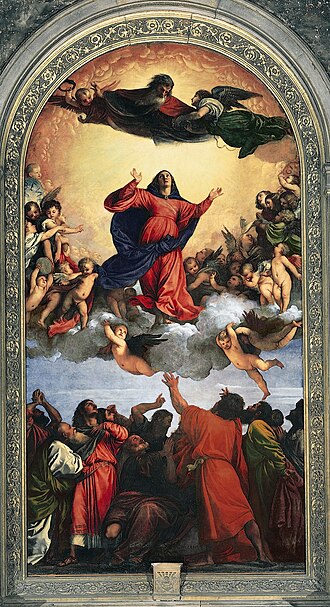 L'Assomption de la Vierge - Titian (1510s)
FXD.jpg) Amour sacré et Amour profane - Titian (1510s)
Amour sacré et Amour profane - Titian (1510s)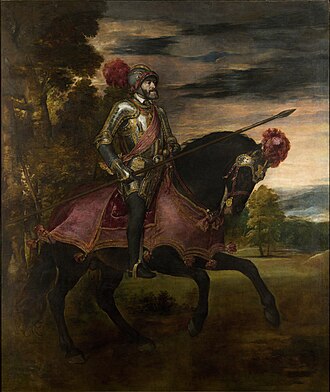 Charles Quint à cheval à Mühlberg - Titian (1548)
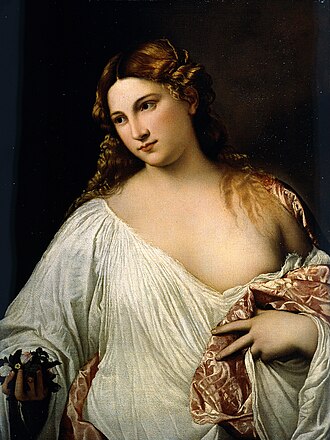 Flore - Titian (1517)
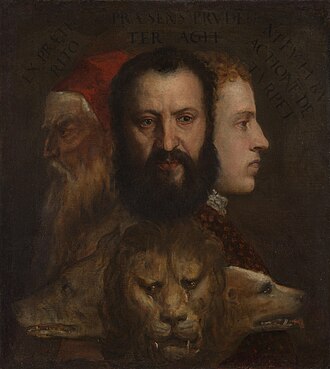 Allégorie du Temps gouverné par la Prudence - Titian (1550)
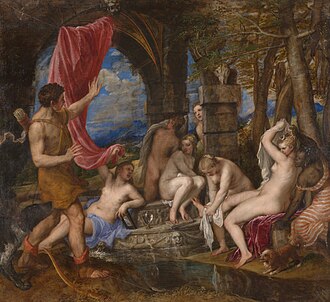 Diane et Actéon - Titian (1550s)
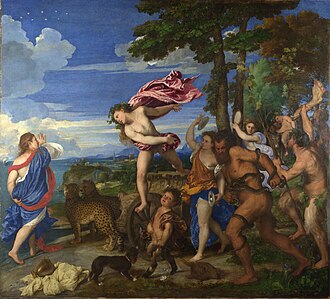 Bacchus et Ariane - Titian (1520s)
Œuvres d'artistes liés
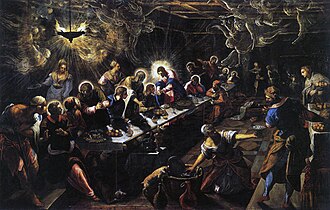 La Cène - Jacopo Tintoretto (1563)
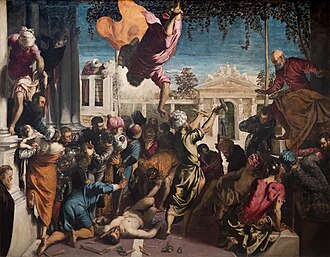 Miracle de l'esclave - Jacopo Tintoretto (1540s)
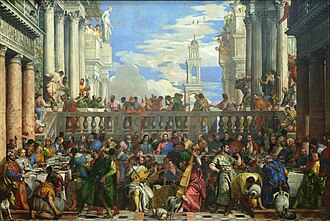 Les Noces de Cana - Paolo Veronese (1560s)
.jpg) Le Repas chez Levi - Paolo Veronese (1573)
Le Repas chez Levi - Paolo Veronese (1573)