Louis XIV et Molière
Jean-Léon Gérôme · 1862
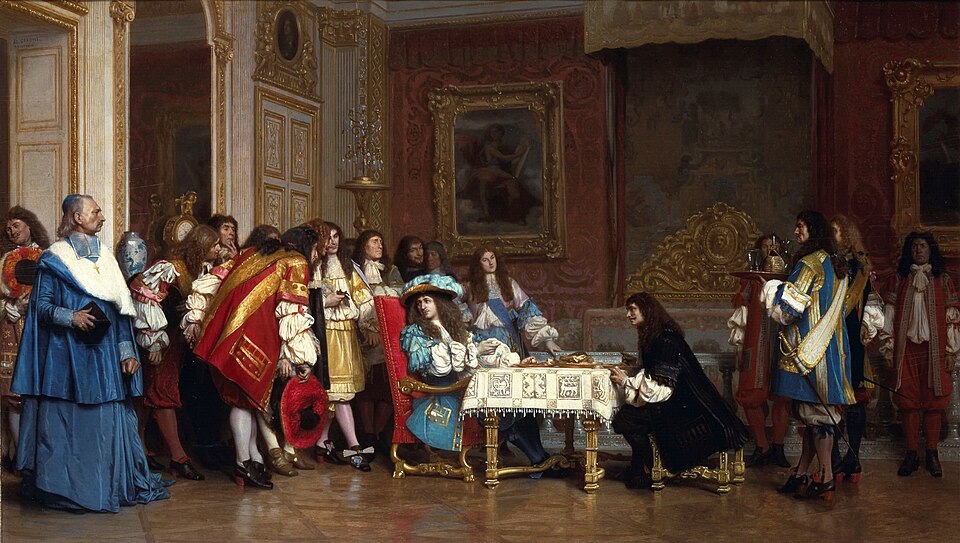
The Sun King shares his breakfast with Molière while the whole court watches, and the Archbishop of Paris does not hide his displeasure. Gérôme turned a court anecdote into a scene that critics loved to attack.
The story behind the painting
Jean-Léon Gérôme painted this oil on a wooden panel in 1862. The subject comes from an anecdote in the memoirs of Madame Campan, published in 1823. Molière had bought the post of valet of the king's chamber, which gave him the right to sit at table with the nobility, yet the other valets refused to eat with him. To rebuke the court, Louis XIV invited Molière to his own table and said: you see me busy feeding Molière, whom my valets do not find good enough company for them. It was the first time Gérôme painted a seventeenth-century history scene, following a painting of the same subject by Ingres.
What to look for
The scene takes place in the king's apartments at Versailles. In the centre, Louis XIV sits in a red velvet armchair with gilded arms, at a table where he shares a meal with Molière alone. Molière sits opposite on a stool, holding his fork. The composition is built on contrast: on the right, Molière, soberly dressed, with four servants behind him; on the left, the richly dressed king and a crowd of courtiers. Among them stands the Archbishop of Paris in a brilliant blue ecclesiastical robe, making no secret of his displeasure. The signature, J.L.GEROME, is on the door at the upper left.
Meaning and intent
The painting is about rank and respect. A king, at the summit of the court's rigid hierarchy, chooses to honour a playwright and actor whom the court looked down on, and makes his choice public at breakfast. The horizontal format, 45.7 by 78.7 cm, lets Gérôme line up the two worlds face to face, the plain Molière and the glittering court. Critics did not all accept this lighter tone. T. Pelloquet found the king too ordinary, with none of the dignity history gives him. Mantz wrote that he hoped it would be Gérôme's last mistake, accusing him of turning history into vaudeville.
Legacy
Gérôme showed the painting at the Salon of 1863, the same year as The Prisoner. Thanks to the publisher and dealer Goupil and Cie, the picture became very famous, and it was compared favourably with a work by Jacques-Edmond Leman at the same Salon. A study and an autograph replica exist in private collections. Gérôme went on to paint other scenes of Versailles, among them the Reception of the Grand Condé at Versailles in 1878. In 1940 the painting was bought for the public library of Malden, Massachusetts, where it remains.
Le saviez-vous ?
- Oil on wood panel, 1862, 45.7 x 78.7 cm.
- Based on an anecdote in Madame Campan's memoirs of 1823.
- Shown at the Salon of 1863.
- Bought in 1940 for the public library of Malden, Massachusetts.
À propos de l'artiste
Jean-Léon Gérôme (1824-1904)
Autres œuvres de Jean-Léon Gérôme
 Pollice verso - Jean-Léon Gérôme (1872)
 Le Marché aux esclaves - Jean-Léon Gérôme (1866)
 Phryné devant l'Aréopage - Jean-Léon Gérôme (1861)
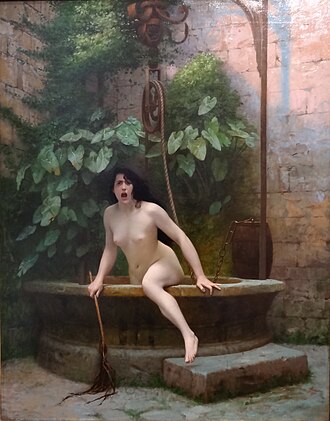 La Vérité sortant du puits armée de son martinet pour châtier l’humanité - Jean-Léon Gérôme (1896)
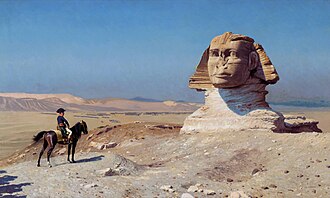 Bonaparte devant le Sphinx - Jean-Léon Gérôme (1867)
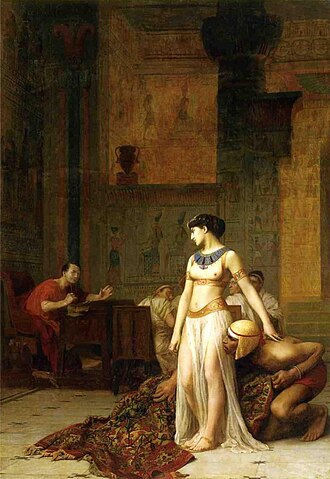 Cléopâtre et César - Jean-Léon Gérôme (1866)
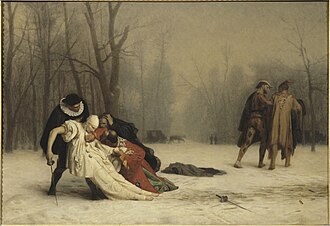 Suites d'un bal masqué - Jean-Léon Gérôme (1857)
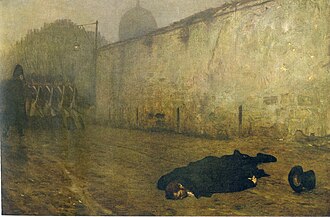 L'exécution du maréchal Ney - Jean-Léon Gérôme (1868)
Œuvres d'artistes liés
 Le Déjeuner sur l'herbe - Édouard Manet (1863)
 Olympia - Édouard Manet (1863)
 L'Origine du monde - Gustave Courbet (1866)
 Un enterrement à Ornans - Gustave Courbet (2020)
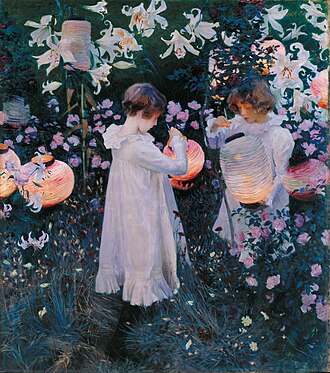 Œillet, lys, lys, rose - John Singer Sargent (1885-1886)
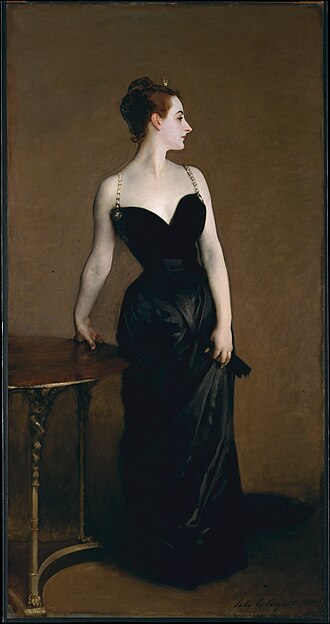 Madame X - John Singer Sargent (1884)
 La Liberté guidant le peuple - Eugène Delacroix (1830)
 La Mort de Sardanapale - Eugène Delacroix (1827)
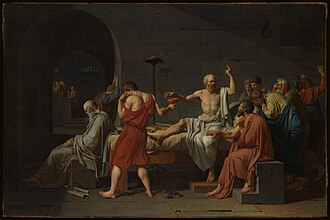 La Mort de Socrate - Jacques-Louis David (1787)
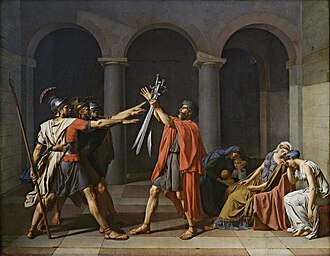 Le Serment des Horaces - Jacques-Louis David (1784)
 The Ladies Waldegrave - Joshua Reynolds (1780)
 Capitaine George K. H. Coussmaker - Joshua Reynolds (1782)