Jean-Léon Gérôme
1824-1904
By 1880 Jean-Léon Gérôme was arguably the most famous living artist in the world, his pictures reproduced everywhere. His thumbs-down gladiator scene still echoes in films today, and more than 2,000 students passed through his studio.
Origins
Jean-Léon Gérôme was born at Vesoul, in Haute-Saône, on 11 May 1824. He first learned drawing at school there, under the local artist and teacher Claude-Basile Cariage, and his work was good enough to deserve better teaching. In 1840, at 16, he was sent to Paris to study under Paul Delaroche, whom he followed to Italy in 1843, visiting Florence, Rome, the Vatican and Pompeii. Back in Paris in 1844 he joined the studio of Charles Gleyre for a short time and then attended the École des Beaux-Arts. In 1846 he tried for the Prix de Rome but failed in the final stage because his figure drawing was judged inadequate.
Life and turning points
His Cock Fight won a third-class medal at the Salon of 1847, and a review by the critic Théophile Gautier made him famous. He gave up on the Prix de Rome and seized his success. A state commission in 1852 funded travel to Constantinople, Greece and the Danube, and in 1856 he made his first trip to Egypt, the start of many Orientalist pictures. In 1863 he married Marie Goupil, daughter of the art dealer Adolphe Goupil; they had four daughters and a son. From 1864 he taught at the École des Beaux-Arts, and in 1865, on his fifth attempt, he was elected to the Institut de France. In his thirties he also took up sculpture. He died on 10 January 1904.
Style and technique
Gérôme worked in the style now called academicism, across history painting, Greek myth, Orientalism and portraits, often with very fine finish. On his travels he collected objects and costumes to stage scenes in the studio and made oil sketches outdoors for backgrounds; in 1878 he wrote that he preferred three touches of colour on canvas to the most vivid memory. The source notes that pictures such as The Slave Market combined accurately observed Middle Eastern architecture with idealised nudes painted in Paris, so they were works of imagination. As a sculptor he experimented with tinted marble, bronze, ivory and gems, as in Bellona, shown at the Royal Academy in London in 1892.
Stories and anecdotes
His studio at the École was famous for rowdy student initiations, from slashing canvases to fencing on the model's stand. Gérôme came every Wednesday and Saturday; a student called him merciless in judgement yet possessed of a singular magnetism. The Execution of Marshal Ney, shown in 1868, split opinion, and he refused a request from Ney's family to withdraw it; a caricature showed him before a wall with the critics as firing squad. In 1894 he publicly opposed Caillebotte's bequest of Impressionist paintings to the State. Of Manet's memorial exhibition in 1884, he remarked that it was not so bad as he had thought.
Legacy
Gérôme was among the most important painters of the academic period and, with Meissonier and Cabanel, one of the three most successful artists of the Second Empire. Pollice Verso, his 1872 scene of gladiators in the Colosseum, became one of his most famous works, and its thumb signalling life or death was repeated in films up to the 2000 Oscar winner Gladiator. Between 1864 and 1904 more than 2,000 students learned at least part of their art in his studio, among them Mary Cassatt, Thomas Eakins and Osman Hamdi Bey. He was demanding, but he also invited students to his own studio and recommended them to the Salon, and his influence spread far across the world.
Le saviez-vous ?
- He was invited to the opening of the Suez Canal in 1869.
- In 1851 he decorated a vase that Napoleon III gave to Prince Albert, now in the Royal Collection.
- His home and studio at the Boîte à Thé became a meeting place where George Sand entertained Berlioz, Brahms and Rossini.
- He was named honorary president of the Society of French Orientalist Painters, founded in 1893.
académisme · orientalisme · peinture orientaliste
Artistes liés
Édouard Manet · Gustave Courbet · John Singer Sargent · Eugène Delacroix · Jacques-Louis David · J. M. W. Turner · Gustave Moreau
Œuvres de Jean-Léon Gérôme
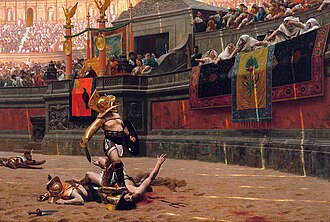 Pollice verso - Jean-Léon Gérôme (1872)
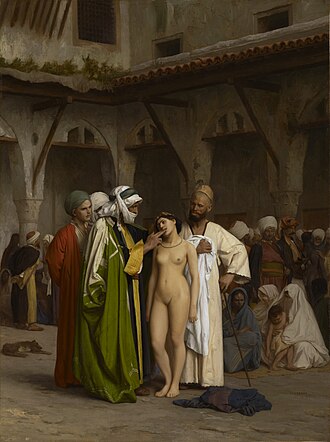 Le Marché aux esclaves - Jean-Léon Gérôme (1866)
%20-%2001.jpg) Phryné devant l'Aréopage - Jean-Léon Gérôme (1861)
Phryné devant l'Aréopage - Jean-Léon Gérôme (1861)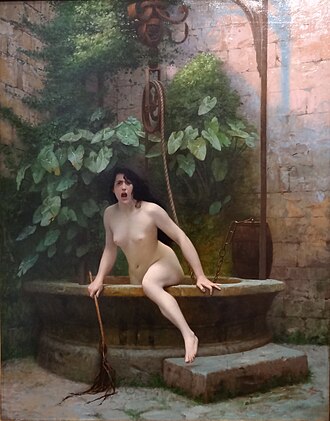 La Vérité sortant du puits armée de son martinet pour châtier l’humanité - Jean-Léon Gérôme (1896)
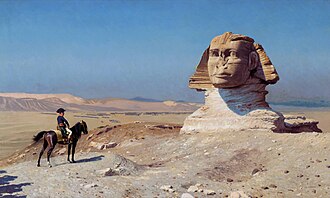 Bonaparte devant le Sphinx - Jean-Léon Gérôme (1867)
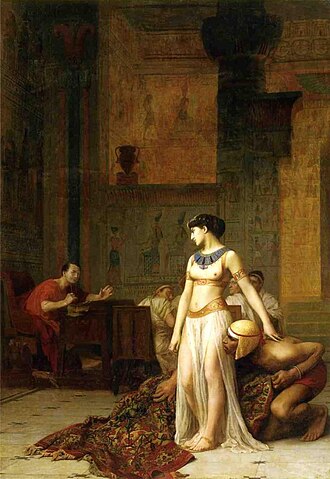 Cléopâtre et César - Jean-Léon Gérôme (1866)
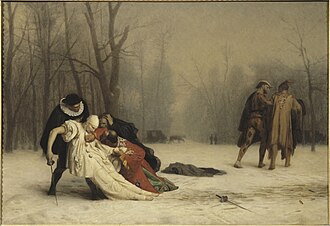 Suites d'un bal masqué - Jean-Léon Gérôme (1857)
.jpg) L'exécution du maréchal Ney - Jean-Léon Gérôme (1868)
L'exécution du maréchal Ney - Jean-Léon Gérôme (1868)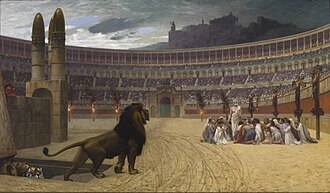 Dernières prières des martyrs chrétiens - Jean-Léon Gérôme (1883)
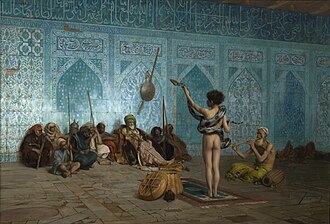 Le Charmeur de serpents - Jean-Léon Gérôme (1879)