Les Bords du Loing vers Moret
Alfred Sisley · 1883
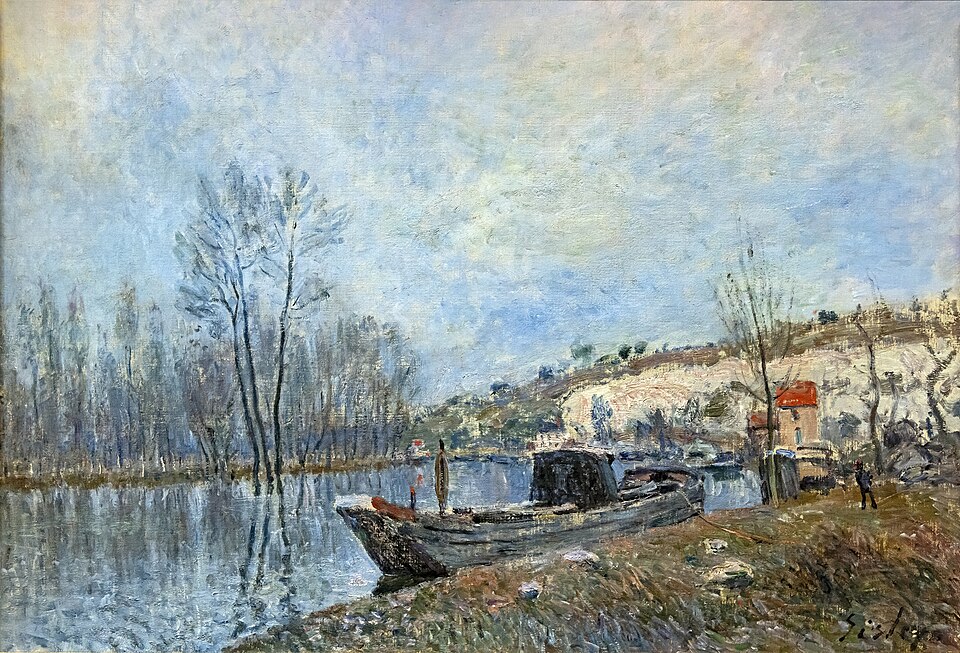
A grey, still river, a long barge at the bank and poplars whose shadows twist in the current. Sisley painted the Loing near Moret in 1883, faithful to working outdoors when his friends had gone back to the studio.
The story behind the painting
In 1880 Alfred Sisley settled in the Moret area, first at Veneux-Nadon, where the Loing meets the Seine beside the forest of Fontainebleau and the railway from Paris runs through. With financial help from Paul Durand-Ruel he moved to Moret in 1882, then in September 1883 to Les Sablons nearby. Life there was much cheaper than in Paris, which mattered to a painter in financial difficulty. In 1881 he wrote to Claude Monet praising Moret: two hours from Paris, houses to rent, a weekly market, a very pretty church, fairly picturesque views. He painted this canvas, about 50 by 73 cm, in 1883.
What to look for
The sale catalogue of François Depeaux's collection described it under the title Environs de Moret: the bank on the right with a long barge moored there; further on, a man near some trees, behind which two red-roofed houses stand at the foot of a chalky hill topped by scattered shrubs. On the left, the very calm river, grey like the sky, is bordered on the far bank by a line of poplars. Three of these trees stand in the water and send long shadows into it, twisted by the current. Look for those bending reflections, the quiet heart of the picture.
Meaning and intent
In 1880 Émile Zola, once a defender of Impressionism, wrote that the Impressionists had not produced masterpieces that would last. Renoir, Monet and Pissarro went back to working in their studios. Sisley stayed faithful to Impressionism, painting on the spot to catch the light at each time of day and in each kind of weather. Still, he changed his technique in response to Zola: his palette grew richer, he followed the principle of complementary colours more closely, and he began to separate the planes of his landscapes. This painting is characteristic of his work in the 1880s.
Legacy
François Depeaux, a collector from Rouen who loved Sisley's snow scenes and views of Moret, bought this picture from the artist. In 1909 he wrote to Durand-Ruel that he could not understand why Sisley's paintings were hard to sell, since of all the Impressionists his painting held the most poetry and would continue to be the best understood. The picture was sold in the Depeaux sale in Paris in 1906 and passed through several collections before Georges Bemberg acquired it in 1963. It was shown at the Galerie Daber in Paris in 1956 and is now in the Fondation Bemberg in Toulouse.
Le saviez-vous ?
- Painted in 1883, about 50 x 73 cm.
- Sisley settled in the Moret area in 1880.
- Bought from the artist by the Rouen collector François Depeaux.
- Now in the Fondation Bemberg, Toulouse.
À propos de l'artiste
Alfred Sisley (1839-1899)
Autres œuvres de Alfred Sisley
 Le Canal du Loing - Alfred Sisley (1892)
 L'Abreuvoir à Marly-Le-Roi, gelée blanche - Alfred Sisley (1876)
 L'Aqueduc de Marly - Alfred Sisley (1874)
 La Neige à Louveciennes - Alfred Sisley (1875)
 La Machine de Marly - Alfred Sisley (1873)
 L'Inondation à Port-Marly - Alfred Sisley (1876)
 Paysage d'hiver à Louveciennes - Alfred Sisley (1874)
 La Seine à Bougival - Alfred Sisley (1873)
Œuvres d'artistes liés
 Impression, soleil levant - Claude Monet (1872)
 Nymphéas - Claude Monet (1906)
 Le Déjeuner sur l'herbe - Édouard Manet (1863)
 Olympia - Édouard Manet (1863)
 Bal du moulin de la Galette - Pierre-Auguste Renoir (1876)
 Le Déjeuner des canotiers - Pierre-Auguste Renoir (1881)
 Le Berceau - Berthe Morisot (1872)
 Jour d'été - Berthe Morisot (1879)
 L'Absinthe - Edgar Degas (1875)
 La Famille Bellelli - Edgar Degas (1858)
 Rue de Paris, temps de pluie - Gustave Caillebotte (1877)
 Les Raboteurs de parquet - Gustave Caillebotte (1875)