Alfred Sisley
1839-1899
Alfred Sisley painted rivers, floods, village streets and wide skies with a quiet constancy no other Impressionist matched. Born in Paris to English parents, he lived most of his life in hardship, and only after his death did the world see what he had given to landscape painting.
Origins
Sisley was born in Paris on 30 October 1839, the youngest of four children of William Sisley, a prosperous British merchant of imported luxury goods, and Felicia Sell. Little is known of his childhood beyond the fact that he was educated in both French and English. In 1857, at eighteen, he was sent to London to live with English relatives and prepare for a career in the family import and export business. According to his friend and biographer Gustave Geffroy, he stayed a few years but learned above all painting from Turner and Constable and literature from Shakespeare. Showing no talent for business, he returned to Paris in 1861. That same year he entered the studio of the Swiss painter Charles Gleyre at the École des Beaux-Arts, where he became friends with Frédéric Bazille, Claude Monet and Pierre-Auguste Renoir.
Life and turning points
Unlike Monet and Renoir, Sisley was supported by his family while he studied, and he shared a studio with Renoir. In 1866 he met Eugénie Lescouezec, a model and florist; they had a son, Pierre, in 1867, a daughter, Jeanne, in 1869, and a second son who died in infancy. The Franco-Prussian War of 1870 to 1871 ruined his father's business, and the family's support ended, also because of Eugénie's humble, unmarried status. From then on Sisley depended on patrons, friends and sales. In 1874, after the first Impressionist exhibition, he went to London with the singer Jean-Baptiste Faure and painted around Hampton Court. In 1897 the couple travelled to Wales and married in Cardiff. Eugénie died in October 1898, and Sisley, ill with throat cancer, died on 29 January 1899 at Moret-sur-Loing, aged 59.
Style and technique
Sisley is considered the most consistent of the Impressionists in his devotion to painting outdoors, and his work is almost entirely landscape. With Monet, Renoir and Bazille he worked en plein air to catch the passing effects of sunlight, producing pictures more colourful and loosely painted than the public expected, which the Salon usually rejected. His early landscapes are sombre, in dark browns, greens and pale blues. Turner, Constable, Courbet and Corot may have influenced him, and he drew on Camille Pissarro and Édouard Manet. His style resembles Monet's, though his effects are more subdued, and his skies are always impressive. Art historian Robert Rosenblum described his work as almost a textbook idea of a perfect Impressionist painting. His great subjects include the Thames at Hampton Court, the floods at Marly-le-Roi in 1875, the Seine west of Paris and the church at Moret.
Stories and anecdotes
The art historian Kenneth Clark called Sisley's twenty paintings of the Thames near Hampton Court 'a perfect moment of Impressionism'. A painting trip to the Isle of Wight in 1881 had to be abandoned when his canvases and materials, shipped from France, never arrived. On his last visit to Britain, he painted from the cliffs above Penarth, and after the wedding the couple honeymooned at Langland Bay on the Gower Peninsula, where he painted the coves. Though he lived in France all his life, he twice applied for French citizenship late on, and illness intervened; he remained a British citizen. His Lane of Poplars at Moret has been stolen three times from the museum in Nice, once by its own curator, and was found once in the sewers of Marseille.
Legacy
Sisley received little recognition or money in his lifetime. Before he died he asked Monet to look after his children, who were left with little more than unsold canvases. Monet organised a benefit auction at the Galerie Georges Petit in May 1899, adding works donated by friends across the Impressionist circle. Sisley left more than 900 oil paintings and about 100 pastels. Since his death his work has been reassessed, and his contribution to Impressionism and French landscape painting is now widely recognised, with major retrospectives in London, Paris, Baltimore, Madrid, Lyon, Cardiff and elsewhere. Some of his paintings were looted by the Nazis from Jewish collectors, and several have since been returned to the owners' heirs. In his calm rivers and open skies, the gentle heart of Impressionism endures.
Le saviez-vous ?
- Sisley's father commissioned a portrait of himself from Renoir.
- His student works from Gleyre's studio are lost, and his studio in Bougival was destroyed in the Franco-Prussian War.
- Monet and Renoir both attended his funeral at Moret.
- His Street in Moret and Sand Heaps belong to the Art Institute of Chicago.
Artistes liés
Claude Monet · Édouard Manet · Pierre-Auguste Renoir · Berthe Morisot · Edgar Degas · Gustave Caillebotte · Camille Pissarro · Joaquín Sorolla
Œuvres de Alfred Sisley
 Le Canal du Loing - Alfred Sisley (1892)
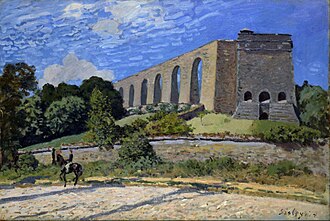 L'Aqueduc de Marly - Alfred Sisley (1874)
 L'Abreuvoir à Marly-Le-Roi, gelée blanche - Alfred Sisley (1876)
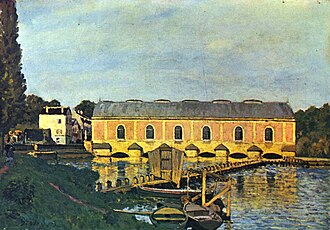 La Machine de Marly - Alfred Sisley (1873)
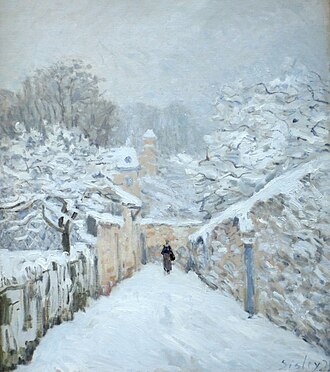 La Neige à Louveciennes - Alfred Sisley (1875)
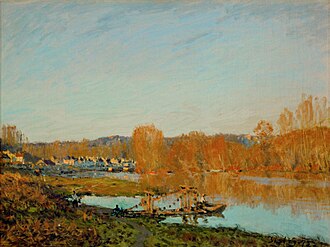 L'Automne: Bord de la Seine près de Bougival - Alfred Sisley (1873)
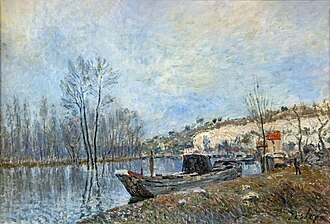 Les Bords du Loing vers Moret - Alfred Sisley (1883)
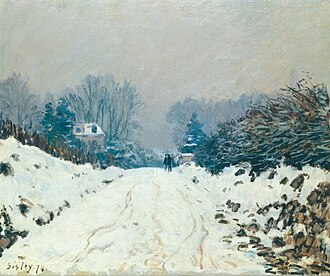 Paysage d'hiver à Louveciennes - Alfred Sisley (1874)
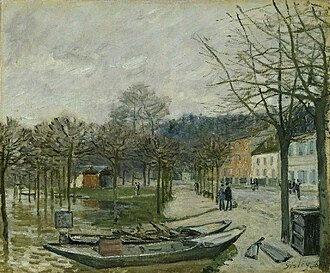 L'Inondation à Port-Marly - Alfred Sisley (1876)
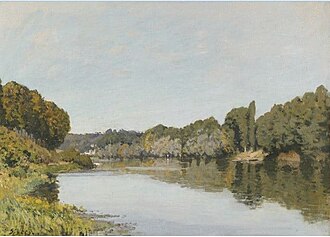 La Seine à Bougival - Alfred Sisley (1873)
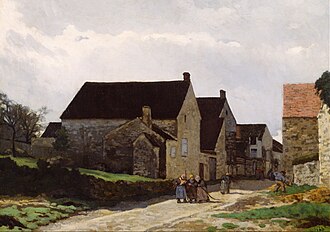 Femmes allant au bois, paysage - Alfred Sisley (1866)