Paysage avec Orphée et Eurydice
Nicolas Poussin · 1650
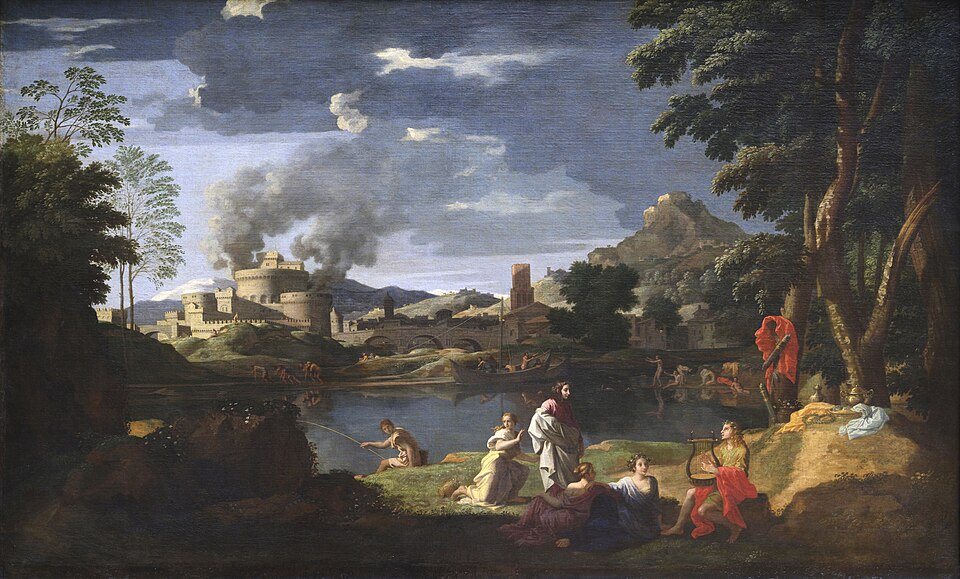
Orpheus and Eurydice in a Roman countryside, while smoke pours from a burning castle and dark clouds gather. Poussin made the myth into a landscape, and it remains one of his most cryptic pictures.
The story behind the painting
Poussin painted this work between 1650 and 1653 for his longtime friend and patron Jean Pointel, a rich Paris banker. Pointel, like Poussin himself, moved in the circle of the libertines, and his collection held many works by Poussin. When the political climate in Paris changed, this painting was stored away, and another Poussin landscape, with a snake and a dying man, hung in its place in Pointel's private collection. Wikidata gives the year 1650, the start of that period.
What to look for
The canvas is large, 124 by 200 cm. Poussin sets the Greek story in the Campagna Romana, the countryside around Rome: you can recognise the Castel Sant'Angelo and the Torre delle Milizie, borrowed from the Eternal City. Dense smoke rises from a fire that devastates the castle and darkens a sky already heavy with sombre clouds. The fall of light cuts the landscape diagonally into bright and dark zones, a division you can see clearly on the Torre delle Milizie.
Meaning and intent
The source says the work remains cryptic, with various opinions about how to read it. It does not settle on one meaning, and neither should we. What the painting offers for certain is a contrast: a myth of love and loss placed inside a calm classical landscape, while fire and smoke darken the city behind. The meaning is left to the viewer. Even the patron who owned it chose, for a time, to keep it out of sight.
Legacy
Many of Poussin's pictures have darkened, mainly because a red underpainting has begun to show through the colours. The Orpheus has escaped this: it has kept its original transparency even in its darker passages, and the whole painting is in a particularly fine state of preservation. It is in the collection of the Louvre in Paris. Its clear, unfaded colour lets visitors see Poussin's light much as Pointel first saw it.
Le saviez-vous ?
- Painted 1650 to 1653 for the banker Jean Pointel.
- Set in the Roman countryside with Castel Sant'Angelo.
- Unusually well preserved among Poussin's works.
- Held by the Louvre, Paris.
À propos de l'artiste
Nicolas Poussin (1594-1665)
femme · homme · département des peintures du musée du Louvre · serpent · paysage historique
Autres œuvres de Nicolas Poussin
 L'Adoration du Veau d'or - Nicolas Poussin (1634)
 La Danse de la vie humaine - Nicolas Poussin (1630s)
 La Peste d'Asdod - Nicolas Poussin (1630)
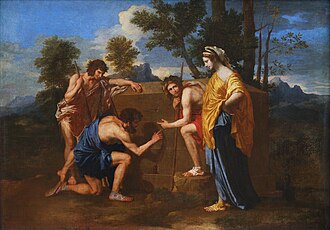 Les Bergers d'Arcadie - Nicolas Poussin (1638)
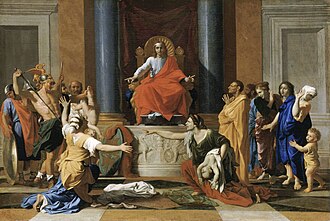 Le Jugement de Salomon - Nicolas Poussin (1649)
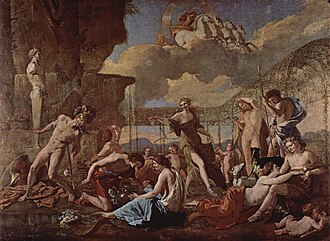 L'Empire de Flore - Nicolas Poussin (1631)
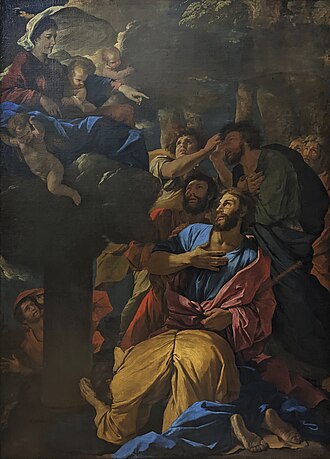 L'Apparition de la Vierge à saint Jacques le Majeur - Nicolas Poussin (1620s)
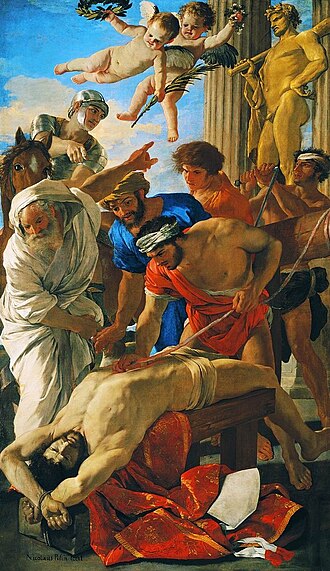 Le Martyre de saint Érasme - Nicolas Poussin (1628)