La Lamentation du Christ
Rogier van der Weyden · 1460s
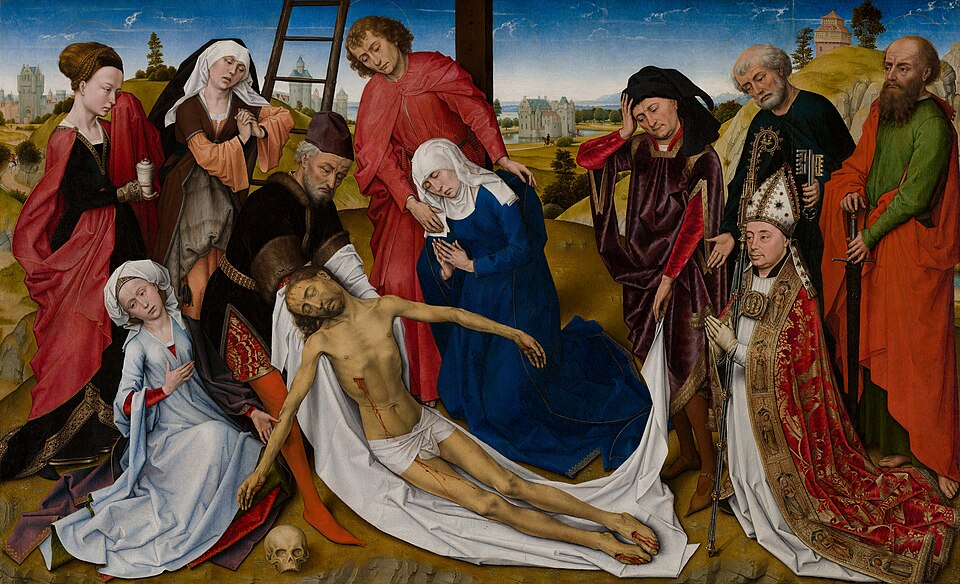
Mourners crowd around the dead body of Christ, and among them kneels a bishop in a gorgeous cope, as if he had stepped into the Gospel scene. Who he was, and when the panel was painted, are still open questions.
The story behind the painting
This oil on panel in the Mauritshuis in The Hague came from the workshop of Rogier van der Weyden, perhaps around 1460 to 1464, though the dating is disputed. Erwin Panofsky identified the patron, who took Saint Peter as his patron saint, as Pierre de Ranchicourt, the only bishop named Pierre at the time. If so, the panel cannot predate April 1463, when Ranchicourt became Bishop of Arras, and Rogier may have made the first design before his death in 1464, with assistants finishing it. Others name Jean Chevrot, which would mean a much earlier date, while Albert Chatelet proposed Philippe Courault, abbot of Saint Peter's in Ghent.
What to look for
The panel, about 81 by 130 cm, surrounds the body of Christ with those the Bible places at the crucifixion: Mary, the apostle John, Mary Magdalene and the two other Marys, along with Nicodemus and Joseph of Arimathea, who embalmed and buried the body. The kneeling bishop is painted with great care. The top of his crozier shows the Annunciation, the clasp of his cope shows Christ blessing between two angels, and the Twelve Apostles run along its hems. Behind him stand Saint Peter with the key and Saint Paul with the sword.
Meaning and intent
Placing a living patron beside the mourners turned a scene of grief into a personal prayer. The bishop kneels as a witness, presented by the two great apostles as if they were his protectors or illustrious predecessors. Art historians agree that most of the painting is not by Rogier himself, but it is of high quality, and parts such as the body of Christ could be his. The composition as a whole is less coherent and harmonious than one would expect from him, a sign of many hands at work.
Legacy
The panel is a variation on earlier Lamentations by Rogier, such as the Miraflores Altarpiece and the Brussels Christ mourned by his Mother, Saint John and Mary Magdalene. Its underdrawing resembles that of his authentic works. Some figures come from workshop drawings: the kneeling woman in the foreground reappears, mirrored, as Mary Magdalene in a Cologne imitation of his famous Descent from the Cross. Underdrawing shows an ointment jar was first planned beside her, the Magdalene's usual attribute, though in the finished work the Magdalene stands at far left.
Le saviez-vous ?
- Workshop of Rogier van der Weyden, dating disputed (about 1460-1464).
- Panofsky identified the bishop as Pierre de Ranchicourt.
- Saints Peter and Paul stand behind the kneeling patron.
- Kept in the Mauritshuis, The Hague.
À propos de l'artiste
Rogier van der Weyden (1390s-1464)
art religieux · femme · homme · Jésus-Christ · Primitifs flamands · cadavre · Mauritshuis
Autres œuvres de Rogier van der Weyden
 La Descente de Croix - Rogier van der Weyden (1440s)
 Portrait d'une dame - Rogier van der Weyden (1460)
 Le Jugement dernier - Rogier van der Weyden (1443)
 Saint Luc dessinant la Vierge - Rogier van der Weyden (1490)
 Columba triptyque - Rogier van der Weyden (1450s)
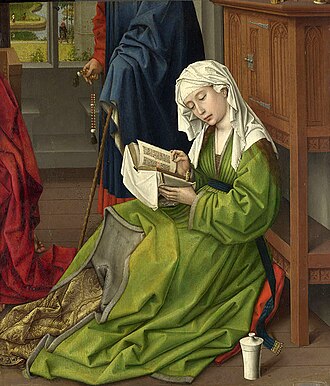 Marie Madeleine lisant - Rogier van der Weyden (1435)
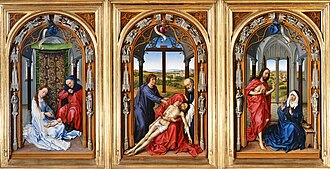 Retable de Miraflores - Rogier van der Weyden (1443)
 Triptyque de la famille Braque - Rogier van der Weyden (1452)
Œuvres d'artistes liés
 Les Époux Arnolfini - Jan van Eyck (1434)
 L'Agneau mystique - Jan van Eyck (1432)
 L'Annonciation - Hans Memling (1480s)
 Scènes de la Passion du Christ - Hans Memling (1470)
 Le Jardin des délices - Hieronymus Bosch
 La Nef des fous - Hieronymus Bosch (1500s)
 Les Chasseurs dans la neige - Pieter Bruegel the Elder (1565)
 Les Proverbes flamands - Pieter Bruegel the Elder (1551)