Lamentation sur le Christ mort et Mise au tombeau
Rogier van der Weyden · 1450
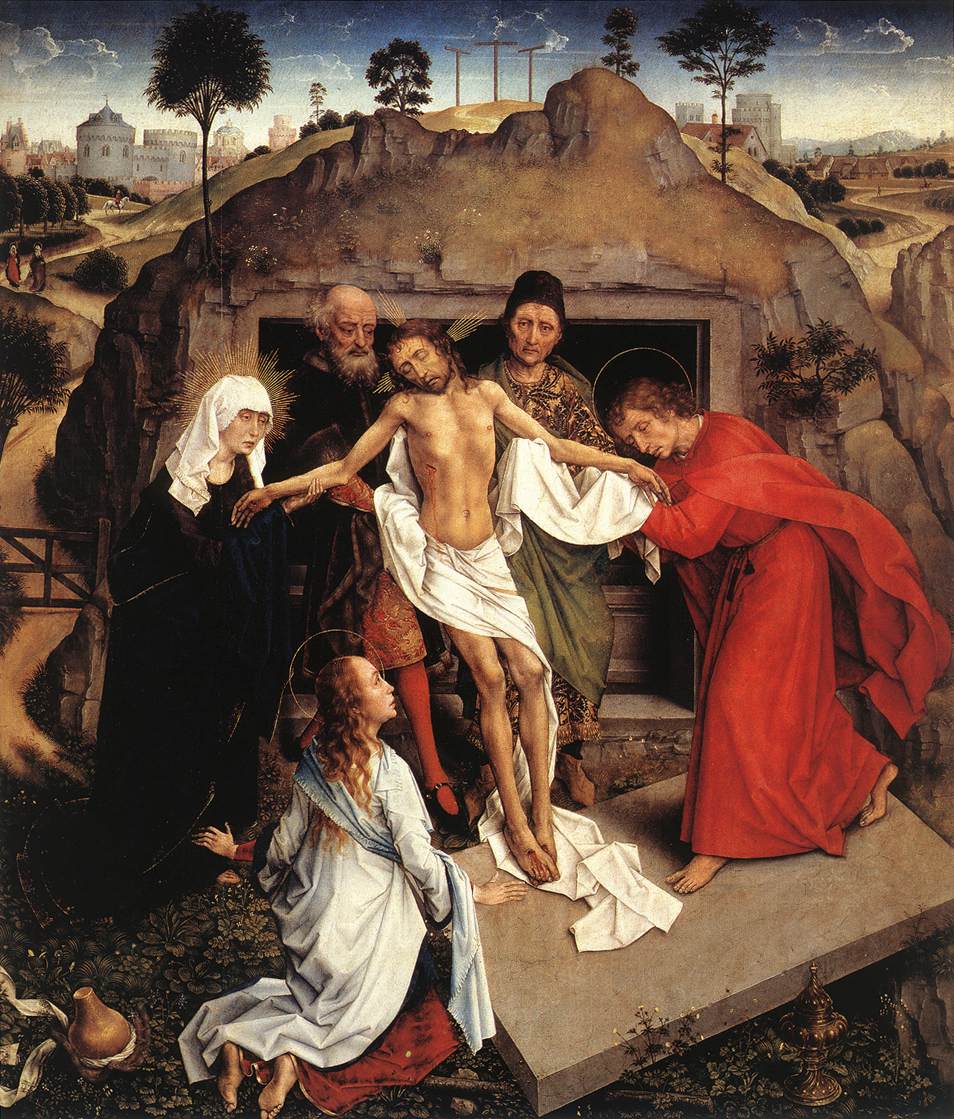
A Flemish master travels to Italy, sees a Florentine Pieta, and answers it with deeper colours and more anguished faces. This panel in the Uffizi is a meeting point between Florence and Flanders.
The story behind the painting
Wikipedia dates this oil on panel to around 1460 to 1463, while Wikidata gives 1450, the year linked to Rogier's pilgrimage to Italy in 1449 and 1450, mentioned by Bartolomeo Facio around 1456. It may be the altarpiece with Our Lord's sepulchre and five other figures listed in 1492 at the death of Lorenzo de' Medici, which hung in the Medici villa at Careggi from as early as 1482. Other theories link it to a lost triptych for Lionello d'Este of Ferrara mentioned in 1449, or to a painting Vasari gave to Hans Memling.
What to look for
The panel, about 110 by 96 cm, shows Christ being laid in the tomb. The weeping Mary and John the Evangelist hold his hands. Joseph of Arimathea and Nicodemus support the body; Nicodemus, in refined clothing of the time, gazes out toward us, and was once thought to be a self-portrait of the artist but is now known to portray Cosimo the Elder. Mary Magdalene kneels low in the foreground. Notice the faces, more anguished than in Italian versions, and the deep, glowing colour made possible by oil.
Meaning and intent
The composition follows the same scheme as Fra Angelico's Pieta for the predella of the San Marco Altarpiece, made between 1438 and 1443 and now in Munich, which supports the idea that Rogier saw it in Florence. Yet he transforms it. His scene is more crowded and complex, the lines less geometrically ordered, and the grief more raw. With oil paint he reached deeper colours and brighter light, and his attention to detail is typical of the early Netherlandish school. It is a dialogue between two traditions, held in one image of mourning.
Legacy
The panel belonged to Cardinal Carlo de' Medici and moved to the Uffizi in 1666. Its authorship wandered for centuries: Filippo Baldinucci called it a work by Albrecht Durer, and as late as 1989 some scholars still gave it to Memling. In 1992 reflectography revealed the underdrawing, clearly by van der Weyden, settling the question. It may also belong to a group of Medici commissions to the artist that includes the Medici Madonna now in the Stadel in Frankfurt. Today it remains in Florence.
Le saviez-vous ?
- Dated around 1460-1463 by Wikipedia; Wikidata gives 1450.
- Probably owned by the Medici, possibly listed in 1492.
- Nicodemus is now thought to portray Cosimo the Elder.
- Reflectography in 1992 confirmed van der Weyden's hand.
À propos de l'artiste
Rogier van der Weyden (1390s-1464)
art religieux · femme · homme · Jésus-Christ · Primitifs flamands · cheveux longs · galerie des Offices · Marie de Magdala · déploration du Christ
Autres œuvres de Rogier van der Weyden
 La Descente de Croix - Rogier van der Weyden (1440s)
 Portrait d'une dame - Rogier van der Weyden (1460)
 Le Jugement dernier - Rogier van der Weyden (1443)
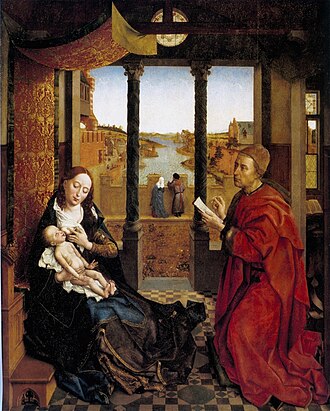 Saint Luc dessinant la Vierge - Rogier van der Weyden (1490)
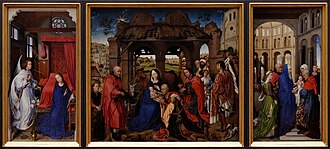 Columba triptyque - Rogier van der Weyden (1450s)
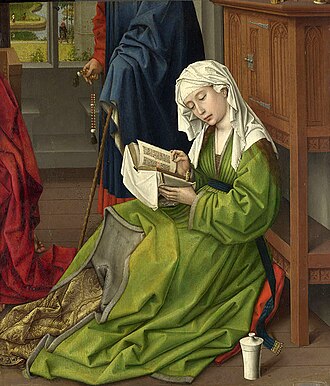 Marie Madeleine lisant - Rogier van der Weyden (1435)
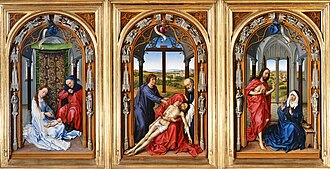 Retable de Miraflores - Rogier van der Weyden (1443)
 Triptyque de la famille Braque - Rogier van der Weyden (1452)
Œuvres d'artistes liés
 Les Époux Arnolfini - Jan van Eyck (1434)
 L'Agneau mystique - Jan van Eyck (1432)
 L'Annonciation - Hans Memling (1480s)
 Scènes de la Passion du Christ - Hans Memling (1470)
 Le Jardin des délices - Hieronymus Bosch
 La Nef des fous - Hieronymus Bosch (1500s)
 Les Chasseurs dans la neige - Pieter Bruegel the Elder (1565)
 Les Proverbes flamands - Pieter Bruegel the Elder (1551)