Chasse avec un appeau
Francisco Goya · 1775
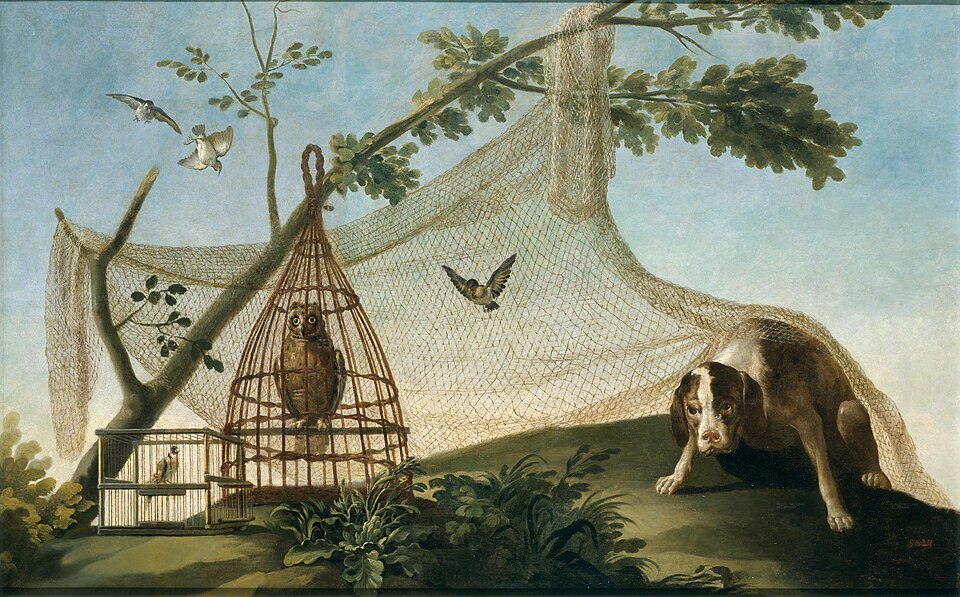
An owl as bait, two caged birds, a net and a dog that rules the whole scene. Goya painted this hunting stand in 1775 to hang above a door in the royal dining room at El Escorial, and its success opened the way to his own inventions.
The story behind the painting
Goya painted Hunting with a Decoy, also called Hunting with an Owl and Net, in 1775 for his first series of tapestry cartoons. All the pictures in the series were meant for the dining room of the Prince of Asturias, the future Charles IV, and Maria Luisa of Parma at the palace of El Escorial. The canvas was delivered to the Royal Tapestry Factory with the rest of the series on 24 May 1775. Its wide format, 112 by 179 cm, came from its intended place above a door, and hunting, the favourite pleasure of the king and his son, was chosen for a site where they hunted.
What to look for
The canvas shows a hunting stand with a lure: an owl, two birds shut in their cages, a dog, and a net that frames everything. The owl seems to have been copied from a dissection study, and it resembles the owl that Goya would later use in his drawings as a symbol of evil. Like all the pictures of the first series, it is a simple canvas without a wide range of colours, perhaps because the weavers needed a simple model to work the loom well. Look for the simple pyramid shapes, the dog dominating the composition, and the diagonal branches that tie it together.
Meaning and intent
The source suggests Goya was interested in wildlife in his early years, and that this is exactly what he shows here. The influence of Francisco Bayeu, his brother-in-law, and of Anton Raphael Mengs is clear. Bayeu directed Goya, who remained so restrained that works by the two painters from this time can be confused. Still, it is a careful, detailed style meant to be seen from below because of its place above a door. The skies and trees typical of all Goya's cartoons are already clearly visible, and the historian Janis Tomlinson found the composition remarkable.
Legacy
It was probably well received by the royal family, since the directors of the factory then allowed Goya to paint cartoons of his own invention. That small freedom matters: it marks the step from following his elders to designing his own scenes. It was considered lost until 1869, when Gregorio Cruzada Villaamil found the canvas in the basement of the Royal Palace in Madrid. It was handed to the Prado in 1870 by orders of 19 January and 9 February, and first appeared in the museum's catalogue in 1876. Today it hangs in room 90.
Le saviez-vous ?
- Painted in 1775 for the first tapestry cartoon series.
- Designed to hang above a door in the royal dining room at El Escorial.
- Its owl resembles the owl Goya later used as a symbol of evil.
- Its success let Goya paint cartoons of his own invention.
À propos de l'artiste
Francisco Goya (1746-1828)
musée du Prado · arbre · chien · oiseau
Autres œuvres de Francisco Goya
 Tres de Mayo - Francisco Goya (1814)
 La Maja nue - Francisco Goya (1800)
 Saturne dévorant un de ses enfants - Francisco Goya (1819)
 La Famille de Charles IV - Francisco Goya (1800)
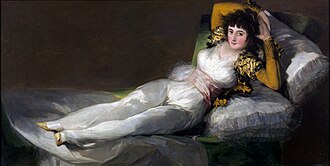 La Maja vêtue - Francisco Goya (1800)
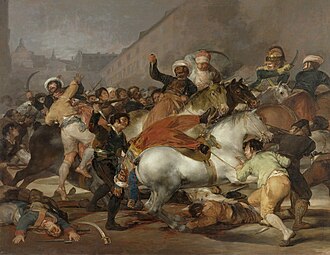 Dos de Mayo - Francisco Goya (1814)
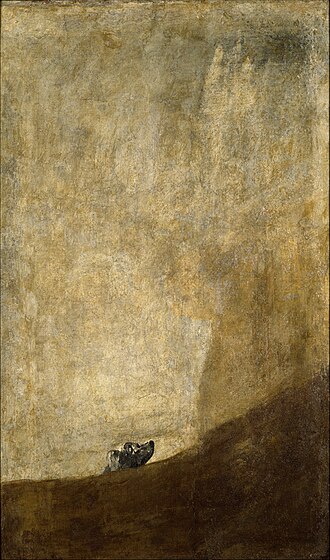 Le Chien - Francisco Goya (1819)
 Le Sabbat des sorcières - Francisco Goya (1820s)
Œuvres d'artistes liés
 Le Voyageur contemplant une mer de nuages - Caspar David Friedrich (c. 1818)
 L'Abbaye dans une forêt de chênes - Caspar David Friedrich (1800s)
 La Liberté guidant le peuple - Eugène Delacroix (1830)
 La Mort de Sardanapale - Eugène Delacroix (1827)
 Le Dernier Voyage du Téméraire - J. M. W. Turner (1839)
 Pluie, Vapeur et Vitesse - J. M. W. Turner (1844)
 L'Enfant bleu - Thomas Gainsborough (1770)
 Les Époux Andrews - Thomas Gainsborough (1748)