Paysage à Saint-Rémy
Vincent van Gogh · 1889
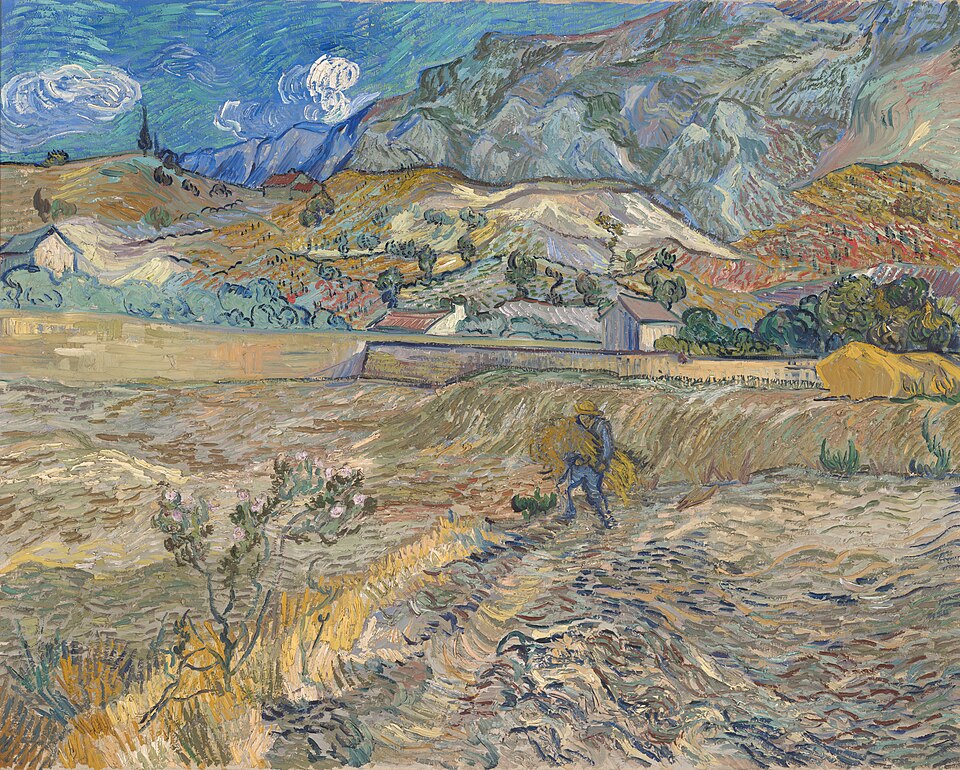
A violet ploughed field, the Alpilles climbing almost to the top edge, and one small figure dragging a bundle of straw. Van Gogh painted it from the asylum at Saint-Rémy as the partner to his yellow Reaper.
The story behind the painting
Van Gogh painted this canvas around 12 October 1889, working outdoors over several days. He had voluntarily entered the asylum at Saint-Rémy-de-Provence after his breakdown on Christmas Eve 1888, during Paul Gauguin's visit, and had only recently resumed painting. The field near the asylum was the same one he had painted earlier that year in The Reaper. It is also known as Landscape at Saint-Rémy, or Ploughed field with a man carrying a bundle of straw, and is catalogued as F641 and JH1795.
What to look for
The Size 30 canvas, about 73 by 92 cm, shows ploughed mounds, a lilac bush, a peasant carrying a wheatsheaf, a few buildings and the Alpilles with a small patch of sky. Van Gogh described it to Émile Bernard as broken lilac ploughed fields with mountains going all the way up the canvas, and a little violet and yellow man. To Theo he added a thistle and dry grass in the foreground and a blue-green sky with small white and violet clouds. The hurried strokes make the field seem to move.
Meaning and intent
Van Gogh saw it as a pendant to The Reaper: where that picture was almost entirely yellow, this one was almost completely violet, in broken and neutral violets. He wrote that the reaper seemed done at random and that this canvas would balance it. Only one human appears, yet the painting seems to pulse with life. It is the most topographically accurate of his four views of this field at the foot of the Alpilles.
Legacy
He sent it to Theo in January 1890. After Vincent's and then Theo's deaths it went to Johanna van Gogh-Bonger, and in 1905 Paul Cassirer sold it in Berlin to the banker Robert von Mendelssohn. His children took it to the United States, and through Justin Thannhauser it reached Caroline Marmon Fesler, who gave it in 1944 to the John Herron Art Institute, now the Indianapolis Museum of Art. It remains in the museum's permanent collection.
Le saviez-vous ?
- Painted around 12 October 1889 near the asylum at Saint-Rémy.
- Planned as a violet pendant to the yellow Reaper.
- Van Gogh described it in letters to Émile Bernard and Theo.
- Given to the Indianapolis museum in 1944.
À propos de l'artiste
Vincent van Gogh (1853-1890)
paysage · champ · Musée d'Art d'Indianapolis · paysan ou paysanne · Triticum
Autres œuvres de Vincent van Gogh
 La Nuit étoilée - Vincent van Gogh (1889)
 Terrasse du café le soir - Vincent van Gogh (1888)
 Les Tournesols - Vincent van Gogh (1888)
 Amandier en fleurs - Vincent van Gogh (1890)
 Champ de blé aux corbeaux - Vincent van Gogh (1890)
 La Chambre à coucher - Vincent van Gogh (1888)
 Les Mangeurs de pommes de terre - Vincent van Gogh (1885)
 Iris - Vincent van Gogh (1889)
Œuvres d'artistes liés
 Les Grandes Baigneuses - Paul Cézanne (1900s)
 Le Garçon au gilet rouge - Paul Cézanne
 D'où venons-nous ? Que sommes-nous ? Où allons-nous ? - Paul Gauguin (1897-1898)
 Le Christ jaune - Paul Gauguin (1889)
 L'Érection de la croix - Peter Paul Rubens (1609)
 L'Enlèvement des filles de Leucippe - Peter Paul Rubens (1618)
 Promenade au bord de la mer - Joaquín Sorolla (1909)
 Triste héritage - Joaquín Sorolla (1898)
 Bal du moulin de la Galette - Pierre-Auguste Renoir (1876)
 Le Déjeuner des canotiers - Pierre-Auguste Renoir (1881)
 Au Moulin-Rouge - Henri de Toulouse-Lautrec (1892)
 La Toilette - Henri de Toulouse-Lautrec (1896)