Le Maçon ivre
Francisco Goya · 1786
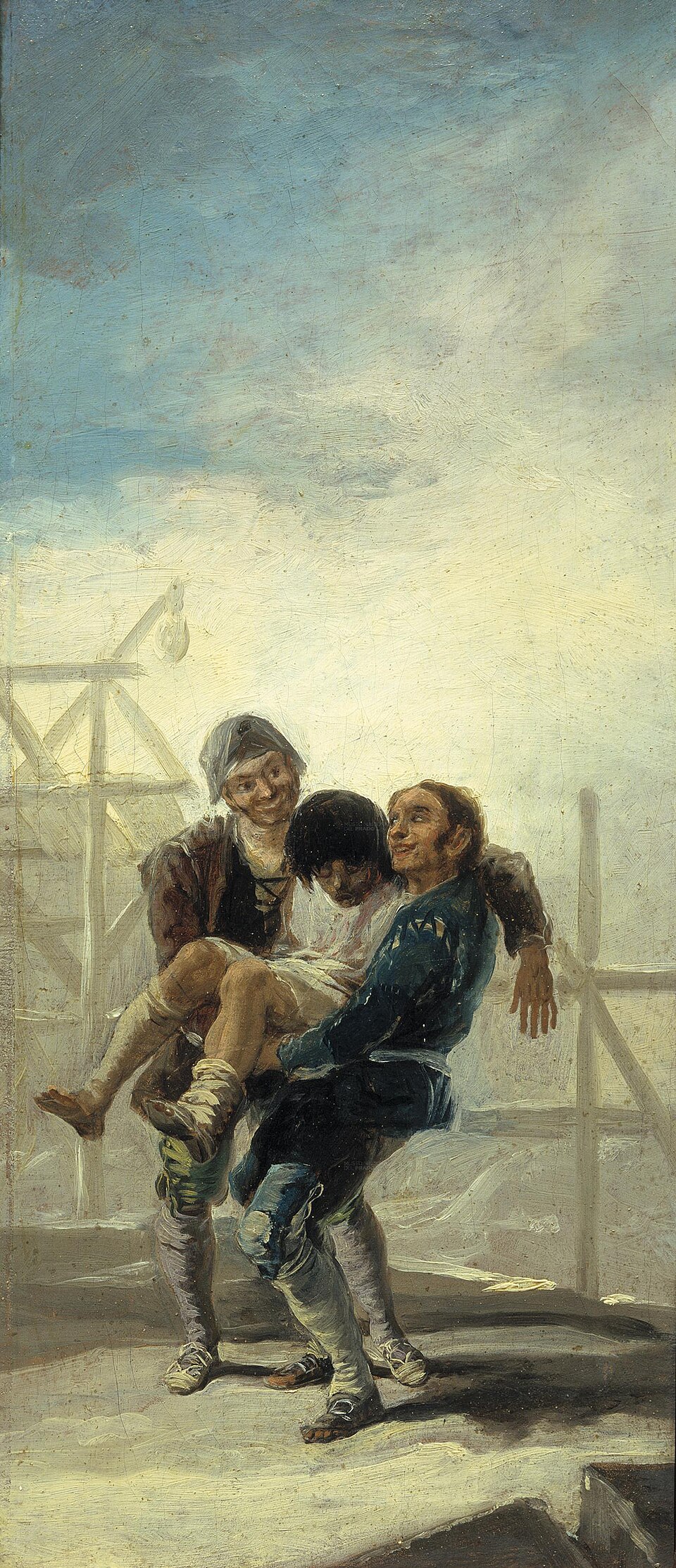
Two laughing workers carry a drunk companion on their backs, his trousers gone, a building site behind them. Goya's small sketch probably became a very different tapestry design: The Injured Mason.
The story behind the painting
In the 1780s Goya was a respected painter of tapestry cartoons for the royal palaces. This small oil sketch belongs to his fifth series, painted between 1786 and 1787 and meant for the dining room of Prince Charles of Bourbon in the Palace of El Pardo. The series was left incomplete after the death of Charles III in 1788. The Prado describes it as a preparatory sketch for the cartoon The Injured Mason, while Valeriano Bozal says it is unclear whether it is a sketch for that work or an independent variation. Wikidata gives the year 1786.
What to look for
The canvas is small and tall, about 35 by 15 cm, an elongated format imposed by the directors of the Royal Tapestry Factory of Santa Barbara. A clearly drunk mason is carried by two companions who make fun of his state; he has lost his trousers and one stocking has slipped down. A construction site rises in the distance. The palette is brown and grey, and the brushwork is quick. The paint is thick in the foreground and thin in the background, and a low viewpoint and a sequence of planes build the space. Note the mocking faces of the workers, which show Goya's skill as a portraitist.
Meaning and intent
The picture was first conceived as a joke, of the kind the princes liked. Drunkenness, Hagen argues, would not have suited a royal palace, so the design became a wounded man, which also alluded to Charles III's edict of 1784 protecting masons. The Injured Mason is often read as social criticism of workers' unsafe conditions, while this sketch has a marked satirical tone. Behind both lies the interest of enlightened men such as Goya's friend Jovellanos in reforms for workers and peasants. The laughing faces against the dark sky are read as a sign of Goya's sympathy for the poor.
Legacy
The sketch was sold with Goya's other cartoon sketches to the Dukes of Osuna. When their goods were sold in 1896, Pedro Fernández Durán acquired it, and he left his collection to the Museo del Prado, which received it after his death in 1930. Pierre Gassier and Juliet Wilson-Bareau gave it number 191 in their catalogue. Nigel Glendinning sees it as a possible forerunner of Goya's paintings for the Osuna estate, a sign that he was moving away from the picturesque conventions expected in tapestries.
Le saviez-vous ?
- Oil sketch from Goya's fifth tapestry series, 1786 to 1787.
- Probably a first idea for the cartoon The Injured Mason.
- About 35 by 15 cm.
- Bequeathed to the Prado by Pedro Fernández Durán, received in 1930.
À propos de l'artiste
Francisco Goya (1746-1828)
scène de genre · musée du Prado
Autres œuvres de Francisco Goya
 Tres de Mayo - Francisco Goya (1814)
 La Maja nue - Francisco Goya (1800)
 Saturne dévorant un de ses enfants - Francisco Goya (1819)
 La Famille de Charles IV - Francisco Goya (1800)
 La Maja vêtue - Francisco Goya (1800)
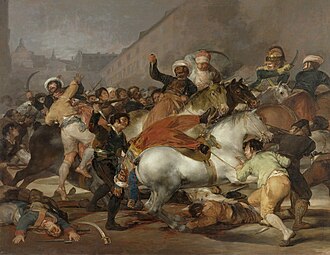 Dos de Mayo - Francisco Goya (1814)
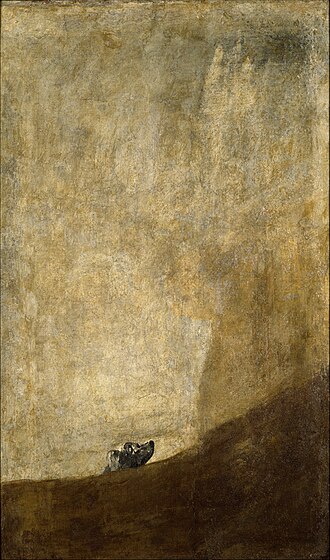 Le Chien - Francisco Goya (1819)
 Le Sabbat des sorcières - Francisco Goya (1820s)
Œuvres d'artistes liés
 Le Voyageur contemplant une mer de nuages - Caspar David Friedrich (c. 1818)
 L'Abbaye dans une forêt de chênes - Caspar David Friedrich (1800s)
 La Liberté guidant le peuple - Eugène Delacroix (1830)
 La Mort de Sardanapale - Eugène Delacroix (1827)
 Le Dernier Voyage du Téméraire - J. M. W. Turner (1839)
 Pluie, Vapeur et Vitesse - J. M. W. Turner (1844)
 L'Enfant bleu - Thomas Gainsborough (1770)
 Les Époux Andrews - Thomas Gainsborough (1748)