Edmondo and Thérèse Morbilli
Edgar Degas · 1865
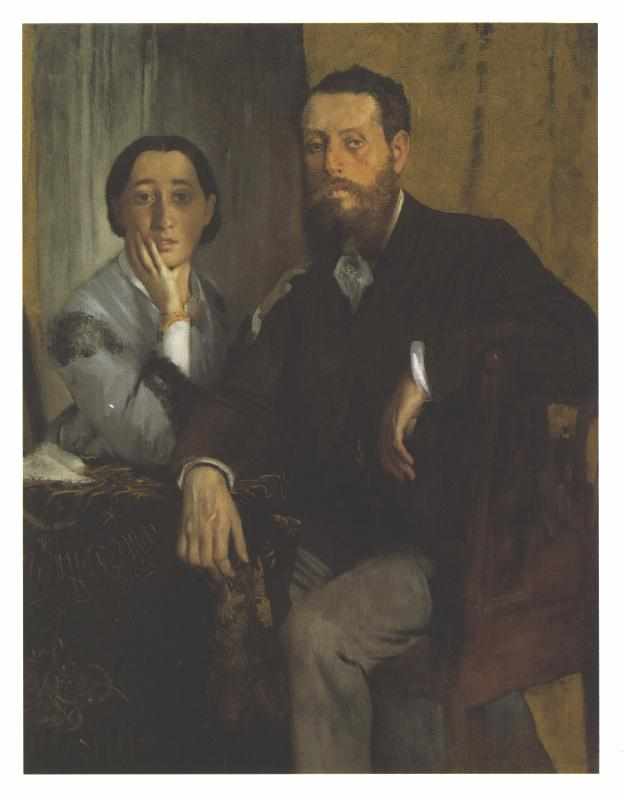
Degas's sister Thérèse sits beside her husband, a hand near his shoulder, her eyes uncertain. Behind this formal double portrait lies a lost child, and a painter who chose neither to dramatise nor to hide it.
The story behind the painting
The sitters are Degas's sister Thérèse and her husband Edmondo Morbilli, who was also her first cousin, the son of Degas's aunt Rose Adelaide Morbilli. Degas first began a more relaxed oil portrait of the couple in a more detailed interior, showing his sister early in a pregnancy. After she lost the child, he decided to paint the pair again, this time in a more formal way. The source dates the work around 1865, although one passage gives about 1895, which does not fit the other dates.
What to look for
The canvas is tall, 116.5 by 88.3 cm. Edmondo is pushed into the foreground, and the two sit side by side. Look at the contrast Degas sets up between them: the husband's self-assured, somewhat dismissive gaze, and his sister's bearing, at once at a loss, seeking protection and holding herself apart. The arrangement is formal, as Degas intended after the loss, yet the two faces tell different stories within the same frame.
Meaning and intent
Jean Sutherland Boggs wrote that the couple bear their loss with dignity. Tobia Bezzola saw the portrait as an important step in Degas's work: here the painter frees himself from compositional and painterly conventions and allows himself subtle but pointed statements about his models. Material hardship and childlessness weighed heavily on the couple, and Degas neither dramatises their tensions nor conceals them. It is a family picture painted with love, but also with an honesty that does not look away.
Legacy
The portrait stayed in the painter's estate and passed to the collection of his brother René de Gas. Through the Paris auction house Drouot it reached the gallery F. Wildenstein and Co. in New York in 1927. There it was acquired by the collector and patron Robert Treat Paine II, who gave it to the Museum of Fine Arts in Boston in 1931. It remains there today, one of two portraits Degas made of his sister and her husband.
Le saviez-vous ?
- Degas painted his sister Thérèse and her husband Edmondo Morbilli twice.
- This more formal version followed the loss of their child.
- Kept by Degas until his death, then by his brother René.
- Given to the Museum of Fine Arts Boston in 1931.
À propos de l'artiste
Edgar Degas (1834-1917)
musée des Beaux-Arts de Boston
Autres œuvres de Edgar Degas
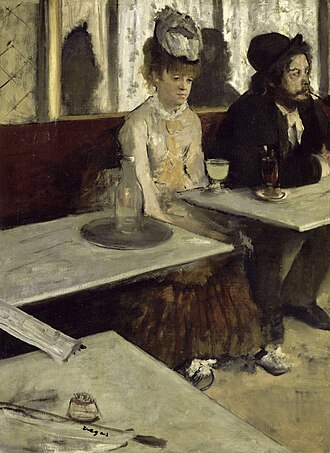 L'Absinthe - Edgar Degas (1875)
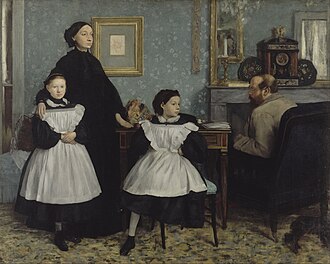 La Famille Bellelli - Edgar Degas (1858)
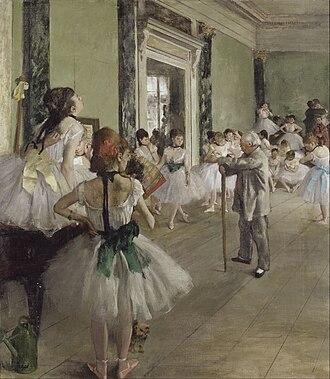 La Classe de danse - Edgar Degas (1871)
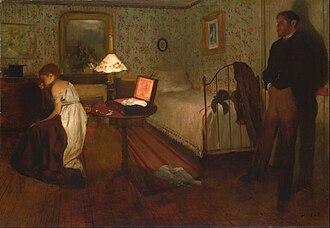 Intérieur - Edgar Degas (1868)
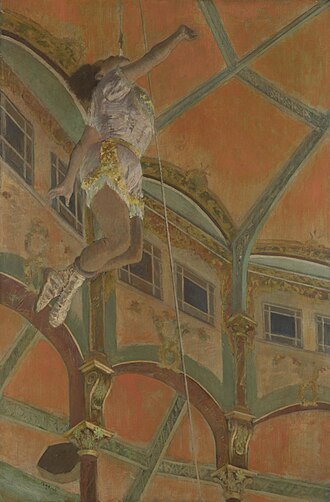 Mademoiselle La La au cirque Fernando - Edgar Degas (1879)
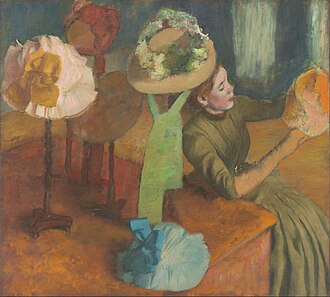 Chez la modiste - Edgar Degas
.jpg) Le Tub - Edgar Degas (1886)
Le Tub - Edgar Degas (1886)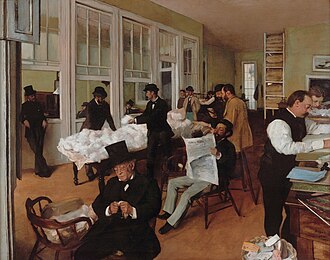 Le Bureau de coton à La Nouvelle-Orléans - Edgar Degas (1873)
Œuvres d'artistes liés
 Impression, soleil levant - Claude Monet (1872)
 Nymphéas - Claude Monet (1906)
 Le Déjeuner sur l'herbe - Édouard Manet (1863)
 Olympia - Édouard Manet (1863)
 Bal du moulin de la Galette - Pierre-Auguste Renoir (1876)
 Le Déjeuner des canotiers - Pierre-Auguste Renoir (1881)
 La Nuit étoilée - Vincent van Gogh (1889)
.jpg) Terrasse du café le soir - Vincent van Gogh (1888)
Terrasse du café le soir - Vincent van Gogh (1888) Le Dernier Voyage du Téméraire - J. M. W. Turner (1839)
 Pluie, Vapeur et Vitesse - J. M. W. Turner (1844)
 D'où venons-nous ? Que sommes-nous ? Où allons-nous ? - Paul Gauguin (1897-1898)
%201889.jpg) Le Christ jaune - Paul Gauguin (1889)
Le Christ jaune - Paul Gauguin (1889)