Les potins
Paul Gauguin · 1891
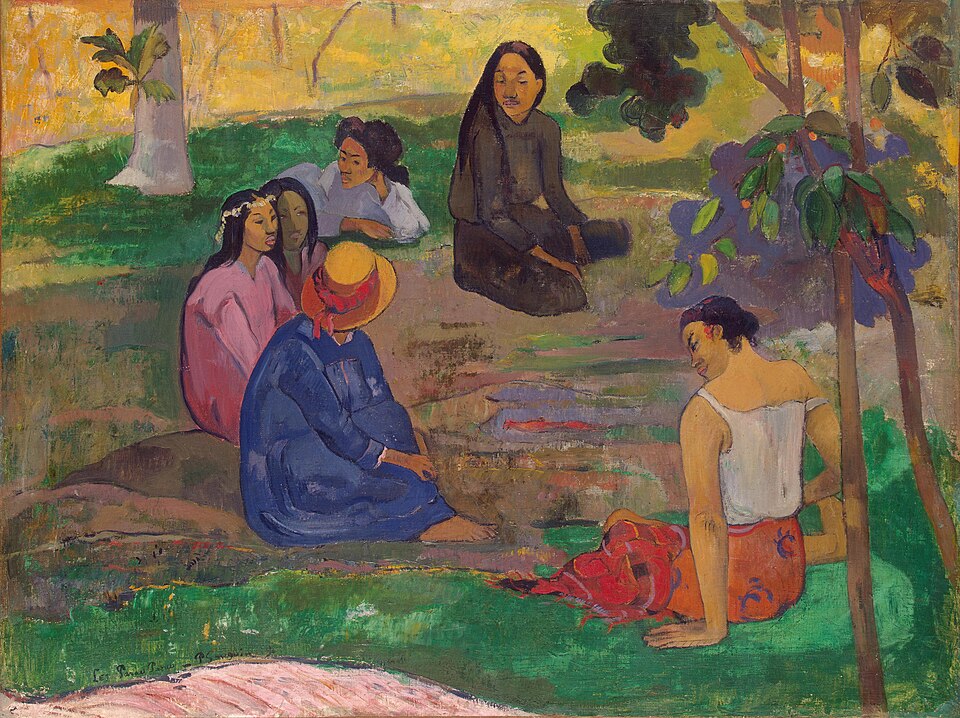
Six Tahitian women sit in a circle in the grass, talking quietly. Gauguin called the picture Parau Parau, words, words, and insisted that his strange titles be printed exactly as he wrote them.
The story behind the painting
In 1891 Gauguin left for Tahiti, hoping to find an untouched paradise where he could live a happy, simple life. In the capital Papeete he found that European civilisation had already deeply changed the islanders' traditional way of life. So he settled in the village of Mataiea, about 40 km away, and rented a hut. There he painted Tahitian life on many canvases, including this one, painted the same year. His stay did not last long: in 1893 money and health problems forced him to sail back to France.
What to look for
The canvas shows six Tahitian women chatting calmly in a circle. The pose of the woman in front also appears in one of Gauguin's first Tahitian paintings, The Big Tree. He returned to the theme later, for example in another painting called Parau Parau, now at the Yale University Art Gallery. Only in this Hermitage version are the women painted in the foreground, which gives this picture a special place in the series. Wikidata gives its size as about 70.5 by 90.3 cm.
Meaning and intent
For Gauguin the scene expressed the rhythm of life on the island. In Noa Noa, the book he wrote about his time in Tahiti, he described an open air life that is still intimate, among thickets and shaded streams, with women whispering in an immense palace decorated by nature itself. He gave the title himself: in the local language, which he knew a little, parau parau means words, words, or conversation. In December 1892 he wrote to his wife Mette that the titles should be printed as on the paintings, because the language is strange and has several meanings.
Legacy
In 1895 Gauguin left the canvas for safekeeping with his friend Georges Chaudet in Paris. After Chaudet's death around 1899 it passed to the dealer Ambroise Vollard and was shown at Paul Durand-Ruel's gallery in November 1903. After time in a private Paris collection it returned to Vollard, and in 1907 Ivan Morozov bought it with another Gauguin. It moved to Moscow's Museum of New Western Painting in 1918, and in 1948 to the Hermitage in Saint Petersburg, where it remains.
Le saviez-vous ?
- Painted in Tahiti in 1891.
- Gauguin's own title, Parau Parau, means words, words, or conversation.
- Collected by Ivan Morozov in 1907.
- In the Hermitage Museum since 1948.
À propos de l'artiste
Paul Gauguin (1848-1903)
scène de genre · musée de l'Ermitage
Autres œuvres de Paul Gauguin
 D'où venons-nous ? Que sommes-nous ? Où allons-nous ? - Paul Gauguin (1897-1898)
 Le Christ jaune - Paul Gauguin (1889)
 Quand te maries-tu ? - Paul Gauguin (1892)
 Femmes de Tahiti - Paul Gauguin (1890)
 Vision après le sermon - Paul Gauguin (1888)
Manaò tupapaú - Paul Gauguin (1892)
 Vincent van Gogh peignant les tournesols - Paul Gauguin (1888)
 Ia Orana Maria - Paul Gauguin (1891)
Œuvres d'artistes liés
 La Nuit étoilée - Vincent van Gogh (1889)
 Terrasse du café le soir - Vincent van Gogh (1888)
 Promenade au bord de la mer - Joaquín Sorolla (1909)
 Triste héritage - Joaquín Sorolla (1898)
 Les Grandes Baigneuses - Paul Cézanne (1900s)
 Le Garçon au gilet rouge - Paul Cézanne
 Bal du moulin de la Galette - Pierre-Auguste Renoir (1876)
 Le Déjeuner des canotiers - Pierre-Auguste Renoir (1881)
 Au Moulin-Rouge - Henri de Toulouse-Lautrec (1892)
 La Toilette - Henri de Toulouse-Lautrec (1896)