Christ with Arms Folded
Rembrandt van Rijn · 1660
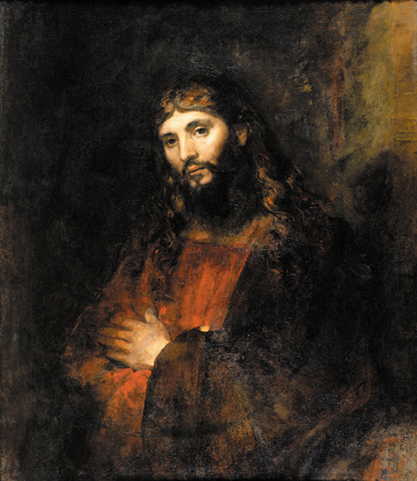
A young man with long hair and a light beard folds his arms and looks straight at us. For two centuries this Christ was a celebrated Rembrandt. Then photographs of a restoration revealed that its centre had been cut out and replaced.
The story behind the painting
The painting has been known since the early 18th century. In the early 19th century it belonged to Cardinal Joseph Fesch, a half uncle of Napoleon, whose collection reportedly held more than 20,000 paintings. It was auctioned in Rome in 1845, then passed through Paris collections, including the dealer Charles Sedelmeyer from 1873, and on to Count Orloff-Davidoff in Saint Petersburg. After the October Revolution it went to the Soviet state, was in the Pushkin Museum in 1927, and in 1933 was sold abroad to the American paper industrialist Louis Hyde.
What to look for
The life-size half figure of a young man stands with arms crossed before his chest, the left over the right. He is seen from half left and meets our eyes with his head slightly tilted. His dark brown hair, parted in the middle, falls in waves past his shoulders, and he has a light full beard. He wears a dull red garment with a dark cloak over his left shoulder. Light from above falls on his face, while the chest and hand emerge from a dark, shapeless background. It is neither signed nor dated.
Meaning and intent
Scholars long read it as a high point of Rembrandt's late work. In 1956 Otto Benesch called it the most monumental painting of its kind, and Wilhelm Reinhold Valentiner saw it as the central figure of a series of evangelist portraits. Seymour Slive linked it to a group of small heads of Christ, all thought to use the same young man as model, and imagined Rembrandt enlarging one into a new vision of Christ. Horst Gerson still called it a beautiful interpretation of the ideal image of Christ in 1969.
Legacy
In 1988 Gary Schwartz published photographs of a 1958 restoration. They showed that the central part of the canvas had at some point been cut out and replaced, so much of the picture is a restorer's work, and the surface is in poor condition. Major Rembrandt catalogues no longer list it. German Wikipedia now describes it as by an unknown Dutch painter, around 1659, while Wikidata still gives Rembrandt and 1660, and its owner, The Hyde Collection in Glens Falls, New York, still presents it as an original Rembrandt.
Le saviez-vous ?
- Known since the early 18th century; once owned by Cardinal Fesch.
- Sold by the Soviet state in 1933 to Louis Hyde.
- A 1958 restoration showed the centre of the canvas had been replaced.
- The Hyde Collection still calls it a Rembrandt; many scholars do not.
À propos de l'artiste
Rembrandt van Rijn (1606-1669)
portrait · homme · Jésus-Christ
Autres œuvres de Rembrandt van Rijn
 La Ronde de nuit - Rembrandt van Rijn (1642)
 Autoportrait - Rembrandt van Rijn (1659)
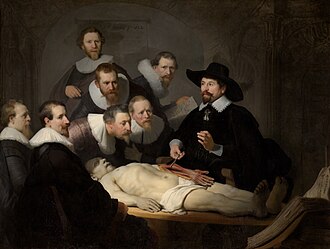 La Leçon d'anatomie du docteur Tulp - Rembrandt van Rijn (1632)
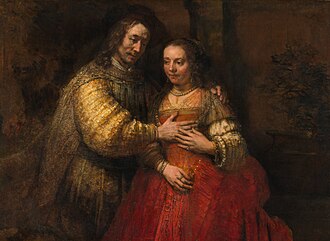 La Fiancée juive - Rembrandt van Rijn (1660s)
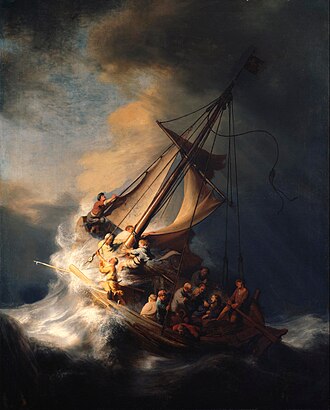 La Tempête sur la mer de Galilée - Rembrandt van Rijn (1633)
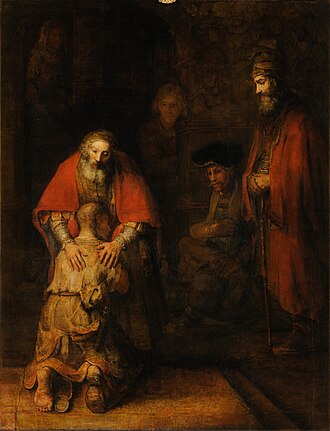 Le Retour du fils prodigue - Rembrandt van Rijn (1668)
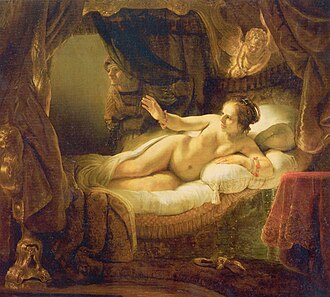 Danaé - Rembrandt van Rijn (1636)
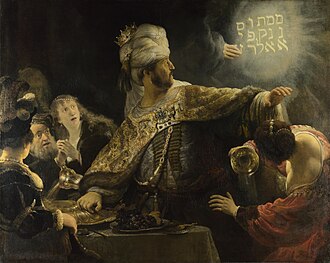 Le Festin de Balthazar - Rembrandt van Rijn (1636)
Œuvres d'artistes liés
 La Jeune Fille à la perle - Johannes Vermeer (1665)
 La Laitière - Johannes Vermeer (c. 1658)
 La Fête de la Saint-Nicolas - Jan Steen (1660s)
 La Mangeuse d'huîtres - Jan Steen (1658)
 Le Joyeux Buveur - Frans Hals (1620s)
 Le Cavalier riant - Frans Hals (1624)
 Le Moulin près de Wijk bij Duurstede - Jacob van Ruisdael (1670)
 Le Cimetière juif - Jacob van Ruisdael (1650s)
 La Cour d'une maison à Delft - Pieter de Hooch (1658)
 La Peleuse de pommes - Pieter de Hooch (1663)