Le Christ et la femme adultère
Pieter Bruegel the Elder · 1565
%20-%20Christ%20and%20the%20woman%20taken%20in%20adultery.jpg)
A small grey panel, a crowd, a frightened woman, and Christ bending to write in the dust. Bruegel kept this picture all his life, and four centuries later it was stolen and missing for ten years.
The story behind the painting
Pieter Bruegel the Elder signed and dated this small panel in 1565. It tells the episode from John 8 in which a woman accused of adultery is brought before Jesus by Pharisees and scribes. The crime was punishable by stoning, but Jesus stoops and writes on the ground: he that is without sin among you, let him first cast the stone at her. Bruegel wrote those words in Dutch at her feet. The artist never sold the painting, and it seems to be the only one inherited by his son Jan Brueghel the Younger.
What to look for
The panel is tiny, about 24.1 by 34.4 cm, and painted in grisaille, almost without colour, in tones of grey. Find the words written on the floor, and then the stones that were never thrown, lying to the woman's left. The woman herself is one of the few graceful figures in the scene, idealised in a way unusual for Bruegel, whose women are usually earthy and homely. The layout is Netherlandish, but the austere composition and monumental figures have been called perhaps the most Italianate in all of Bruegel's paintings.
Meaning and intent
Grisaille was rare in Bruegel's surviving work. Besides this panel, only an even smaller Three Soldiers in the Frick Collection and The Death of the Virgin at Upton House survive, the latter also an unusually conventional religious subject for him. Yet his earliest documented work, in Mechelen in 1550 and 1551, was grisaille wings for an altarpiece by Peeter Baltens, now lost. The grey palette strips the story to its moral core: mercy confronting judgement, with the accusers left holding stones they cannot throw.
Legacy
Paul Perret published an engraving of it in 1579, and pricks along the edges suggest a grid for copying. Copies followed, some attributed to Bruegel's sons, including one by Pieter Brueghel the Younger of about 1600 in Philadelphia, and the panel was lent to Cardinal Federico Borromeo for copying. Sold by the family in the seventeenth century, it reached England, was sold at Christie's in 1834 and 1952, and was bought by Count Antoine Seilern, whose collection went to the Courtauld in 1978. Stolen from the Courtauld Gallery on 2 February 1982, it was unsaleable and was recovered by British police in 1992.
Le saviez-vous ?
- Signed and dated 1565; grisaille on panel, about 24.1 x 34.4 cm.
- Kept by Bruegel and inherited by his son Jan Brueghel the Younger.
- Stolen from the Courtauld Gallery in 1982, recovered in 1992.
- One of only three surviving grisaille paintings by Bruegel.
À propos de l'artiste
Pieter Bruegel the Elder (1525-1569)
art religieux · Jésus-Christ · station debout · Institut Courtauld · foule
Autres œuvres de Pieter Bruegel the Elder
%20-%20Google%20Art%20Project.jpg) Les Chasseurs dans la neige - Pieter Bruegel the Elder (1565)
Les Chasseurs dans la neige - Pieter Bruegel the Elder (1565)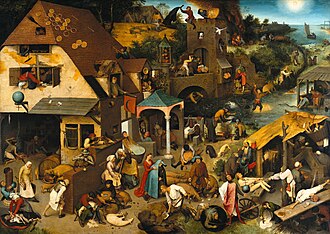 Les Proverbes flamands - Pieter Bruegel the Elder (1551)
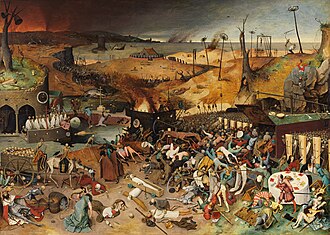 Le Triomphe de la Mort - Pieter Bruegel the Elder (1560s)
%20-%20Blind%20leading%20the%20blind%20Google%20Art%20Project.jpeg) La Parabole des aveugles - Pieter Bruegel the Elder (1568)
La Parabole des aveugles - Pieter Bruegel the Elder (1568)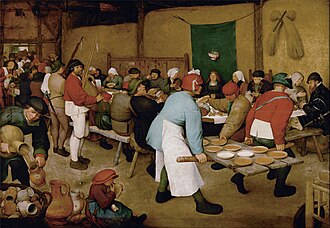 Le Repas de noce - Pieter Bruegel the Elder (1560s)
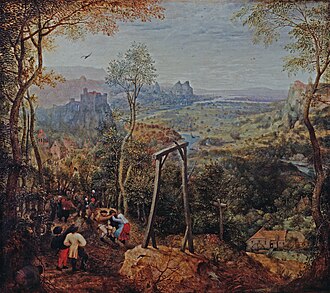 La Pie sur le Gibet - Pieter Bruegel the Elder (1568)
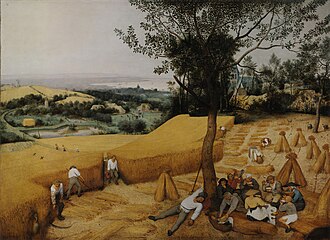 Les Moissonneurs - Pieter Bruegel the Elder (1565)
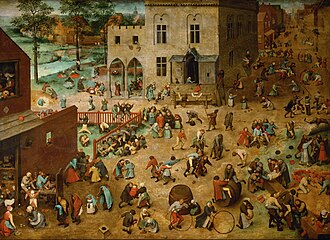 Les Jeux d’enfants - Pieter Bruegel the Elder (1560)
Œuvres d'artistes liés
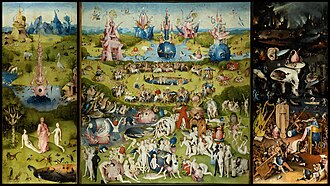 Le Jardin des délices - Hieronymus Bosch
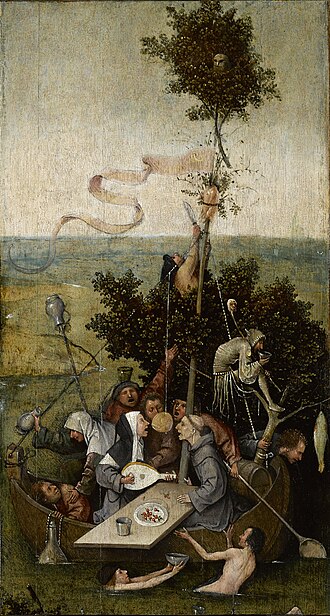 La Nef des fous - Hieronymus Bosch (1500s)