Butcher shop in Schäftlarn
Lovis Corinth · 1897
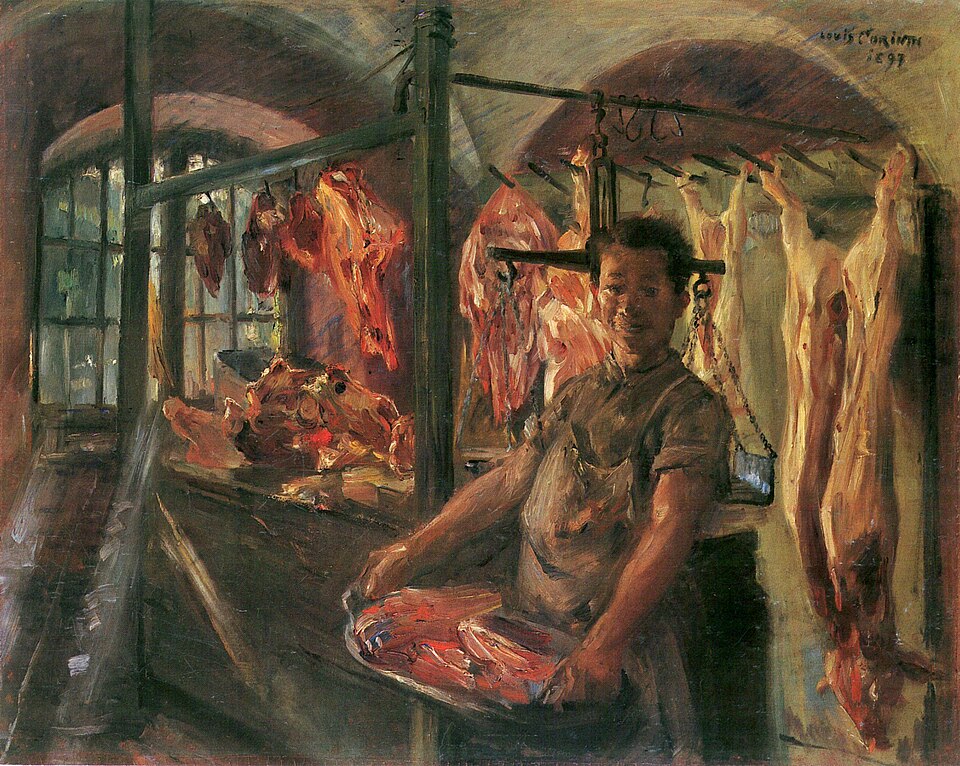
A smiling boy holds a bowl of meat while pig carcasses hang behind him and green daylight leaks in from a window. Corinth, a tanner's son, kept coming back to butcher shops, and this is one of his best known.
The story behind the painting
Lovis Corinth painted this butcher shop in Schäftlarn, near Munich, in 1897, after studying in Königsberg, Munich and at the Académie Julian in Paris. He signed it in black at the upper right, Lovis Corinth 1897. In the same year he painted The Temptation of St. Anthony, Susanna and the Two Old Men and The Witches. Corinth returned to slaughter and meat in 14 paintings in all, and art historians widely see these works as his way of processing childhood memories as the son of a tanner.
What to look for
A smiling young man stands with a bowl of meat in front of a counter hung with a meat scale. Slaughtered pigs, chunks of flesh and animal heads hang from the bar and the wall. Greens and browns dominate the background, and a window at the back lets in daylight and a glimpse of foliage. Two arched bays split the picture into equal halves, while the meat seems lit by another light from the front. The canvas is 69 by 87 cm in Wikipedia, 70 by 87 cm in Wikidata.
Meaning and intent
Horst Uhr notes how the dark background sets off the vivid, many-coloured meat, and how the glossy paint gives the flesh a greasy texture. Lucia Klee-Beck stresses the strict composition, with a central table dividing the hanging carcasses at the back from the cut pieces in front. Hans-Jürgen Imiela points to the window's strong backlight. Corinth knew Rembrandt's Slaughtered Ox in the Louvre and painted within a long tradition of meat scenes.
Legacy
The painting is described as one of Corinth's most renowned works on the theme of slaughter, alongside paintings such as In the Slaughterhouse of 1893 and Slaughtered Pig of 1906, now at the Museum of Modern Art. Scholars often connect these meat pictures to his nudes. The canvas is held in the Kunsthalle Bremen. Contemporaries such as Max Liebermann, with his Butcher Store in Dordrecht of 1877, and Max Slevogt also painted the theme, but Corinth returned to it more often than most.
Le saviez-vous ?
- Painted in 1897 and signed upper right.
- One of 14 Corinth paintings on slaughter and meat.
- Corinth was the son of a tanner.
- Held in the Kunsthalle Bremen.
À propos de l'artiste
Lovis Corinth (1858-1925)
Autres œuvres de Lovis Corinth
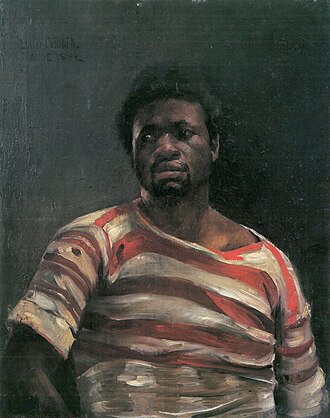 Le Nègre Othello - Lovis Corinth (1884)
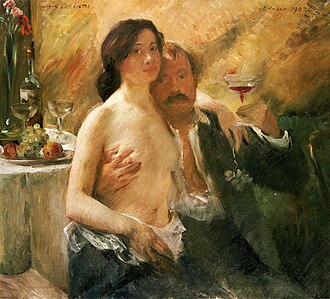 Self portrait with his wife Charlotte Berend-Corinth and a sekt glass - Lovis Corinth (1902)
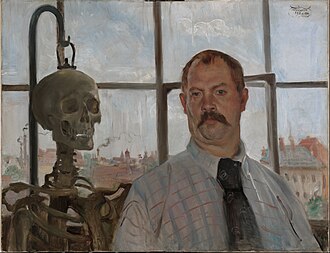 Autoportrait au squelette - Lovis Corinth (1896)
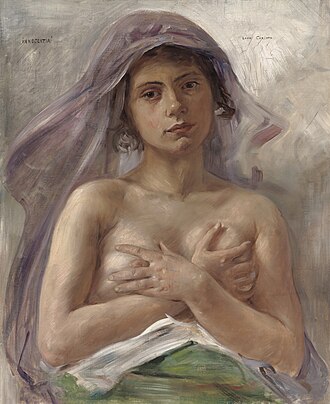 Innocentia - Lovis Corinth (1890)
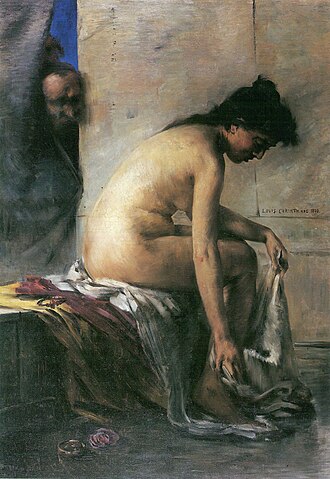 Susanna in the Bath - Lovis Corinth (1890)
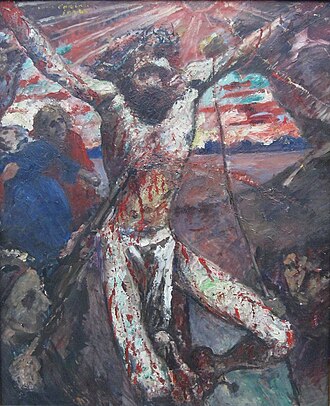 The Red Christ - Lovis Corinth (1922)
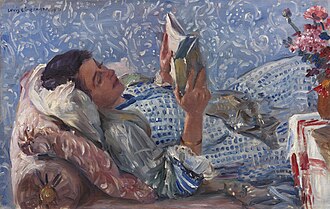 Reading Woman - Lovis Corinth (1911)
 Carmencita - Lovis Corinth (1924)