Garçons grimpant à un arbre
Francisco Goya · 1791
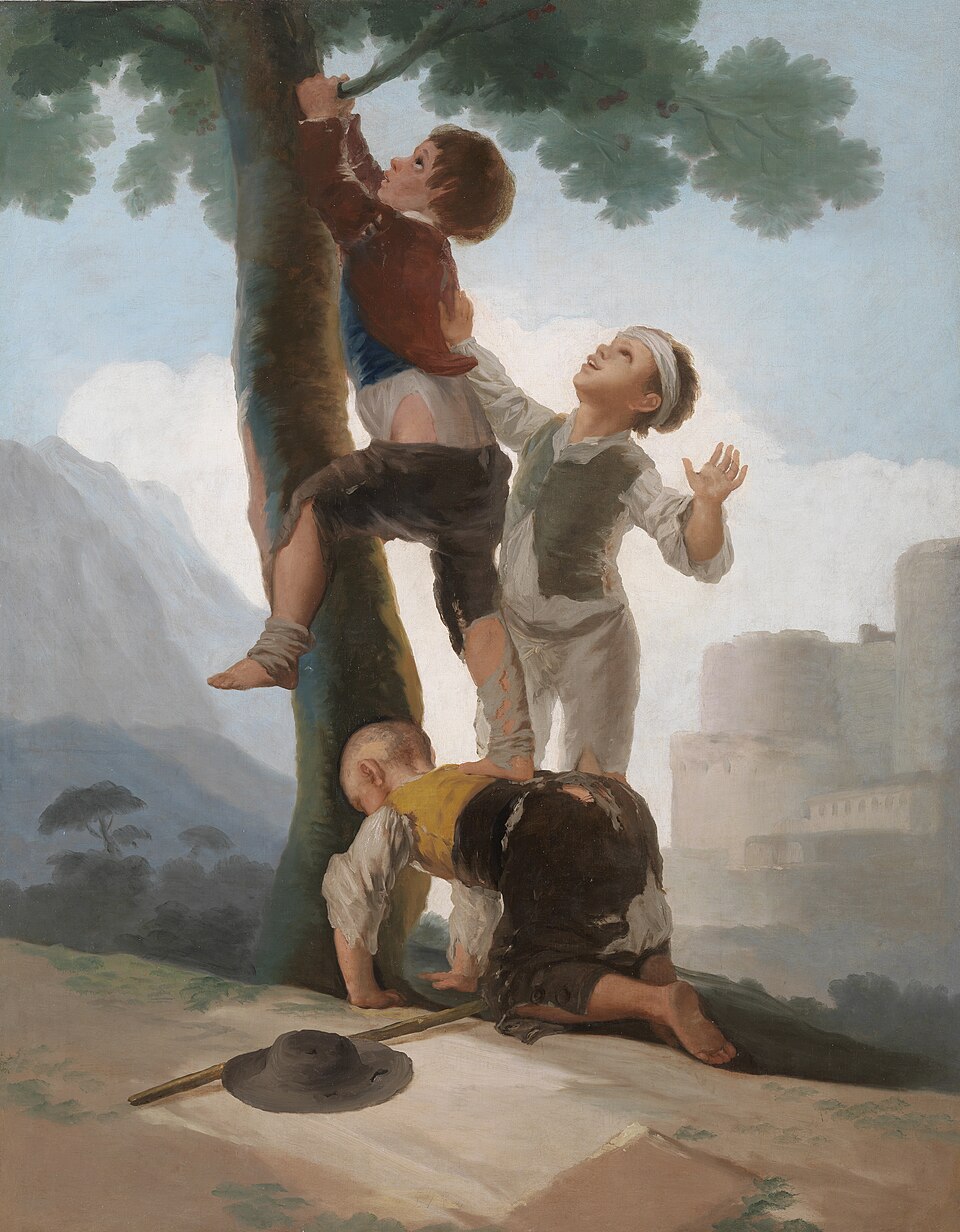
Three boys work together to get one of them up a tree, a castle faint in the distance. It is one of the last designs Goya made for royal tapestries, and it lay forgotten in a palace basement for decades.
The story behind the painting
Goya painted this canvas between late 1791 and early 1792 as part of his seventh series of tapestry cartoons, full-size designs for weavers. The whole series was meant for the study of Charles IV, the former Prince of Asturias, at the Escorial palace. Its companions were The Wedding, The Stilts, The Seesaw, The Little Giants, The Straw Manikin and Girls with Jugs. Wikidata dates the painting 1791, while the French Wikipedia article gives late 1791 to early 1792.
What to look for
Three children are playing at climbing a tree: one boy leans on the other two and is helped up by the third. A castle can be made out far away. The scene has real depth, partly thanks to the foreshortened bald child the climber leans on. The mountains are done with a light brushstroke typical of Goya's last years as a cartoon painter. The canvas measures about 141 by 111 cm.
Meaning and intent
The picture was conceived to hang above a door, and it repeats the triangular scheme of Goya's earlier Boys Picking Fruit, though the technique and style have moved on. Bartolomé Esteban Murillo and other Spanish Baroque artists had painted several scenes of children playing at reaching fruit, and their influence is clear here. Here the brushwork is lighter than in the earlier cartoon, the space deeper, and the climbing game becomes a small lesson in balance and trust between the three boys, built on the same stable triangle.
Legacy
The canvas was thought lost until 1869, when Gregorio Cruzada Villaamil found it in the basement of the Royal Palace of Madrid. It went to the Museo del Prado in 1870 by orders of 19 January and 9 February, and first appeared in the Prado catalogue in 1876. It hangs in Room 93. It was one of Goya's last cartoons, and today it is shown alongside the earlier childhood scenes he painted for the royal palaces.
Le saviez-vous ?
- Painted late 1791 to early 1792 as a tapestry cartoon.
- Part of Goya's seventh series, for Charles IV's study at the Escorial.
- Rediscovered in 1869 in the basement of the Royal Palace of Madrid.
- In the Museo del Prado since 1870.
À propos de l'artiste
Francisco Goya (1746-1828)
scène de genre · musée du Prado
Autres œuvres de Francisco Goya
 Tres de Mayo - Francisco Goya (1814)
 La Maja nue - Francisco Goya (1800)
 Saturne dévorant un de ses enfants - Francisco Goya (1819)
 La Famille de Charles IV - Francisco Goya (1800)
 La Maja vêtue - Francisco Goya (1800)
 Dos de Mayo - Francisco Goya (1814)
 Le Chien - Francisco Goya (1819)
 Le Sabbat des sorcières - Francisco Goya (1820s)
Œuvres d'artistes liés
 Le Voyageur contemplant une mer de nuages - Caspar David Friedrich (c. 1818)
 L'Abbaye dans une forêt de chênes - Caspar David Friedrich (1800s)
 La Liberté guidant le peuple - Eugène Delacroix (1830)
 La Mort de Sardanapale - Eugène Delacroix (1827)
 Le Dernier Voyage du Téméraire - J. M. W. Turner (1839)
 Pluie, Vapeur et Vitesse - J. M. W. Turner (1844)
 L'Enfant bleu - Thomas Gainsborough (1770)
 Les Époux Andrews - Thomas Gainsborough (1748)