Au lit de mort
Edvard Munch · 1895
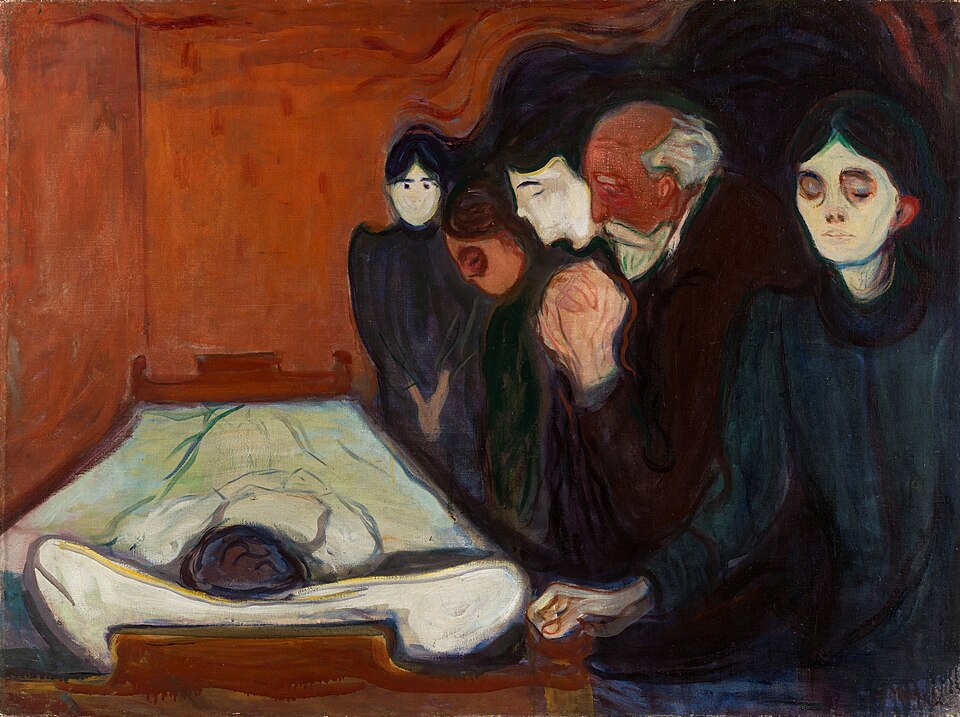
A family dressed in black crowds around a bed, a father's hands raised in prayer, faces flushed red or drained white. Munch painted the room of his childhood, where, as he said, sickness and death lived.
The story behind the painting
Munch knew illness and death from early childhood. His mother died of tuberculosis in 1868, when he was five, and in 1877 his older sister Sophie died of the same disease at fifteen. He was a frail, often sick child, and he later said that sickness and death lived in his parents' house and shaped his art. Mille Stein links this motif to a serious illness of his own youth, recalled in a diary note of 5 February 1890: his father folding his hands over the bed and praying, the others around it, some red from crying, some white.
What to look for
On the left a figure lies in bed; we see only the back of the head and hands folded over the blanket. On the right five people stand, their silhouettes merging into one almost solid black shape. A bald, bearded old man, identified as Munch's father Christian, lifts his hands in prayer. A woman in front turns away, gripping the bedpost. The faces are reduced to masks, the eyes to black dots or strokes. Fever red clashes with the pale green of sickness. Munch used thinned paint on sparsely primed canvas, then built up faces and sheets in dense white.
Meaning and intent
The steep, foreshortened perspective carries the eye across the bed to the empty back wall. Ulrich Bischoff wrote that this makes the viewer a direct witness, even a visitor, in the sickroom. Arne Eggum went further: the viewer takes the dying person's place without seeing her, and is forced to share the struggle. Death scenes were common in nineteenth century art, but the open depiction of the fear of death was taboo. Munch said he painted from memory, adding nothing, hence the simplicity and visible emptiness of his pictures. Who the woman in front is remains debated: Ydstie sees Munch's mother, already dead before Sophie.
Legacy
The motif began in sketches from 1893 and a pastel now at the Munch Museum in Oslo, where fever visions of grimaces and a skeleton haunt the walls. In this 1895 oil, part of Munch's Frieze of Life and shown in the Rasmus Meyer Collection at the Bergen Art Museum, those visions are gone. In 1896 he made a lithograph, bringing the masks back; the Munch Museum holds 21 prints. In 1915 he returned once more with two oils titled Death Struggle, brighter and more translucent, in Copenhagen and Oslo, where the earlier dark stillness gives way to a sense of movement.
Le saviez-vous ?
- Main oil version painted in 1895, part of the Frieze of Life.
- Draws on the deaths of his mother and sister Sophie and his own youthful illness.
- Also made as a pastel, a 1896 lithograph and two 1915 oils.
- Shown in the Rasmus Meyer Collection, Bergen.
À propos de l'artiste
Edvard Munch (1863-1944)
Autres œuvres de Edvard Munch
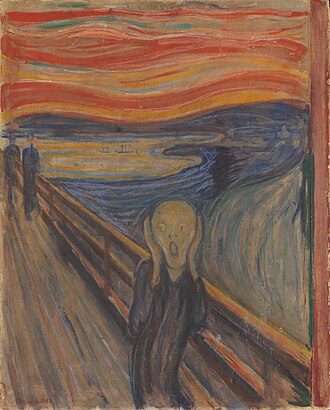 Le Cri - Edvard Munch (1893)
 La Danse de la vie - Edvard Munch
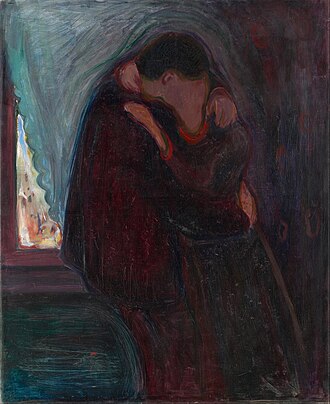 Le Baiser - Edvard Munch (1897)
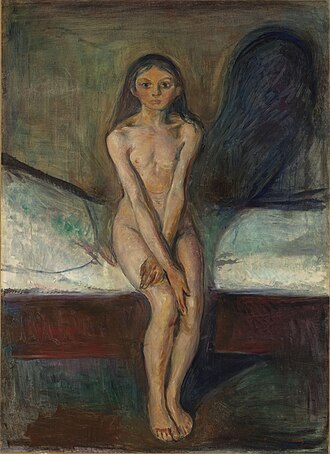 Puberté - Edvard Munch (1895)
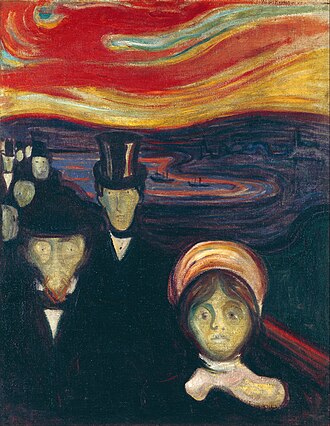 Anxiété - Edvard Munch (1894)
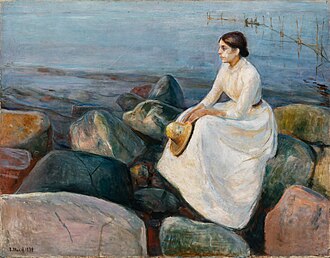 Inger sur la plage - Edvard Munch (1889)
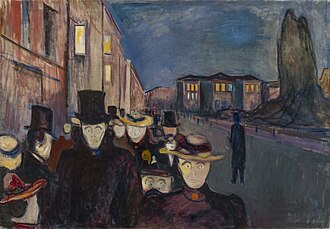 Soirée sur l'avenue Karl Johan - Edvard Munch (1892)
 Nuit à Saint-Cloud - Edvard Munch (1890)